Everything You Should Know About a Glass Staircase for Your Home
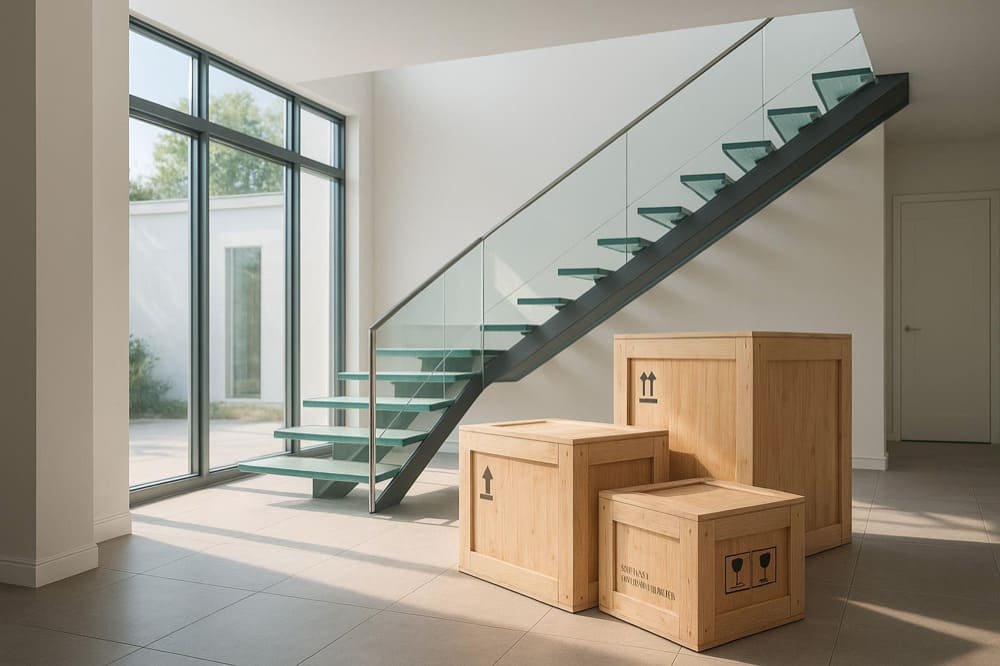
If you build premium residences, a glass staircase isn’t just a design statement—it’s a coordination exercise across codes, engineering, QA, packaging, and installation.
The right early decisions prevent the three headaches developers and contractors fear most: safety/compliance gaps, tolerance and fit issues, and breakage during international shipping.
This guide walks you through the decisions that truly move the needle so you can deliver the look your client wants without surprises.
When a glass staircase makes sense—and what “glass” can mean
“Glass staircase” covers several system types. Your choice affects thickness, hardware, cost, and installation time.
- Floating or cantilevered stairs: Minimal supports with laminated glass treads or side panels carrying loads.
- Post-and-rail stairs with glass infill: Metal posts and a continuous top rail with tempered/laminated infill panels.
- Frameless balustrades: Laminated structural glass as the guard, often with a shoe/base channel and a top rail for load continuity.
Pick glass when you need openness and light, sightline continuity, or a contemporary aesthetic that pairs with metal and wood.
The trade-off? Tighter tolerances, careful surface selection for slip resistance, and more planning for logistics.
Codes that drive your specification (US, UK/EU)
You don’t need to memorize every clause, but you do need to align your system to the governing code and occupancy, then let the engineer-of-record finalize calcs and details for AHJ approval.
- United States: The 2021 International Building Code (IBC) Chapter 24 classifies glass in guards as a hazardous location and requires safety glazing; IBC 2407 governs glass in handrails and guards, with laminated safety glass where a walking surface exists below and top-rail continuity if a glass baluster fails. For loads, IBC 1607.8 sets 50 plf uniform and 200 lb concentrated loads at the guard top. See the primary text in the 2021 code and respected technical summaries: the ICC’s own chapter on glass and glazing in the IBC 2021 Chapter 24, and a practical overview of glass railings in STRUCTURE Magazine (2022).
- United Kingdom / European Union: Barrier basics are summarized in professional explainers referencing BS 6180 and Eurocode actions: common internal stair/landing heights of 900 mm and balcony heights of 1100 mm, with load cases per occupancy in BS 6180 and EN 1991-1-1 (check the UK National Annex). For accessible explanations, see Balustrade height norms (Balustrade Design UK, 2025) and a broader regulation overview from Gatehouse Architectural (2023).
Remember: jurisdictions vary. Always route final drawings through a licensed engineer and the AHJ.
| Region | Typical guard height (residential baseline) | Guard loads (baseline) |
|---|---|---|
| US (IBC/IRC) | 36 in (IRC dwellings), 42 in (many IBC occupancies) | 50 plf along top rail; 200 lb point at top per IBC 1607.8 |
| UK/EU (BS/EN) | 900 mm internal stairs/landings; 1100 mm balconies | Per BS 6180 and EN 1991-1-1 by occupancy; confirm per project |
Materials and thickness windows that actually get approved
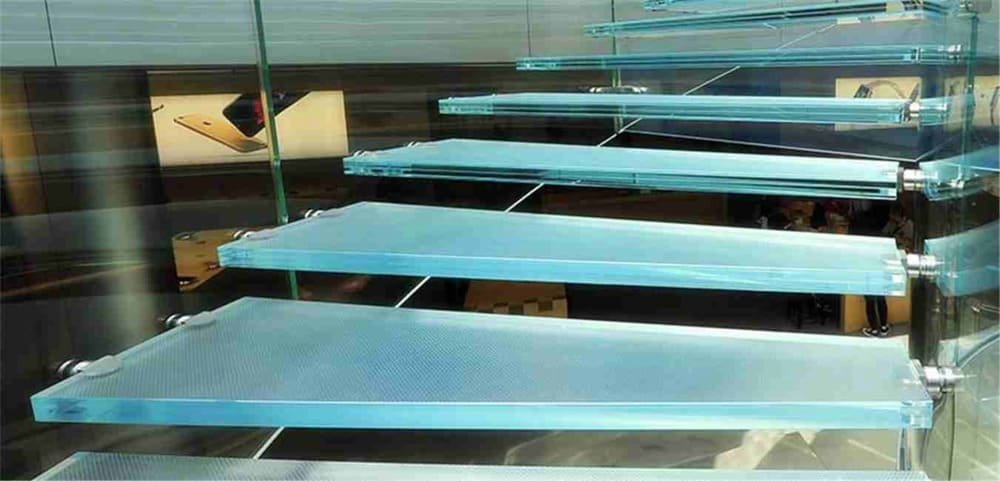
Most residential stair guards today use laminated safety glass; the laminate keeps fragments bound if a ply breaks and supports top-rail continuity requirements in many systems. Interlayers:
Interlayers:
- PVB (polyvinyl butyral): economical and widely used.
- Ionoplast (e.g., SGP): stiffer, better post-breakage behavior—valuable for frameless guards and treads.
Typical ranges engineers end up in (final calcs and testing govern):
- Infill panels in post/rail systems: approximately 10–15 mm laminated (about 3/8–5/8 in) depending on span and fixings.
- Structural/frameless balustrade panels: approximately 15–21 mm laminated (about 5/8–13/16 in), often with ionoplast interlayer for stiffness.
- Glass stair treads/landings: commonly 32–38 mm laminated (about 1.25–1.5 in), often as 3-ply with anti-slip surface treatment.
For foundational references, see the ICC’s glazing chapter noted above and engineering overviews such as STRUCTURE Magazine’s glass railings review (2022).
Slip resistance for glass treads and landings
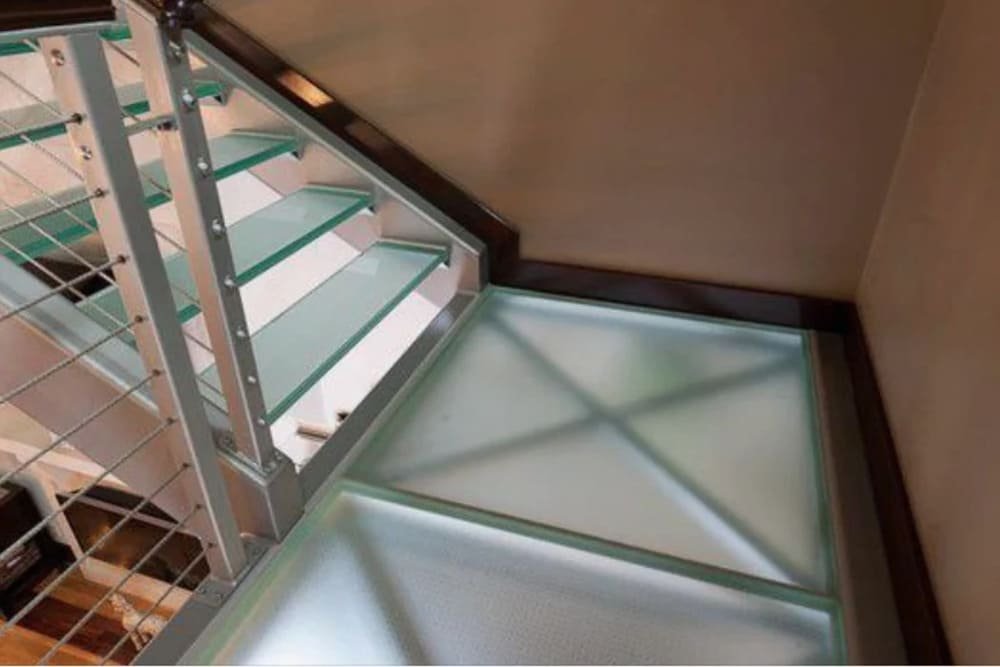
Glass can be safe underfoot when you choose the right surface.
In the US, specifiers often rely on ANSI A326.3’s dynamic coefficient of friction (DCOF) testing to select treatments; many wet-interior targets reference ≥0.42 DCOF.
International projects frequently use the pendulum test (ASTM E303/BS 7976) with typical wet thresholds around PTV ≥ 35 in guidance documents.
Confirm the method and threshold with your AHJ and environment.
Treatment options include micro-etching, ceramic frit patterns, and laminated anti-slip interlayers.
For a manufacturer example with published traction data and standards references, review:
GlasPro (2022) – Anti-slip glass system overview
https://glas-pro.com/products/high-performance-glass/anti-slip-glass/
ANSI A326.3 guidance (TCNA, 2021)
https://tcnatile.com/wp-content/uploads/2023/01/ANSI_A326.3_2021_February_2022_Locked.pdf
Structural coordination that prevents painful rework
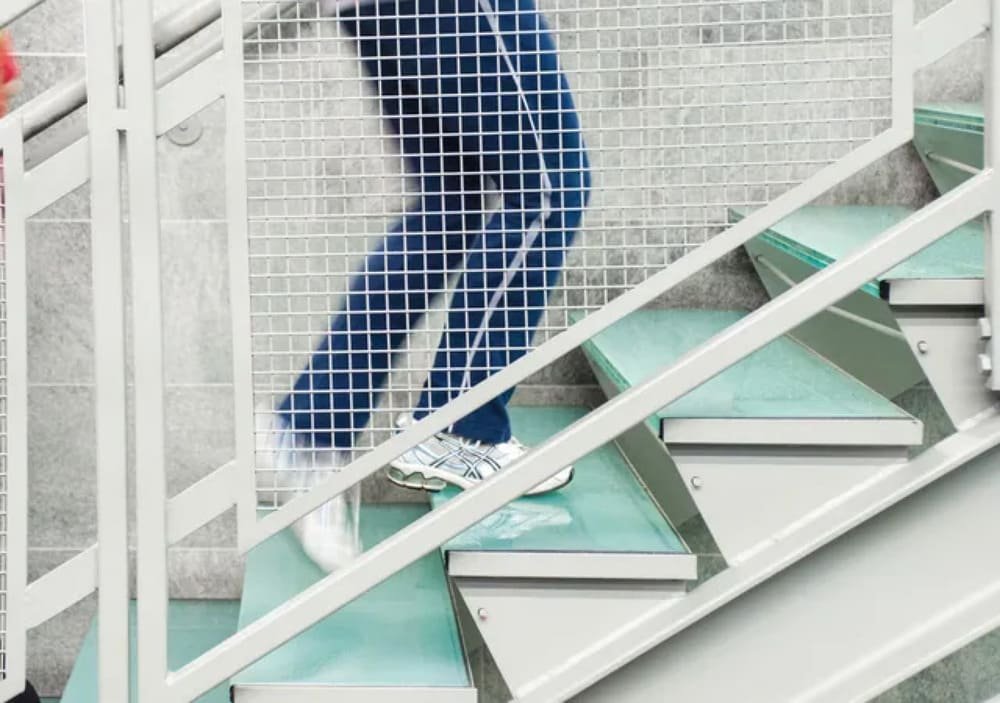
Your glass is only as good as its interfaces. Coordinate early:
- Stringers and anchors: define deflection limits, embed plates, and anchor spacing so panels and treads keep their clearances.
- Hole patterns and stand-offs: lock the grid from survey data; avoid notches and irregular cutouts where possible.
- Heat treatment choices: combine fully tempered and heat-strengthened lamination as appropriate; mitigate nickel-sulfide breakage risk with heat soak testing when specified (see Viracon’s heat soak testing brief (2024)).
Shop drawings, QA, and documentation
Your submittals should spell out: panel sizes/thickness and interlayer, tolerances, hole Locations/diameters, edge finish, handrail height, and interface details with steel/wood. Include labeling and inspection instructions.
On the QA side, capture:
- Safety glazing markings/records per ANSI Z97.1/16 CFR 1201.
- Lamination conformity per EN 14449 and any heat soak certificates (EN 14179) where specified.
- Pre-ship mockup photos and a dimensional inspection log.
On arrival, inspect crates, verify IDs against the packing list, photograph condition (including shock/tilt indicators if used), and measure critical dimensions before signing clear receiving paperwork.
Think of it this way: a 10-minute acceptance check can save a 10-week delay.
Export-ready packaging and logistics (what protects your margin)
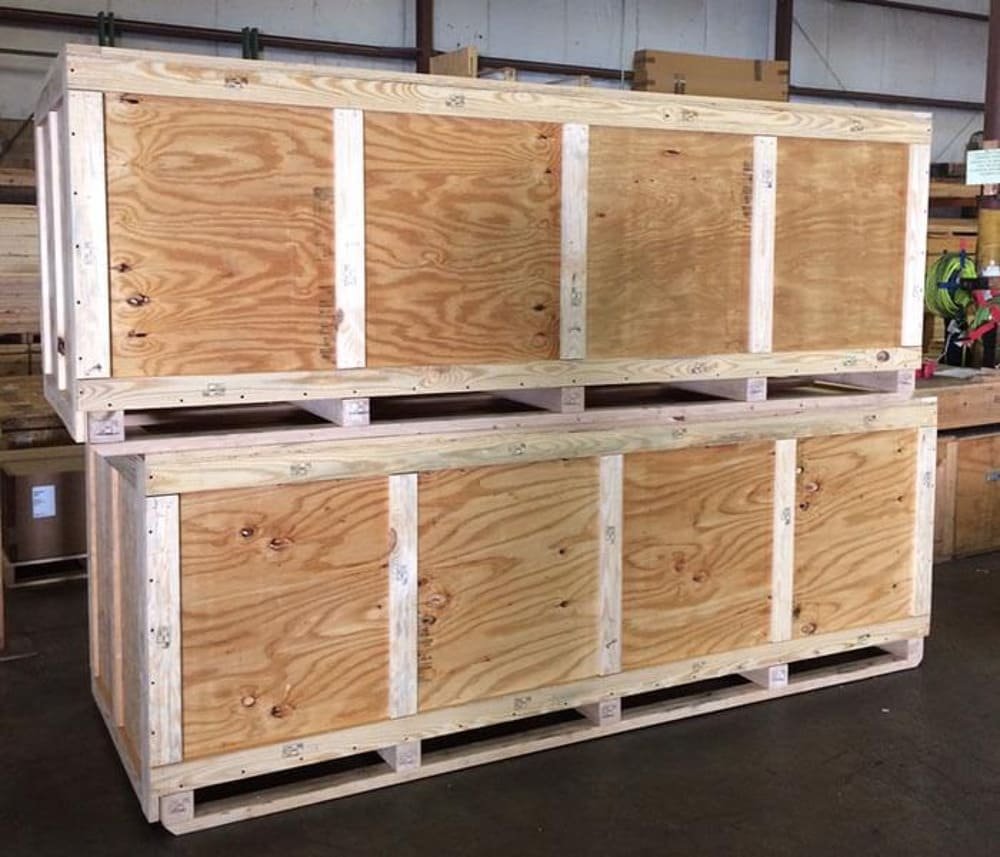
International shipments add risk you can actually control.
An export package plan typically includes:
- Crating with timber framing and plywood skins sized to components
- Glass stacked on edge with soft separators
- Edge protection
- Vibration-damping
- Moisture control via desiccants and vapor barriers
- Clear ISO 780 handling symbols with shock/tilt indicators
Performance test methods such as ISTA 3A and ASTM D4169 offer structured ways to validate packaging.
Label center of gravity and gross weight, design for forklifts/slings, and define a receiving protocol with photos before proof of delivery.
Cost drivers and smart value engineering
Total cost isn’t just glass thickness.
Major drivers are geometry (cantilevered/helical vs straight), span and support strategy, interlayer choice (SGP vs PVB), hardware density/finish, fabrication complexity (holes, edge polish), installation access, and export packaging/insurance.
To value-engineer without cutting safety:
Shorten unsupported spans, consider semi-framed systems where budget is tight, standardize hardware, rationalize hole patterns, and plan lifting/access early to compress on-site hours.
Practical workflow example: from plan to delivered kit

Here’s a typical path we see developers use when coordinating a glass staircase package from China to site:
- Feasibility intake: submit floor/elevation plans, code jurisdiction, target system (post/rail, frameless, floating), spans, and site constraints.
- Preliminary engineering and code check: align to IBC/IRC or BS/EN requirements, decide on laminated make-up and whether a continuous top rail is required, set slip-resistance targets for treads.
- Shop drawings: lock dimensions and tolerances, hole/stand-off patterns, edge finishes, labeling; specify heat-soak for tempered plies if required.
- Factory QA: run inspection checklist, record certifications (ANSI Z97.1/16 CFR 1201, EN 14449, EN 14179 if used), and document with photos.
- Export packaging: design crates with cushioning, moisture control, and shock/tilt indicators; finalize Incoterms and insurance; book transit.
- Site readiness and receiving: verify substrates and anchors, plan lifting/access, stage protection, inspect upon arrival, and proceed to installation sequencing.
Why this matters:
Bundling glass, steel, hardware, lighting, and railings into one coordinated shipment — with in-house QA and export-ready packaging — reduces vendor handoffs and lowers the chance of tolerance clashes or damage in transit.
Next steps
Have a project in mind? Submit your floor plan for a free feasibility review by our engineers.
You’ll get:
- A packaging / logistics plan tailored to your site
- A recommended glass make-up
- The right top-rail strategy
- A preliminary thickness window
Final note:
Codes vary by jurisdiction and update regularly. Always engage a licensed structural engineer and obtain AHJ approval for final design, shop drawings, and installation methods.
Choose slip-resistant surfaces with documented test data suited to your environment and maintenance plan.