Are Loft Beds Safe for Couples? Hospitality Double-Occupancy Safety Standards & Best Practices (2025)
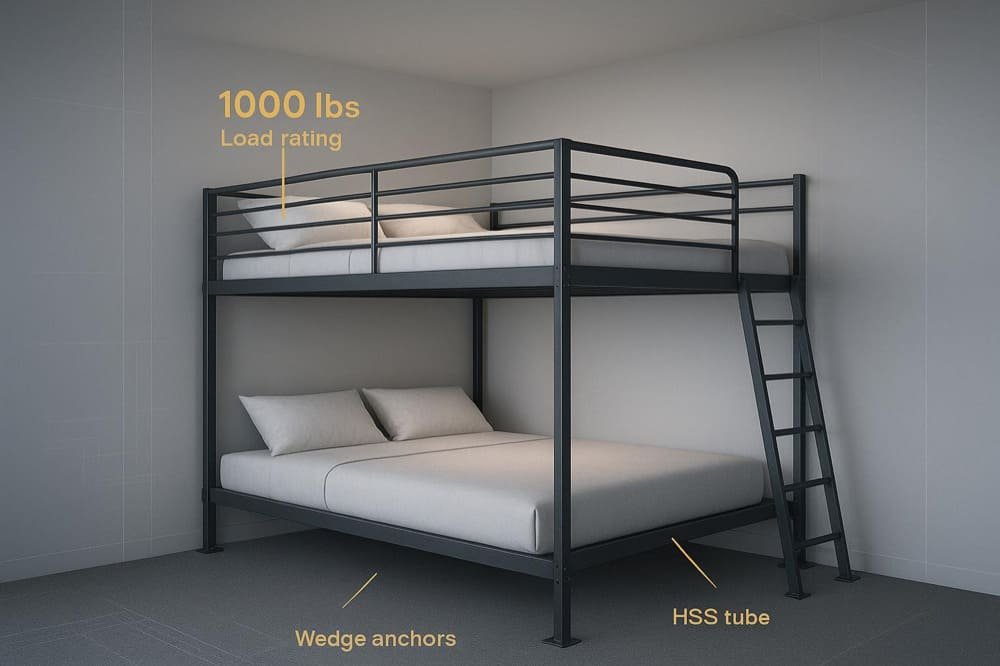
Compact double-occupancy rooms are a design puzzle: you need comfort, durability, and code compliance in a footprint that barely allows circulation.
So, are loft beds safe for two adults?
Yes — when “safe” is treated as a system:
- An operations plan for inspection and maintenance
- A high-capacity frame
- Verified anchors into the building structure
- Geometry that prevents entrapment
What “Safe for Two Adults” Actually Means in Hospitality
“Safe” goes beyond a marketing load rating.
For adult double occupancy, specify a distributed static capacity of ≥800–1000+ lbs for the loft structure and verify it via test reports or commissioning proof-loads.
Real use adds dynamic and lateral forces:
plopping onto the mattress, turning at night, pulling on the ladder, and side loads on guardrails. Your specification should include deflection limits for the bed base and the barriers.
In U.S. hospitality projects, guardrail geometry and access must align with consumer safety principles even when the product is custom.
CPSC’s bunk bed rule defines practical rails, openings, and labeling. For example:
- The upper guardrail edge should sit at least 5 inches above the mattress top at the maximum mattress thickness.
- Openings must resist entrapment per wedge-block and sphere tests, as summarized in CPSC 16 CFR Part 1513 (2022).
For EU projects, the 2024 update to bunk/high-bed standards applies to adult commercial use. Barrier design, openings, and test methods are covered in: EN 747-1:2024 and EN 747-2:2024
Where your loft is legally a “sleeping loft,” coordinate with building and fire codes. The ICC’s 2024 Appendix P outlines guard heights, egress, and geometry that interact with hospitality layouts: IBC 2024 – Appendix P: Sleeping Lofts
Always confirm local adoption and amendments.
Engineering the Frame: Materials, Joints, and Guardrails
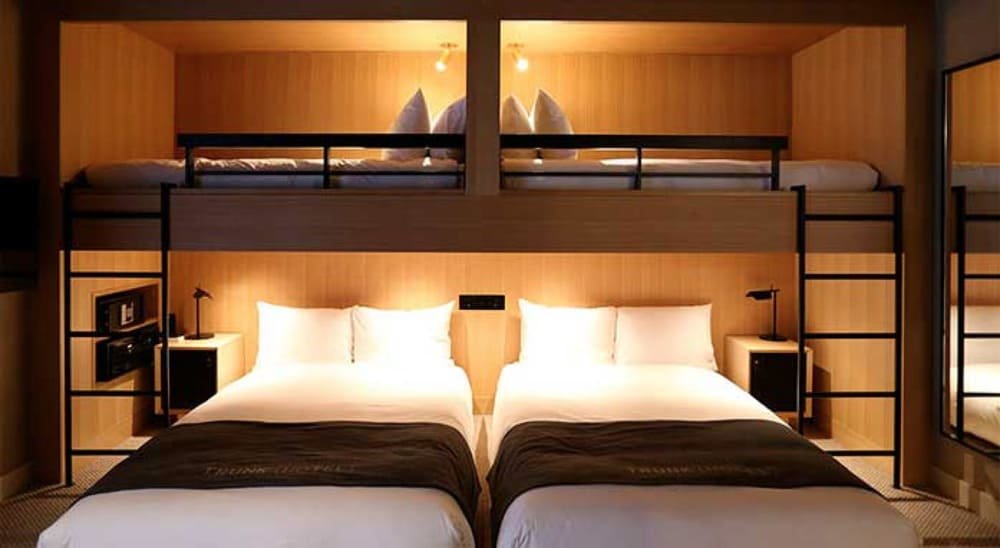
A quiet night’s sleep starts with a rigid frame. For heavy-duty hospitality use, specify welded steel HSS tube main members — think 50×50×3 mm (≈2×2×.120 in) or heavier for primary posts and rails — and avoid thin-wall tubes that dent or buckle.
Require weld quality per recognized standards (e.g., AWS D1.1 or equivalent), continuous fillets at stress nodes, and full-penetration welds where loads concentrate.
For bolted joints, use high-grade fasteners such as ISO 898-1 class 8.8/10.9 or ASTM equivalents (F3125/A325). Maintain thread engagement of at least one bolt diameter, and add lock washers or prevailing-torque nuts to resist loosening under vibration.
Guardrails and ladders need adult-grade stiffness. Write horizontal and vertical deflection targets into the spec, and ensure the ladder is fixed to the frame or structure, not just hooked.
Align rail geometry with CPSC wedge-block and sphere tests (U.S.) and EN barrier principles (EU).
Powder coating or baked enamel adds corrosion resistance and is easy to touch up during operations.
Anchoring Methods: Wall, Floor, and Ceiling — Choose by Substrate
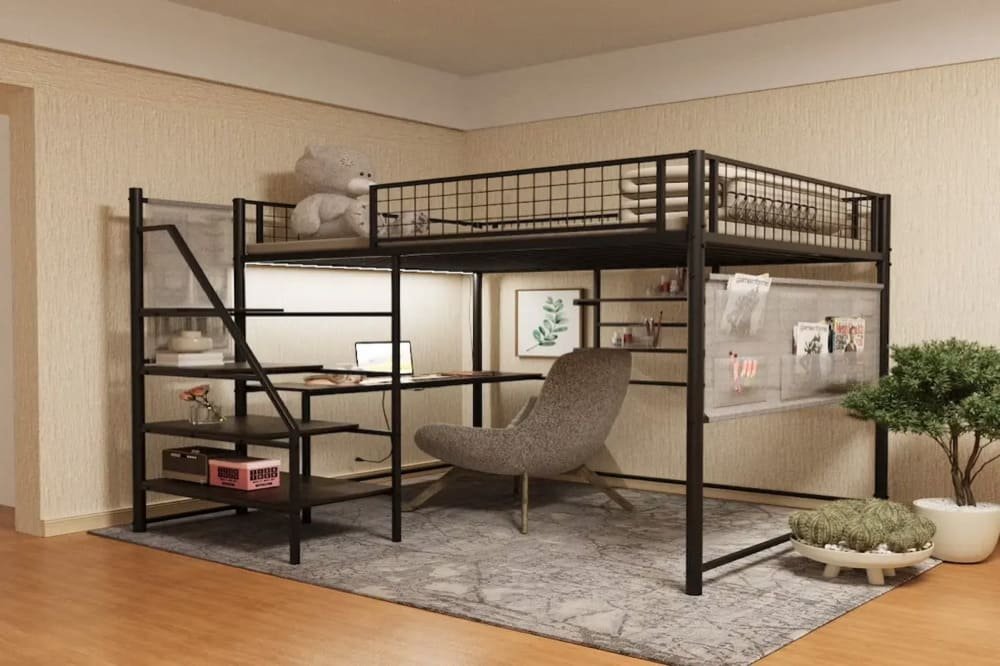
A loft bed for two adults should not rely only on freestanding friction. Anchoring to the building structure controls sway, reduces noise, and protects joints from fatigue.
Concrete or CMU
- Use code-listed wedge expansion anchors (e.g., Simpson Strong-Tie Strong-Bolt 2, Hilti KB-TZ2) with design taken from ICC-ES evaluation reports. See ICC-ES ESR-3037 for Strong-Bolt 2 and ICC-ES ESR-4266 for KB-TZ2. Typical constraints include minimum edge distances and spacing expressed as multiples of anchor diameter, plus embedment depth specific to the anchor size and concrete strength. Use calibrated torque wrenches and record torque values during commissioning.
Light-gauge steel studs
- Do not depend on drywall or hollow anchors. Add structural blocking/backing or shift the load path to a floor-anchored, braced frame. When tying to studs, distribute connections across multiple studs and consider through-bolts to backing plates for higher loads.
Ceiling bracing (case-by-case)
- Only where the structural ceiling allows. Coordinate with the structural engineer to avoid conflicts with MEP and sprinkler layout, and verify fire/life safety clearances.
| Substrate | Recommended anchoring | Notes |
|---|---|---|
| Reinforced concrete/CMU | Wedge anchors per ICC-ES (e.g., 3/8–1/2 in dia), embedment per ESR; torque-verified | Observe edge distance/spacing; consider stainless steel in humid rooms |
| Light-gauge steel stud walls | Add blocking/backing; use a floor-anchored braced frame; through-bolts to plates where feasible | Avoid drywall/hollow anchors; distribute across studs |
| Timber studs | Lag screws or through-bolts into solid studs; optional floor plates for overturning control | Verify stud layout; avoid split risks; consider washers/plates |
| Structural ceiling | Suspended bracing only with engineer approval | Coordinate with MEP/sprinklers; check vibration and acoustic transmission |
Commissioning Tests and Ongoing Maintenance
Commissioning is where claims become evidence.
Load the bed base to 1,000 lbs distributed — sandbags work well — then record deflection and verify no permanent deformation.
Perform lateral push/pull tests on guardrails and ladder, and document torque on critical fasteners.
Where applicable, confirm guard height against the installed mattress thickness and check clearances for egress.
Hospitality operations should plan regular checks:
- Monthly: Visual inspection for loosened fasteners, coating damage, and ladder/guard wear; spot torque checks at critical joints.
- Quarterly: Full torque verification, guardrail and ladder attachment tests, mattress height confirmation, and anchor point re-inspection.
- Annually: Comprehensive inspection, component replacement as needed, and revalidation of anchors and structural joints.
For projects defining sleeping lofts, align guard heights and opening limits with building code requirements; see ICC’s 2024 Appendix P for guard provisions and geometry.
Example: Specifying a Hospitality Loft Bed with ChinaBestBuy
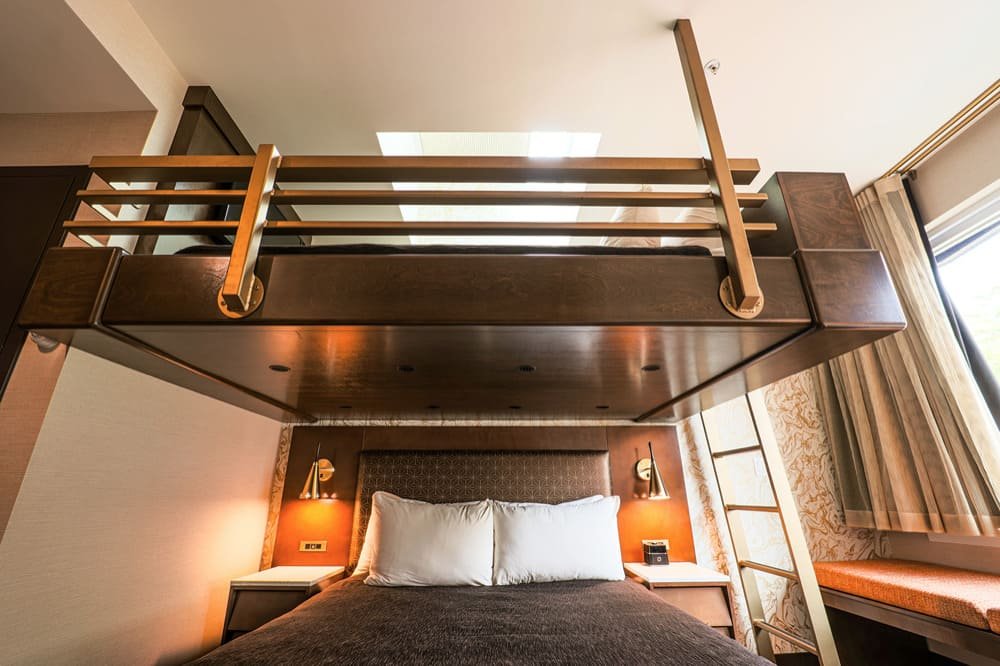
Think of this as a mini-project. Procurement asks for engineering evidence; production provides it. A typical ChinaBestBuy package includes:
- Structure and joint drawings with HSS tube profiles, wall thicknesses, and weld symbols
- Material options (carbon steel grades), coating systems, and colorways
- Anchor schedules by substrate, with ESR references and torque tables
- Installation methods: floor, wall, and optional ceiling bracing, plus edge distance/spacing diagrams
- Mock-up protocol: proof-load, guard/ladder lateral tests, and deflection logs
How procurement uses the spec sheet: you review substrate conditions, confirm anchor selection, set mattress thickness to meet guard height, and lock in inspection intervals. The spec becomes part of your FF&E package and installation SOP, giving operations a clear maintenance plan.
Quick Procurement Checklist
- Specify ≥800–1000+ lbs distributed static capacity with a commissioning proof-load plan
- Require HSS main members (≈2×2×.120 in or 50×50×3 mm) and weld quality per AWS D1.1 or equivalent
- Call for ISO 898-1 class 8.8/10.9 or ASTM F3125/A325 fasteners with locking features
- Define guardrail geometry per CPSC 16 CFR Part 1513 and note EN 747-1:2024 applicability for EU projects
- Select anchors per ICC-ES ESR tables and record torque during commissioning (e.g., Strong-Bolt 2, KB-TZ2)
- Confirm substrate: concrete/CMU vs steel studs; add blocking or floor-anchored frames where needed
- Document monthly/quarterly/annual inspection intervals and replacement cycles
- Include drawings, ESR references, torque tables, and a mock-up plan in RFQs
Next Steps
Ready to evaluate a loft bed for adult double occupancy in your next compact room?
Request the structural spec sheet and material options — including:
- Structure / joint drawings
- Steel tube specs and thicknesses
- Mock-up details
- Installation methods (floor, wall, and ceiling anchoring)
Visit ChinaBestBuy — One-stop Building Solutions to start the conversation.
Notes
- For cracked/uncracked concrete and seismic categories, rely on ICC-ES anchor report tables + project structural calculations.
- Jurisdictional requirements vary. Always confirm local adoption of building and fire codes.
- Coordinate anchoring choices with the project’s structural engineer.