How Much Does It Cost to Decorate the Bathroom? (2025 Guide)
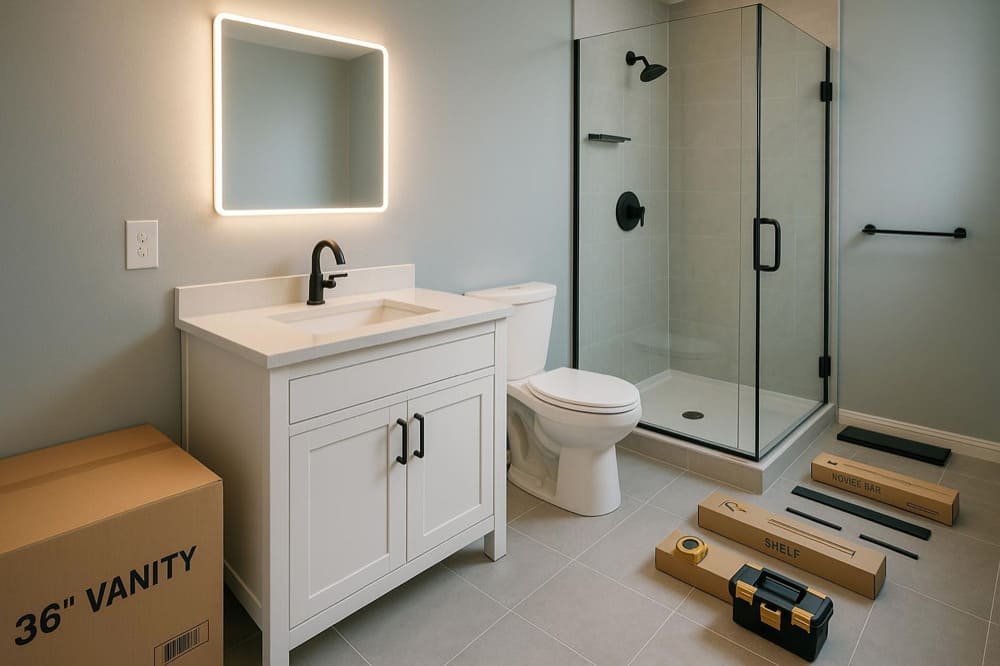
A “decorated” bathroom is not a full gut remodel. Think light refresh and targeted upgrades you can complete in 2–8 weeks: swap fixtures and hardware, add a new mirror or medicine cabinet, upgrade the vanity/top, refresh select tiles or wall finishes, improve lighting, and tidy up accessories.
That scope lands well below remodel budgets you often see in the news—where full remodels can run into five figures—so this guide focuses on realistic 2025 costs for refresh projects and where factory‑direct sourcing can stretch your dollars.
Context check: National remodel averages help set expectations. In 2025, broad bathroom remodel ranges span roughly $6,600–$30,000+, with many projects landing around $12,000–$18,500, depending on scope and finish level, as summarized by the 2025 cost overviews from Angi’s bathroom remodel guide (2025) and Modernize’s bathroom remodel cost page (2025).
We’re staying under those totals by keeping plumbing locations as-is and focusing on cosmetic improvements and partial upgrades.
Quick self-check: Which tier fits your project?
- You just want a fresher look fast (new faucet/shower set, mirror, lighting, accessories), and maybe repair/retile a small area → Basic Refresh
- You also want a new vanity and a proper shower enclosure, plus some selective tile → Mid‑Range Upgrade
- You’re aiming for premium finishes and custom touches while still avoiding layout changes → Premium/Luxury Decorate
1) Budget tiers with itemized ranges
Note: Ranges below are typical totals per bathroom in USD for 2025. Materials can be sourced locally or factory‑direct; labor varies by region. Tile/glass shipments should include 5–10% overage to cover cuts and breakage, a common logistics practice for brittle goods as discussed in tile import guidance (2025).
Basic Refresh — $1,500–$3,500
What’s typically included: faucet and shower set swap, new mirror/medicine cabinet, fresh lighting, accessories (towel bars, hooks), minor tile patching/caulk, and paint.
| Line item | Typical specs | Materials (range) | Labor (range) |
|---|---|---|---|
| Faucet & shower set | Brass body, ceramic cartridge | $100–$350 | $150–$400 |
| Mirror/medicine cabinet | 24–36 in; LED optional | $80–$450 | $50–$150 |
| Lighting (2–3 points) | Damp‑rated, code‑compliant | $120–$400 | $150–$400 |
| Tile patch/caulk | Spot repair; 5–10% overage | $80–$250 | $200–$500 |
| Accessories set | 5‑piece 304 SS set | $40–$120 | $50–$150 |
| Paint/touch‑ups | Moisture‑resistant | $50–$150 | $200–$400 |
Typical lead times: In‑stock local items can be installed within days. If importing small kits in a consolidated shipment, plan roughly 4–8 weeks door‑to‑door depending on lane and consolidation.
Evidence notes:
- Mid‑market brass faucet/shower sets often fall in the ~$40–$80 FOB China band for factory‑direct buyers, with QA claims like 24–200 h salt spray and ≥50,000 valve cycles as shown on an example Aquacubic shower faucet listing (2025 update). Local retail will be higher; landed cost adds freight/taxes.
Mid‑Range Upgrade — $4,000–$8,000
What’s typically included: new 32–48 in vanity with quartz top and basin, partial new tiling (e.g., floor or shower walls), upgraded faucet/shower set, frameless shower enclosure, new lighting, mirror/LED mirror, accessories.
| Line item | Typical specs | Materials (range) | Labor (range) |
|---|---|---|---|
| Vanity (32–48 in) | MDF cabinet + quartz top + basin | $400–$1,200 | $200–$400 |
| Tiles (select areas) | 600×600 mm porcelain | $300–$1,000 | $600–$1,500 |
| Shower enclosure | 8–10 mm tempered glass | $300–$900 | $400–$800 |
| Faucet & shower set | Brass, ceramic cartridge | $150–$500 | $150–$400 |
| Mirror (LED optional) | 24–36 in, defogger optional | $120–$600 | $50–$150 |
| Lighting (2–3 points) | Damp‑rated, code‑compliant | $150–$500 | $200–$500 |
| Accessories set | 5‑piece 304 SS | $60–$160 | $50–$150 |
Typical lead times: Factory‑direct production 15–45 days plus sea transit that averages ~14–22 days China→US West Coast or ~30–31 days China→N. Europe, per door‑to‑door indicators such as the Flexport Ocean Timeliness Indicator (Sept 2025).
Evidence notes:
- Mid‑market vanities are frequently quoted around $200–$500 FOB for 32–48 in MDF + quartz sets (sink included) in supplier catalogs; example category pages indicate low‑end variants and help bound price expectations (2024–2025 updates). See a category snapshot such as this Made‑in‑China bathroom cabinet catalog page (2025 update) and a general cabinet lead‑time explainer from a trade source, e.g., CastaCabinetry on regional cabinet lead times (2025). For tiles, mid‑range polished porcelain 600×600 mm can fall around $5.6–$7.2/m² FOB in public listings like JTS Ceramics’ glazed porcelain catalog (2025 update).
- Shower enclosures with 8–10 mm tempered glass typically list in the ~$150–$300 FOB range for standard sizes; see glass standards contexts via AJJ Glass tempered glass overview (2025) and LETEL Glass standards page.
Premium/Luxury Decorate — $10,000+
What’s typically included: custom or oversize vanity with premium quartz/sintered stone, full‑height shower glass, higher‑design fixtures and lighting, larger/heavier tiles or specialty finishes, premium LED mirror, upgraded accessories, and meticulous finishing. Still no plumbing relocation.
| Line item | Typical specs | Materials (range) | Labor (range) |
|---|---|---|---|
| Custom vanity | Non‑standard widths, premium top | $1,200–$3,500 | $300–$700 |
| Specialty tiles | Large‑format, patterned, or stone | $1,000–$3,000 | $1,200–$3,000+ |
| Shower enclosure | Custom glass/hardware | $800–$2,500 | $600–$1,200 |
| Designer fixtures | Branded/thermostatic sets | $400–$1,500 | $200–$500 |
| Premium LED mirror | Dimmable, anti‑fog | $300–$1,200 | $50–$200 |
| Layered lighting | Multiple circuits | $300–$1,000 | $300–$800 |
| Accessories | Coordinated finishes | $150–$500 | $50–$200 |
Typical lead times: Custom fabrication can extend production to 4–8+ weeks; shipping similar to above lanes. Build schedule buffers recommended.
2) Line‑item guidance: specs, lead times, and practical tips
- Vanity (32–48 in): MDF cabinet with quartz top and integrated basin is the workhorse spec for mid‑range. Factory‑direct, mid‑market sets often quote roughly $200–$500 FOB (spec‑dependent) with ~25–45 days production; see indicative category pricing in this bathroom cabinet catalog snapshot (2025 update). If buying local retail, expect higher ticket but faster pickup.
- Tiles: 600×600 mm polished porcelain remains a cost‑effective, durable choice. Public listings suggest around $5.6–$7.2/m² FOB for mid‑range SKUs in 2025 (e.g., JTS Ceramics catalog). Add 5–10% overage and plan for protective packaging.
- Faucets & shower sets: For quality, look for brass bodies, ceramic cartridges, and certifications relevant to your market (e.g., cUPC/NSF/WaterSense in the U.S.). QA statements from manufacturers often include 24–200 h salt‑spray tests and ≥50,000 cycle cartridge life; see an example on Aquacubic’s listing (2025 update).
- Shower enclosures: 8–10 mm tempered glass is standard. Confirm safety standards: ANSI Z97.1 (U.S.), EN 12150 (EU), AS/NZS 2208 (ANZ); see glass references like AJJ Glass tempered overview (2025) and LETEL Glass standards.
- Lighting: Ensure code‑compliant fixtures. In the U.S., UL/ETL listings and GFCI protection are typical requirements; an overview of UL listing concepts is summarized in a 2025 explainer by Modern Place on UL listings for lighting. In the EU/UK and ANZ, respect zone‑based IP ratings (e.g., Zone 1 IP65; Zone 2 IP44) as explained in guides like Deluxe Bathrooms’ EU IP zones article.
Lead time & shipping reality check: Door‑to‑door import timelines for consolidated bathroom materials commonly range around 4–8+ weeks depending on production and lane. The China→US West Coast average transit is roughly 14–22 days port‑to‑port, while China→N. Europe is ~30–31 days; see the Flexport Ocean Timeliness Indicator (Sept 2025).
3) Regional notes (US/EU/ME/ANZ) you should consider
- US: Labor can represent 40–60% of project costs for many bathroom scopes, per 2025 summaries like Angi’s remodel cost guide. West Coast labor can run above national averages; budget accordingly.
- EU: Expect import VAT on top of customs value and duties; the European Commission clarifies that the VAT base includes customs value plus import‑related transport/insurance up to the first EU destination (2025). See the EC’s page on the VAT import taxable amount formula.
- Middle East (UAE/KSA): Sanitary ware/fixtures often require water‑efficiency compliance. For KSA, the SASO Water Efficiency Label is mandatory for covered products; see an overview of the SASO Water Efficiency Label framework (2025). UAE projects align with local green building programs and efficiency targets; confirm approvals early.
- Australia & New Zealand: Installation labor rates tend to be higher than many U.S. markets; 2025 Australian consumer guides place average bathroom renovation totals around AUD 26,000 with plumber labor commonly AUD 100–150/hr; see Canstar’s 2025 bathroom cost explainer.
4) Common pitfalls—and how to avoid them
- Underestimating freight and taxes: For import calculations, plan approximately 10–20% of goods value for international sea freight (small/mid volumes) and budget for duties, VAT, and clearance. The EC clarifies import VAT calculation (see the EC trade portal, 2025), while U.S. West Coast ports apply fees like TMF/MPF/HMF; for example, PierPASS announced a 2025 TMF rate update for LA/LB (PierPASS TMF update, 2025).
- Skipping waterproofing and setting materials: A small leak can erase savings. Even in a “decorate” scope, allocate budget for proper prep and sealants; rework costs dwarf material savings.
- Choosing oversized or irregular tiles without planning labor: Complex layouts can spike installation hours; large‑format tiles often require special handling and more cutting.
5) Import vs local: where factory‑direct shines—and where local wins
Consider importing (strong savings potential, assuming compliance and QC):
- Vanities (customizable sizes, quartz tops)
- Faucets & shower sets (complete kits with relevant certifications)
- Shower enclosures/glass partitions (tempered glass + hardware)
- Accessories (towel bars, shelves, mirrors)
- Tiles (plan freight density and breakage allowance)
Prefer local purchase:
- Toilets (install complexity and warranty/service response)
- Some waterproofing compounds (must meet local codes)
- Select lighting SKUs (voltage, UL/ETL or equivalent, inspection requirements)
Quality assurance cues when importing: ask suppliers for pressure integrity tests, salt‑spray hours, and cartridge life testing (≥50,000 cycles common), as frequently disclosed by faucet makers in 2025 (e.g., the QA details illustrated on Aquacubic’s listing). For glass, verify tempering standards (ANSI/EN/AS/NZS) via supplier documentation (see standards context from AJJ Glass (2025)).
6) Tools & resources (neutral)
- ChinaBestBuy — Factory‑direct bathroom bundles (vanities, faucets/shower sets, enclosures, tiles, accessories) with integrated QC, consolidation, and global logistics. Best for 4–10+ week timelines aiming for landed‑cost savings and customization; not ideal for same‑week pickup. About Us — Since 2006, 1,000+ projects in 60+ countries.
- Local big‑box retailers (e.g., Home Depot/Lowe’s) — Pros: immediate availability, straightforward returns; Cons: limited customization, retail pricing.
- Regional bath boutiques — Pros: curated brands, local installation support and warranty; Cons: higher prices, limited volume discounts.
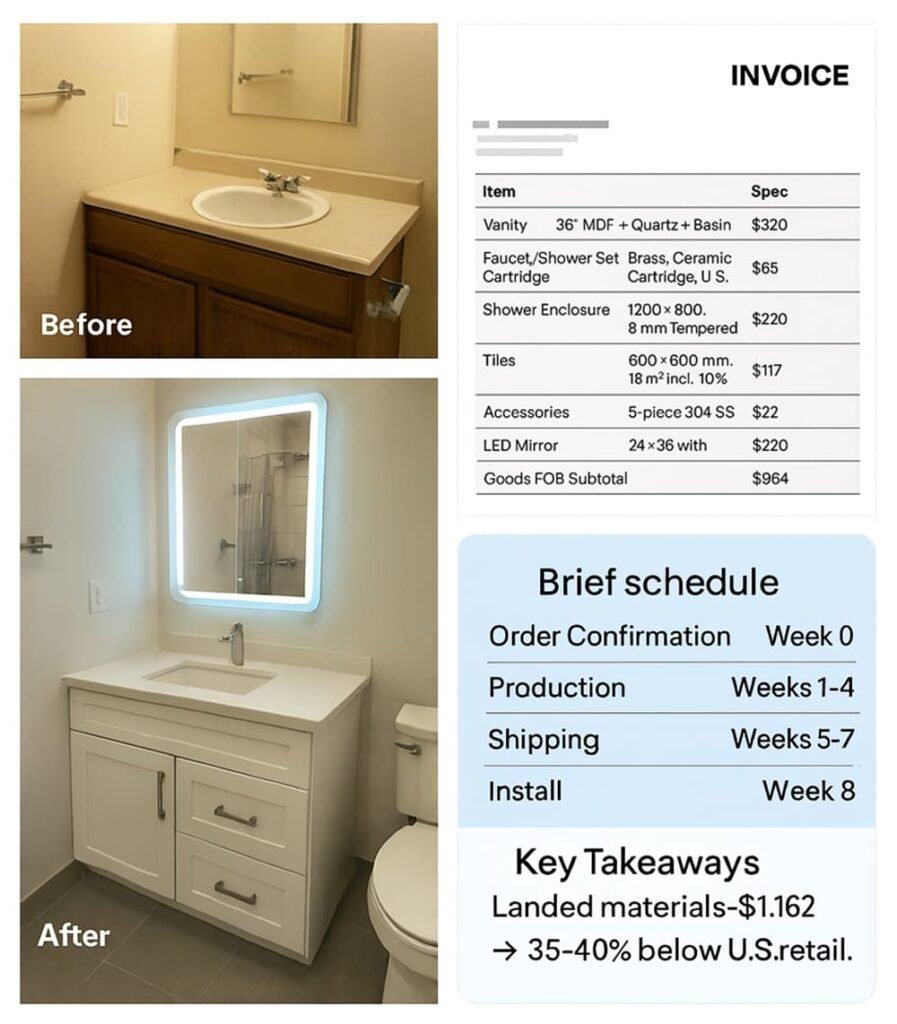
7) Mini case: 5 m² guest bath (U.S. West Coast) — landed cost math
Scenario: Light decorate/upgrade, no layout changes. Materials imported in a small consolidated shipment; local trades handle install.
Bill of Materials (FOB China assumptions):
- Vanity 36 in MDF + quartz + basin: $320 FOB (mid‑market)
- Faucet/shower set (brass, ceramic cartridge, U.S. compliance): $65 FOB
- Shower enclosure 1200×800, 8 mm tempered: $220 FOB
- Tiles 600×600 mm, 18 m² incl. 10% overage: $6.5/m² → $117 FOB (select areas)
- Accessories 5‑piece 304 SS set: $22 FOB
- LED mirror 24×36 with defogger: $220 FOB
Goods FOB subtotal: $964
Protective packaging/reinforcement (2.5%): ≈ $24
International ocean freight (12% of goods value, small LCL consolidation): ≈ $116
Duties (illustrative 3% across mixed bathroom HS codes; actuals vary): ≈ $29
Customs clearance & port/broker fees (≈3% modeled, includes TMF/HMF/MPF allocations for illustration): ≈ $29
Estimated landed materials total: ≈ $1,162
Last‑mile delivery (local) not included; vary by city and contractor.
Local install labor (West Coast light decorate scope): $2,000–$3,000 typical. Labor shares of 40–60% are common in broader bath projects, per Angi 2025.
Indicative project total: ~$3,200–$4,200 (materials landed ≈ $1,162 + labor range). Your city, contractor availability, and inspection requirements will move this number.
Transit timing: Plan roughly 4–8+ weeks door‑to‑door for consolidated imports (production + shipping), with port‑to‑port averages of ~14–22 days China→USWC per the Flexport OTI (Sept 2025). Port fees such as PierPASS’s TMF also apply at LA/LB (TMF 2025 update).
8) Methodology & sources
How we built the ranges:
- Scope controls: No layout moves or plumbing relocation, limited electrical changes. Emphasis on fixtures, vanity, tiles/wall finishes, lighting, and accessories.
- Pricing synthesis: Cross‑referenced public 2025 remodel cost benchmarks and factory‑direct FOB indicators for common bathroom SKUs.
- Landed costs: Modeled ex‑factory + packaging (2–3%) + international sea freight (10–20%) + import duties/VAT + customs clearance/port fees (2–5%) + last‑mile delivery + local install labor. The EC details how VAT is calculated for imports in the EU (2025), and U.S. port fee schedules (TMF/MPF/HMF) inform clearance modeling.
- Regional cautions: EU VAT; KSA/UAE water‑efficiency approvals; ANZ higher labor norms; U.S. electrical/plumbing code compliance for fixtures and lighting.
Key 2025 references you can check:
- Remodel context and labor share: Angi bathroom remodel guide (2025) and Modernize bathroom remodel cost (2025)
- EU VAT import base formula: European Commission trade portal (2025)
- Ocean transit timings: Flexport Ocean Timeliness Indicator (Sept 2025)
- LA/LB port fee example: PierPASS TMF update (2025)
- Faucet QA and spec cues: Aquacubic faucet/shower listing (2025 update)
- Glass standards context: AJJ Glass tempered overview (2025) and LETEL Glass standards page
- Tile pricing indicator: JTS Ceramics glazed porcelain catalog (2025 update)
- ANZ labor/cost context: Canstar bathroom renovation cost in Australia (2025)
9) What to do next
- Decide your tier and lock scope (refresh vs upgrade). Small scope changes can swing totals more than material choices.
- If importing, align specs with local codes and plan consolidation. Build a simple landed‑cost sheet (ex‑factory + packaging + freight + duties/VAT + clearance + last‑mile + labor).
- Get two local labor quotes with clear line items, including prep/waterproofing and inspection as required.
If you want help bundling vanities, fixtures, glass, tiles, and accessories at factory‑direct pricing with QC and door‑to‑door logistics, talk to our team at ChinaBestBuy. We’ll match specs to your local compliance requirements and build a clear landed‑cost plan—then ship it as one, ready‑to‑install package.