How Much Does It Cost to Decorate a Bedroom in 2025? (Soft Furnishings + Light Construction)
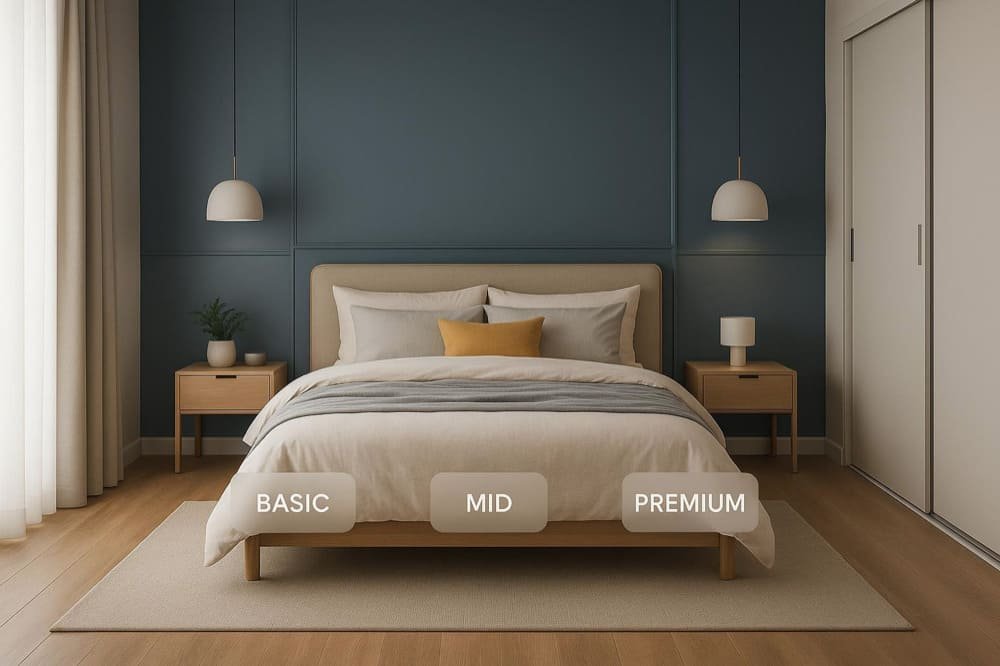
Decorating a bedroom is often a mix of soft furnishings (bed, mattress, bedding, curtains, rug, lighting, decor) and light construction (paint or wall panels, flooring/tiles, a custom wardrobe or millwork, interior door, and optional acoustic panels).
This guide lays out typical 2025 cost ranges in USD, shows three budget tiers, and includes a sample BOQ for a 12–15 m² (130–160 ft²) room. We include materials, factory processing, export-grade packaging, and a baseline for international freight. Optional/variable items—interior design fees, on-site installation labor, taxes/duties, last‑mile delivery, and contingency—are called out separately and vary by region.
Why trust these ranges? We synthesize recent 2024–2025 benchmarks from reputable sources, including HomeGuide and Angi for remodel and fixture pricing, Sleep Foundation for mattress costs, and Freightos/Flexport for mid‑2025 ocean freight indicators.
For example, average bedroom remodel context sits around the mid‑teens to tens of thousands in 2025, per the HomeGuide bedroom remodel cost page (2025) and Angi’s 2025 bedroom remodel overview. Our focus is narrower—soft furnishings + light construction—so totals may be lower than full remodels.
Section A — The 7 Core Cost Components (with 2025 ranges and savings tactics)
Note on tiers: The per‑item ranges below are organized into Basic / Mid‑range / Premium profiles to help you plan. Ranges are indicative and subject to specification, volume, and market changes.
1) Bed & mattress
What’s included: Bed frame (queen, with headboard) and mattress.
Typical 2025 ranges (USD):
- Bed frame (materials only): Basic $250–$600; Mid $600–$1,200; Premium $1,200–$3,000+
- Mattress (queen): Basic $250–$1,000; Mid $500–$1,500; Premium $1,200–$3,000+
Evidence & context: Mattress pricing by construction type (innerspring, foam, hybrid, latex) spans roughly $250–$3,000+ in 2025, according to the Sleep Foundation overview updated in 2025. Room‑level furniture budgets that include beds and casegoods commonly run into the thousands, per the HomeGuide bedroom remodel cost page (updated 2025).
Key cost drivers: Materials (solid wood vs engineered; genuine wood veneer vs melamine), joinery and detailing, brand, mattress build (coil count, foam density, latex type), certifications.
Save-money strategies:
- Choose a sturdy engineered frame with veneer for the visible faces; reserve solid wood for accents.
- Prioritize mattress performance over brand—mid‑range hybrids provide strong value.
2) Casegoods & storage (nightstands, dresser, custom wardrobe)
What’s included: Two nightstands, one dresser, and a built‑in or freestanding wardrobe.
Typical 2025 ranges (USD):
- Nightstands (pair): Basic $150–$400; Mid $400–$900; Premium $900–$2,000+
- Dresser: Basic $250–$700; Mid $700–$1,500; Premium $1,500–$3,000+
- Custom wardrobe (per linear foot): Basic $70–$150/LF; Mid $150–$350/LF; Premium $350–$1,000+/LF
Evidence & context: Custom closet/wardrobe systems average roughly $70–$270 per linear foot across specs, with premium brands much higher, per the HomeGuide custom closet cost guide (2025) and its California Closets cost explainer (2025). Angi’s 2025 updates concur that materials and hardware systems drive large swings in price, especially with sliding gear and interior accessories, as noted in Angi’s custom closet cost overview (2025).
Key cost drivers: Substrates (E0/E1 PB/MDF vs plywood), finish (melamine vs real wood veneer), premium hardware (soft‑close, hidden hinges, sliding systems), interior accessories (drawers, shoe racks, lighting).
Save-money strategies:
- Keep carcasses in melamine/E1–E0 boards; upgrade to veneer or solid wood only on exposed fronts.
- Standardize module widths and heights to reduce waste and special tooling.
3) Soft furnishings (bedding, curtains, rug)
What’s included: One bedding set (duvet/comforter, sheets, pillows), window treatments (curtains or blinds), and one area rug (5×8 or 8×10).
Typical 2025 ranges (USD):
- Bedding set: Basic $120–$300; Mid $300–$700; Premium $700–$1,800+
- Curtains per window (installed): Basic $50–$500; Mid $300–$1,200; Premium $1,200–$4,000
- Rug (8×10): Basic synthetic $100–$400; Mid wool blend $400–$1,000; Premium wool/hand‑knotted $1,000–$3,000+
Evidence & context: Ready‑made curtains installed can run $50–$500 per window, while custom drapery with premium fabrics and linings can reach $300–$4,000 per window, per the HomeGuide curtains cost guide updated in 2025. Area rug pricing scales with size, material, and construction; 2025 retail snapshots and specialty explainers show $100–$400 for synthetic 8×10 and $600–$1,500+ for wool, as summarized in a Rug Gallery 2025 explainer.
Key cost drivers: Fabric type (linen/velvet/blackout lining), custom sizing and hardware, sewing complexity; rug material and construction (tufted vs hand‑knotted).
Save-money strategies:
- Use blackout lining on cost‑effective base fabrics to achieve performance without luxury fabric costs.
- Consider a mid‑pile wool‑blend rug for durability and value.
4) Lighting & electrical fixtures
What’s included: One main ceiling fixture or fan, plus two bedside lamps or sconces; basic switching as needed.
Typical 2025 ranges (USD):
- Fixtures (materials only): Basic $150–$400; Mid $400–$1,000; Premium $1,000–$3,000+
- Install allowances (where applicable): $100–$300 per fixture for simple swaps; recessed lights often $125–$300 each
Evidence & context: Installed fixture costs commonly land in the low hundreds per point for straightforward swaps, per the HomeGuide lighting installation cost page (2025); electricians average about $50–$130/hour in 2025 per HomeGuide’s rate guide.
Key cost drivers: Fixture materials (glass/metal), wiring complexity, ceiling height, dimming/control needs.
Save-money strategies:
- Favor a simple main fixture and invest in quality bulbs and bedside lamps for layered lighting.
- Reuse existing junction boxes where safe to avoid rewiring.
5) Wall & floor finishes (paint/panels, flooring/tiles)
What’s included: Painting walls (plus ceiling/trim as needed) or adding wall panels; flooring such as laminate, LVP/LVT, engineered hardwood, or porcelain tile.
Typical 2025 ranges (USD):
- Painting a bedroom: Basic $320–$1,000; Mid $1,000–$2,400; Premium $2,400–$4,800 (scope increases with ceiling/trim and prep)
- Flooring, installed (per sq ft): Laminate $4–$14; LVP/LVT $4–$16; Engineered hardwood $7–$20; Porcelain tile $15–$50
Evidence & context: 2025 updates from HomeGuide indicate typical room painting at a few hundred to a few thousand dollars depending on scope and labor, per the room painting cost page (2025). Installed flooring ranges vary widely by material and labor conditions, summarized in the HomeGuide flooring installation overview (2025) and related material pages.
Key cost drivers: Paint quality and coats, surface prep; flooring material grade (wear layer, veneer thickness), underlayment, subfloor leveling, patterns/transitions.
Save-money strategies:
- Use a durable scrubbable paint in mid‑sheen only where needed; standard matte elsewhere.
- Choose click‑lock LVP/LVT for a cost‑effective, durable upgrade with efficient install.
6) Doors & hardware
What’s included: One interior bedroom door and basic lever set/hinges.
Typical 2025 ranges (USD):
- Interior door (installed): Basic $226–$400; Mid $400–$650; Premium $650–$824+
Evidence & context: Interior door installation averages a few hundred dollars including labor, per the HomeGuide interior door cost guide updated in 2025.
Key cost drivers: Hollow‑core vs solid‑core/wood, glazing, special tracks (barn/sliding), custom sizes, finish quality.
Save-money strategies:
- Specify solid‑core only if acoustics demand it; otherwise choose a quality hollow‑core with upgraded seals.
- Keep finishes factory‑applied to avoid on‑site paint labor.
7) Logistics & export packaging (international projects)
What’s included: Export‑grade packaging and overseas freight share for a bedroom’s goods (with consolidation where possible).
Typical 2025 ranges (USD):
- Export packaging: ~2%–5% of goods value, or roughly $20–$80+ per item depending on size/fragility
- Ocean freight baseline: LCL often ~$60–$120 per CBM China→US/EU; FCL (40’) mid‑2025 spot lanes: Asia→USWC around $3,100–$3,600/FEU; Asia→N. Europe around $3,300–$3,400/FEU
Evidence & context: Mid‑2025 guidance from Freightos indicates FEU spot rates in the low thousands depending on lane, with LCL per‑CBM higher due to handling and CFS fees, per the Freightos container cost page updated in 2025 and the Flexport Ocean Timeliness Indicator (2025). Packaging best practices and cost share are summarized in a DHL furniture export packaging guide (2025).
Key cost drivers: Shipment volume/weight, consolidation efficiency (LCL vs FCL), route seasonality, destination port charges, packaging sophistication (foam, corner guards, moisture protection).
Save-money strategies:
- Bundle multiple rooms to reach efficient FCL utilization where practical.
- Pre‑assemble and test larger items at the factory, then use export‑grade packaging to reduce damage/rework.
Section B — Total Budget Tiers per Bedroom (materials + factory processing + export packaging + baseline freight)
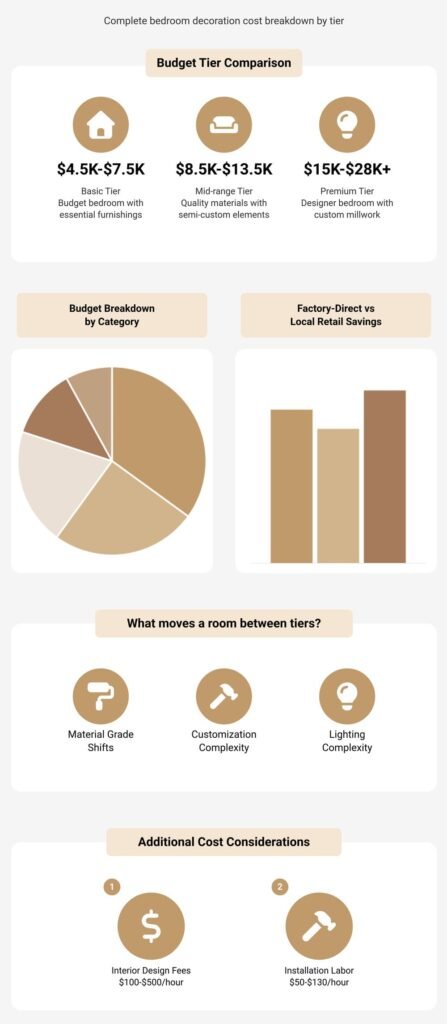
Basic: roughly $4,500–$7,500
- Typical spec: Budget bed/mattress; melamine casegoods; small ready‑made curtains or basic blinds; synthetic 8×10 rug; wall paint; laminate or SPC/LVP flooring; simple fixtures; LCL freight share.
Mid‑range: roughly $8,500–$13,500
- Typical spec: Better hybrid mattress; veneer fronts on E1–E0 substrates; semi‑custom wardrobe; blackout drapery; wool‑blend rug; engineered wood or higher‑grade LVP; layered lighting; consolidated freight.
Premium: roughly $15,000–$28,000+
- Typical spec: Designer bed/mattress; fully custom wardrobe with premium hardware; real wood veneer/solid accents; wall panels; engineered hardwood or porcelain tile; statement lighting; efficient FCL share.
Context: Furnishing alone often runs from a few thousand up to $15,000+ for a room depending on quality, and full remodels can push well beyond, per the HomeGuide bedroom remodel cost page (2025) and Angi’s 2025 summary.
Our tiers are calibrated to the “decorate” scope and include baseline freight/packaging but exclude local install labor, taxes/duties, and design fees.
What moves a room between tiers?
- Material grade shifts (melamine → wood veneer → solid wood accents)
- Customization complexity (standard modules → semi‑custom → fully bespoke with premium hardware)
- Finish scope (paint only → paint + select panels → full wall paneling)
- Flooring selection (laminate/LVP → engineered wood → tile/hardwood)
- Lighting complexity (one fixture → layered lighting with controls)
Section C — Sample BOQ (12–15 m² / 130–160 ft²) with Local Retail vs Factory‑Direct Scenario
Assumptions: Materials + factory processing + export packaging + baseline freight. Excludes interior design fees, on‑site installation labor, local taxes/duties, last‑mile delivery, and contingency.
Pricing varies by market, season, order size, and specification. Freight modeled with consolidation for a single bedroom; multi‑room projects often improve landed unit costs.
| Line Item | Spec Notes | Local Retail (USD) | Factory‑Direct (USD) |
|---|---|---|---|
| Bed frame (queen) | Engineered frame, upholstered headboard | 600–1,200 | 350–700 |
| Mattress (queen) | Mid‑range hybrid | 700–1,500 | 450–900 |
| Nightstands (2) | Veneer fronts, soft‑close | 400–900 | 250–600 |
| Dresser | 4–6 drawers, veneer fronts | 700–1,500 | 450–1,000 |
| Custom wardrobe | 8–10 LF, E1/E0 melamine carcase, veneer doors | 1,600–3,500 | 900–2,400 |
| Curtains (1–2 windows) | Blackout lining, basic hardware | 600–2,000 | 350–1,200 |
| Area rug (8×10) | Wool blend | 400–1,000 | 250–700 |
| Lighting set | 1 ceiling + 2 lamps/sconces (fixtures only) | 300–900 | 200–700 |
| Wall finishes | Paint walls + ceiling | 400–1,500 (materials) | 300–1,100 |
| Flooring (materials) | LVP/engineered wood, 130–160 ft² | 500–2,500 | 350–1,800 |
| Interior door + hardware | Hollow‑core/solid‑core materials | 150–500 (materials) | 120–400 |
| Export packaging | 2%–5% of goods value | — | 200–600 |
| International freight share | Consolidated LCL/FCL allocation | — | 400–1,100 |
| Subtotal (illustrative) | Materials + processing + packaging + baseline freight | 6,050–16,200 | 4,170–12,800 |
How to read this: The “Local Retail” column approximates typical store/installer pricing for comparable quality; “Factory‑Direct” reflects materials/processing from a vetted manufacturer with export packaging and a reasonable freight allocation.
Depending on volume and spec, factory‑direct can illustrate on the order of 30%–50% savings on selected categories. Freight and packaging are modeled based on mid‑2025 lanes, where FEU spot rates sat in the low thousands per lane and LCL ran roughly $60–$120/CBM, per the Freightos container cost page (2025) and Flexport OTI (2025).
Curtain and painting material ranges align with the HomeGuide 2025 curtain guide and room painting cost page (2025). Mattress ranges align with the Sleep Foundation 2025 overview.
Section D — Variables, Regional Adjustments, and Compliance
What’s included vs optional/variable
- Included in this guide’s totals: Materials, factory processing, export‑grade packaging, baseline international freight estimates.
- Optional/variable (estimate locally):
- Interior design fees: Models vary—hourly, flat fee, or percentage. 2025 ranges often fall around $100–$500/hour or $2,000–$12,000+ flat for a room, per Angi’s 2025 designer cost guide, while online package options span lower tiers, according to Decorilla’s 2025 pricing page.
- On‑site installation labor: Highly regional. For example, electricians average roughly $50–$130/hour in 2025 per HomeGuide’s rate guide; painting labor is often $1–$3 per sq ft of surface area per the HomeGuide room painting guide (2025); flooring labor commonly $2–$8/sq ft depending on material and prep, summarized in the HomeGuide flooring overview (2025).
- Taxes/duties & last‑mile delivery: Market‑dependent; confirm HS codes, tariff rates, and delivery surcharges with your local broker and carrier.
- Contingency: 5%–15% advisable for scope creep, punch‑list fixes, or freight fluctuations.
Regional notes and logistics scenarios
- EU, Middle East, Southeast Asia, Australia/NZ, and North America show wide labor and tax variance; always obtain local quotes.
- Shipping mode matters: LCL is flexible for low volumes but often higher per‑unit cost; FCL requires volume but lowers unit freight. Mid‑2025 spot references suggest FEU lanes in the low thousands, though seasonality and geopolitics can swing rates, per the Freightos 2025 tracker.
Compliance reminders
- Confirm VOC/formaldehyde standards (E0/E1) and any required fire ratings for panels, drapery, and finishes before production.
- Verify labeling and documentation (packing lists, MSDS where applicable, test reports) ahead of shipment to avoid delays.
Section E — How the One‑Stop, Factory‑Direct Workflow Comes Together
When you consolidate scope—bed frame and mattress, casegoods and wardrobe, soft furnishings, lighting, finishes—through a single, vetted supply chain, you reduce coordination risk and improve cost predictability. A typical end‑to‑end workflow looks like this:
- Design consultancy: Translate concept to shop drawings; align specs (E0/E1 substrates, veneers vs melamine, hardware systems) and finish samples.
- In‑house QA & inspections: Pre‑production approvals, in‑process checks, final inspection with documented reports and photos.
- Export‑grade packaging: Moisture protection, corner guards, carton tests, and palletization/wood compliance.
- Consolidation & global logistics: Align production to shipping windows; choose LCL vs FCL; prepare documentation.
- After‑sales & replacement parts: Close issues fast; maintain spec continuity for repeat or multi‑room rollouts.
When to consider factory‑direct vs local retail
- Factory‑direct often makes sense if you have two or more rooms to furnish, need consistent finishes/hardware, or want semi‑custom modules without retail markups.
- Local retail can be preferable for one‑off purchases with immediate availability or where after‑sale service must be in‑person.
Ready for a project‑specific BOQ with transparent inclusions and a logistics plan? Share your room size, target specs, and destination port, and we’ll prepare an itemized estimate. We operate as a one‑stop sourcing partner. Learn more at ChinaBestBuy.
FAQ — Quick clarifications
1. Does this include installation labor?
Not in the tier totals. Labor varies widely by region; get local quotes for painting, flooring, electrical, and carpentry.
2. Are taxes and duties included?
No. These depend on destination market and HS codes; consult your broker.
3. Can customization be cheaper than retail?
In batch orders and with standardized modules, yes; unit prices can undercut retail while meeting precise dimensions.
4. Is shipping the biggest cost?
Often not. For a standard bedroom, materials and fabrication typically dominate; freight is frequently around 10%–20% of the landed total under efficient consolidation, consistent with mid‑2025 rate context from Freightos/Flexport.
Credits & methodology: Ranges compiled from 2024–2025 sources and adjusted to a “decorate” scope.
Key references include the HomeGuide bedroom remodel cost page (2025), Angi’s bedroom remodel overview (2025), the Sleep Foundation mattress cost guide (2025), the HomeGuide curtains cost guide (2025), the HomeGuide flooring installation overview (2025), the HomeGuide interior door cost guide (2025), and freight context from the Freightos container cost page (2025) and the Flexport OTI (2025).
All prices subject to change; always verify with live quotes.