I Built Pet Stairs: Should I Use Carpet Stair Treads?
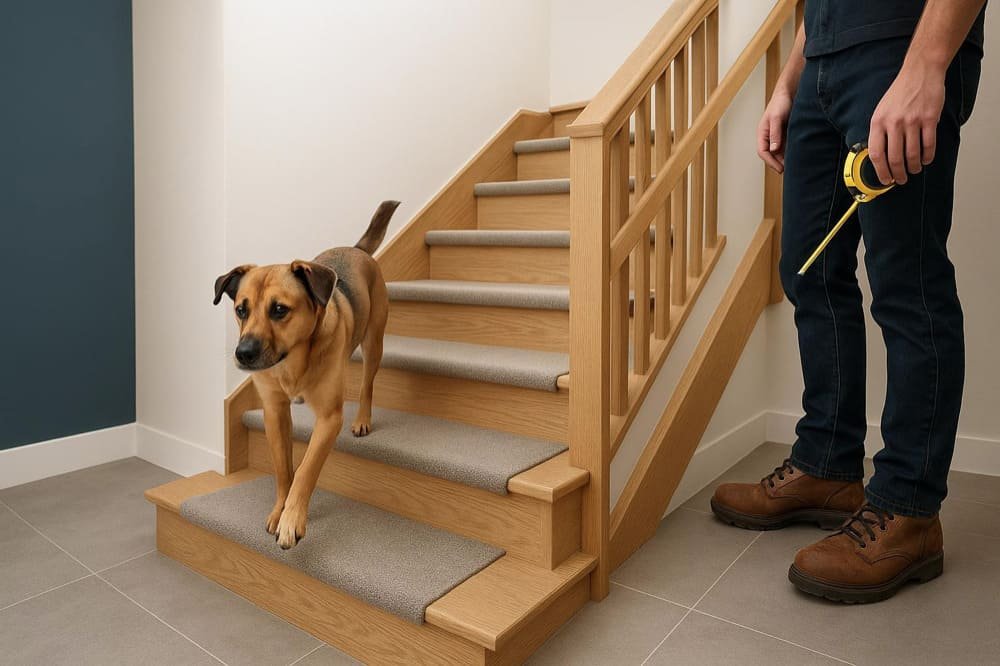
For contractors and trade buyers, the short answer is yes — carpet stair treads are a smart, project-ready upgrade for most indoor pet stairs.
They add non-slip traction for paws, soften step impact to cut noise, and protect the substrate.
The caveat: they need to be correctly specified (materials, backing, dimensions), securely attached, and inspected in bulk before install.
Why carpet stair treads are the safer, quieter choice for pets
- Slip resistance is defined qualitatively in the 2010 ADA Standards: floor surfaces must be “stable, firm, and slip resistant,” and carpet must be “securely attached” to prevent movement or buckling. The ADA does not set a numeric COF threshold; proper securement and surface selection matter most. See the U.S. Access Board’s guidance for floor surfaces, Section 302 Floor or Ground Surfaces (including 302.2 Carpet).
- Workplace guidance focuses on condition and maintenance, not a COF number. OSHA’s Walking–Working Surfaces standards require surfaces to be kept clean, dry where possible, and free of hazards, and set detailed rules for stairways but no numeric slip coefficient. See OSHA 1910.22 and OSHA 1910.25.
- Noise reduction: Carpet reduces impact noise compared with hard treads. While stair-specific IIC values aren’t standardized, the same physics that give carpet assemblies strong IIC performance over slabs (frequently reaching IIC in the mid-60s or higher) apply qualitatively to steps. For context on IIC and ΔIIC for floors, see this primer on IIC ratings and assemblies. On stairs, expect noticeable—but assembly-dependent—quieting.
- Fit still matters. If you’re building the stairs, stay within current code geometry so treads cover properly without creating trip hazards. For reference: the 2024 codes set residential tread depth at ≥10 in (IRC R311.7.5) and commercial at ≥11 in (IBC 1011.5.2). See the ICC’s current text for IRC 2024 R311.7.5 and IBC 2024 1011.5.2.
What to specify in bulk orders (materials and backings)
Choose combinations that match traffic, cleaning expectations, and installation method. Below is a quick, side-by-side reference you can hand to procurement.
| Option | Strengths | Watch-outs | Typical use cases |
|---|---|---|---|
| Nylon face fiber | Excellent wear and resilience; holds pile in high traffic; good recovery after compression | Slightly higher cost than polyester; check stain treatment for pet accidents | Apartments, hospitality corridors, high-traffic residential |
| Polyester face fiber | Good stain resistance; cost-effective; soft hand | Lower resilience than nylon; can show crushing in heavy traffic | Budget rentals, single-family, lighter-traffic stairs |
| TPR (thermoplastic rubber) backing | Phthalate-free pathways; generally lower VOC; flexible across temps; good traction | Verify slide resistance data on your substrates; ensure SDS and IAQ certificates | Peel-and-stick or lay-flat treads on wood/laminate |
| PVC backing | Economical and familiar; strong initial grip with PSA systems | Plasticizer migration and VOC considerations; temperature limits; request low-VOC/GLP compliance | Cost-sensitive projects with strict adhesion requirements |
| Adhesive-free reusable composite | Fast install, low residue; reusable for maintenance | Performance varies by formulation; require traction data and reusability cycle limits | Rental turnovers, short-term projects, refinishing cycles |
Notes and evidence you can request:
- Indoor air quality: Ask for CRI Green Label Plus certificates for carpet, cushion, and adhesives by SKU from the Carpet and Rug Institute database. Some buyers also require GREENGUARD Gold or FloorScore.
- Abrasion: Specify Martindale (ASTM D4966/ISO 12947) cycles for your traffic class. Reference: ASTM D4966 overview and ISO 12947 catalog entry.
- Fire performance: For many projects, confirm ASTM D2859 (pill test) and, where corridor exposure or local code requires, ASTM E648 radiant flux class; EU exports often reference EN 13501-1 for “fl” classes. See ASTM D2859 and ASTM E648.
Procurement and QC checklist for bulk programs

Use this as your RFQ/RFP template and incoming inspection guide.
- Compliance and documentation
- ADA qualitative requirements for slip resistance and secure attachment; include your installation SOP reference. See the U.S. Access Board’s carpet and floor surface sections.
- Fire and safety evidence per occupancy: ASTM D2859; add ASTM E648 or EN 13501-1 when applicable.
- IAQ: CRI Green Label Plus certificates; SDS for backings/adhesives; optional GREENGUARD/FloorScore.
- Product performance
- Abrasion (Martindale cycles), pile weight, and density targets; edge binding durability.
- Backing choice with traction data on your specified substrates; for peel-and-stick, request peel strength data (ASTM D903).
- Color: Submit/approve a master; set batch delta E or AATCC Gray Scale acceptance grade (≥4 where relevant).
- Dimensions: Custom size list with tolerances; thickness variance limits.
- Sampling and inspections
- Pre-production samples for color and backing adhesion; approve against the master standard.
- Lot acceptance with ISO 2859-1 AQL (e.g., Major 2.5, Minor 4.0) and a documented inspection report.
- Packaging and logistics
- Individual polybags, desiccants, humidity indicator cards for ocean lanes; carton ECT rating suitable for stacking.
- Transit validation using ISTA 1A before first shipment.
References for methods: ASTM D903 peel test, ISO 2859-1 sampling, and ISTA 1A.
Getting sizing and fit right for professional work
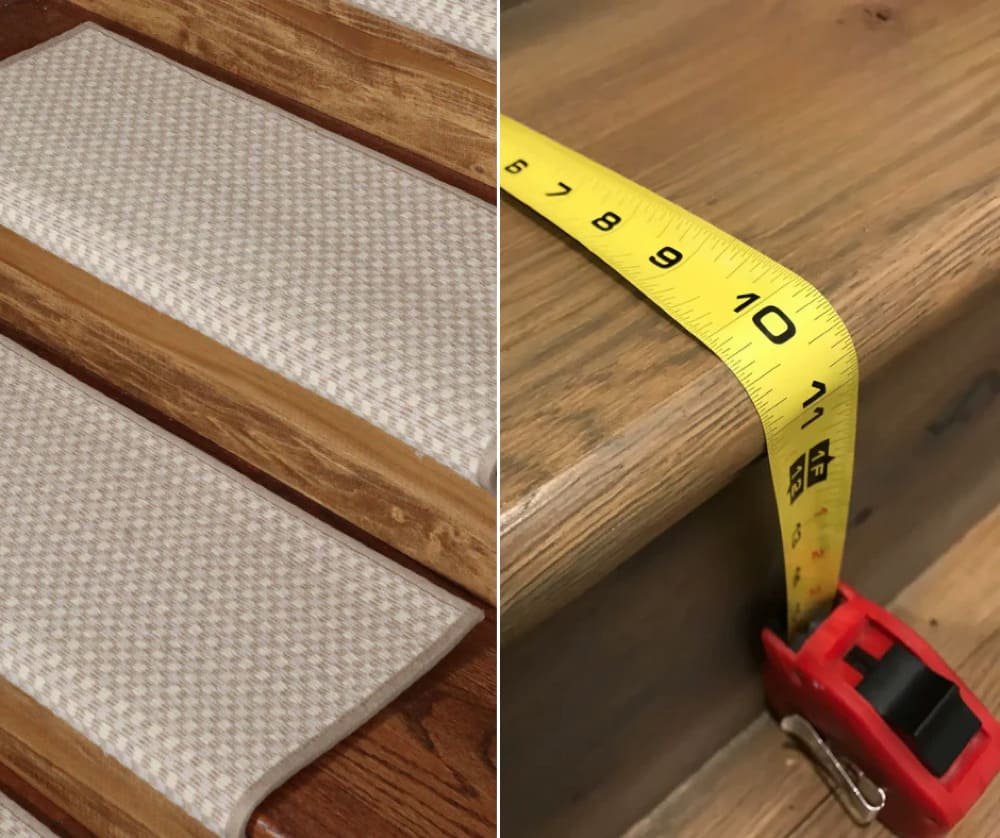
You’ll avoid callbacks by nailing geometry, tolerances, and edges.
Depth coverage:
Target 10–11 in visible coverage depending on your stair type, leaving a small nosing reveal to avoid edge lift.
Confirm the nosing radius so the tread sits flat without tenting.
For precut treads, specify finished dimensions and tolerance (e.g., ±2–3 mm) and squareness (<2 mm across diagonals).
For site trimming, request a margin allowance.
Specify bound edges for durability and a clean look; confirm thread type and color match and include an abrasion requirement for the binding itself.
Finally, if installing over painted wood, sealed MDF, or laminate, validate the backing’s shear resistance and residue profile at your site temperatures.
Installation essentials at scale
- For safe, repeatable installs, align crews to recognized carpet standards and clear substrate prep.
- Follow CRI 104/105 practices for stair installations and secure attachment; a consolidated reference is available in the U.S. DoD’s UFGS 09 68 00 specification, which points to CRI standards for methods and conditions—see UFGS 09 68 00 (carpet).
- Ensure surfaces are clean, dry, and dust-free before applying adhesive or placing reusable backings.
- For reusable systems, define reinstallation cycle limits and cleaning protocols so traction stays consistent.
- For peel-and-stick, verify minimum room temperature at install and observe cure times before opening to traffic.
- Document the securement method per unit (e.g., “TPR peel-and-stick on sealed pine with X N/in peel strength”) so future maintenance teams know what they’re working with.
Example: How a one-stop supplier supports bulk tread programs

Disclosure: ChinaBestBuy is our product.
A typical contractor workflow runs like this:
- You send a cut list (per building stack) with target sizes, nosing notes, and the traffic class.
- Our team proposes a nylon + TPR package with GLP certificates, submits color masters and two backing samples for site tests, and returns traction data on your wood and laminate substrates.
- After approvals, production is slotted with ISO 2859-1 AQL controls, bound edges, and ±2 mm dimensional checks.
- Each tread is bagged; cartons are ECT-rated, with desiccants and humidity cards for sea freight.
- Before shipment, we issue a COA packet: color match vs master, abrasion cycles, peel strength (ASTM D903), and packaging test summaries (ISTA).
- Multilingual coordinators manage schedules and pallet counts so your crews can install on arrival without surprises.
That’s the one-stop approach—design to delivery, verified.
Maintenance, IAQ, and tenant satisfaction
Set a simple cleaning protocol (blot, rinse, approved cleaner) and include it in turnover packets.
Keep 3–5% overage in matching dye lots for future replacements; for reusable backings, document the max reuse cycles.
To reassure property teams, include copies of the CRI Green Label Plus certificates (and any GREENGUARD/FloorScore) with the COA.
When carpet stair treads aren’t the right choice
If you’re dealing with persistent wet areas or exterior stairs, use rubber or vinyl stair covers with integrated nosing and documented wet-condition traction.
In heavy-soil industrial or animal-care back-of-house zones, molded rubber or metal anti-slip nosings with gritted surfaces may perform better.
Where adhesives are restricted, specify mechanical nosings or proven reusable systems with substrate-specific traction data and defined reuse limits.
The bottom line
For indoor pet stairs, carpet stair treads are a practical, safety-forward upgrade—especially at scale.
Specify the right face fiber and backing, align to ADA securement expectations, validate durability and fire/IAQ, and run a documented QC program. Do that, and you’ll deliver quieter steps, steadier paws, and fewer callbacks.
Get a factory-direct quote for bulk carpet stair treads (custom sizes, materials & colors).