Choosing a Carpet Runner for the Stairs: A Procurement Guide for Hospitality and Multi‑Family Projects
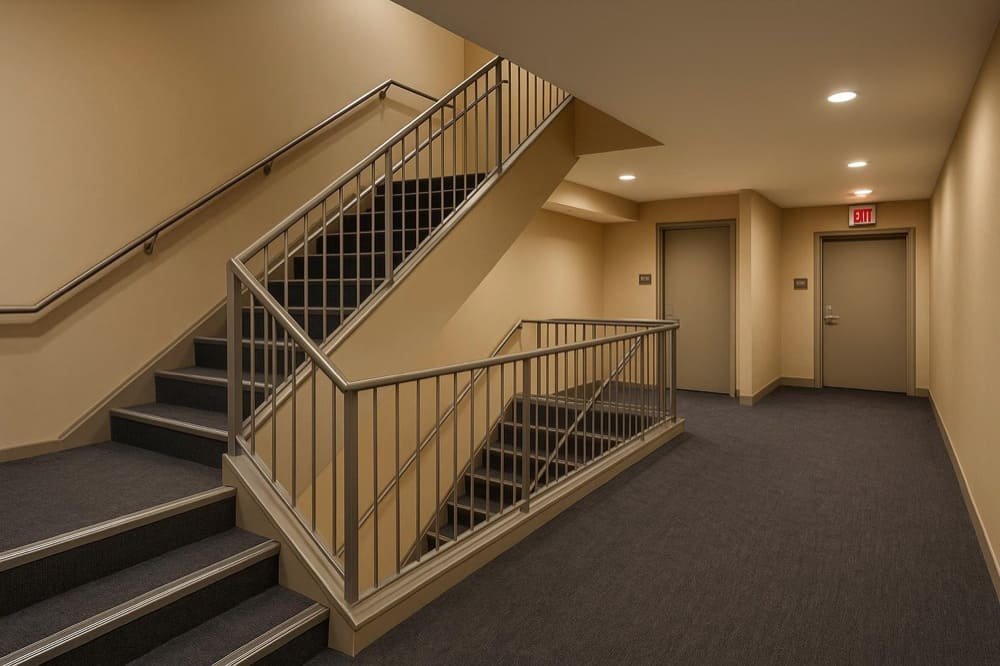
If a project ever exposes weak specifications, it’s the stairs.
Traffic is concentrated, step edges get hammered, and any mistake—slippery pile, non-compliant fire rating, unbound edges—shows up fast, often during commissioning.
This guide distills what “safe and durable” actually means for stair runners in hotels, serviced apartments, and multi-family corridors, and how to document it so your handover is drama-free.
1) What “safe and durable” means in code terms
Across jurisdictions, stair coverings are governed by interior finish and egress requirements. For U.S. projects, the International Building Code sets the testing framework for floor finishes. It recognizes the methenamine pill test for ignition (ASTM D2859/16 CFR 1630) and critical radiant flux via the radiant panel (ASTM E648 or NFPA 253).
See the framework in the ICC’s official text in Chapter 8 of the code: IBC 2024, Interior Finishes.
Many institutional and hospitality specifications conservatively require a Class I radiant flux classification (≥0.45 W/cm²) for exit corridors and stair enclosures; always confirm with the authority having jurisdiction.
For the radiant panel method itself, refer to: NFPA 253 (standard page).
For EU/UK projects, fire classification relies on EN 13501-1 Euroclasses (A1fl–Ffl with smoke indices). Commercial owners typically call for Bfl-s1 or Cfl-s1 for circulation areas, established via EN ISO 9239-1 (radiant panel) and EN ISO 11925-2 (ignitability).
A useful technical overview is Interface’s EMEA explainer on Euroclass testing and thresholds: EU fire testing white paper (Interface).
UK national guidance (Approved Document B) doesn’t prescribe a single floor class for stairs/escape routes—coordinate with building control and the project fire strategy.
Bottom line: specify the correct test regime for your region, name the required class, and collect the lab reports for the exact construction you’re buying (face fiber + pile + backing).
2) Slip resistance: what the codes really say for carpet
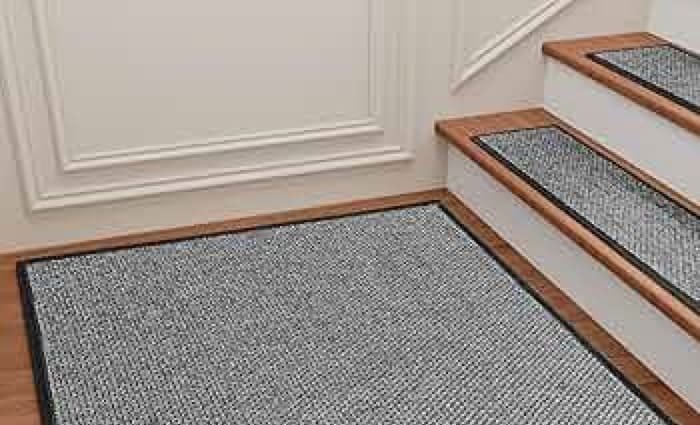
You’ve probably seen hard-surface specs calling for a minimum DCOF value. That doesn’t translate to textiles.
The ADA Standards require accessible flooring to be stable, firm, and slip resistant, but they don’t assign a numeric coefficient for carpet.
The IBC similarly expects slip-resistant surfaces in means of egress without a number for textiles.
For a primary comparison of ADA/IBC language, see the U.S. Access Board’s summary: ADA–IBC Comparison, Chapter 5
So how do we manage traction on carpeted stairs?
- Choose dense, flatter constructions (tight loop or low-level cut/loop) that don’t “roll” underfoot.
- Orient pile down the run (with traffic) to reduce slip propensity at the nosing.
- Use robust stair nosing profiles and wrap/secure the edge per manufacturer guidance to protect traction at the step edge.
- Control transitions at landings; where heights differ, employ reducers/nosing systems to remove trip points.
- Maintain cleanliness—impacted dust and dry contaminants reduce traction on textiles.
Think of it this way: with carpet, you engineer traction through construction, orientation, and detailing—not a single DCOF number.
3) Material and construction choices that hold up on stairs
- Fiber systems: Solution-dyed nylon and premium wool blends are common for commercial stairs. Nylon offers stain resistance and colorfastness; wool provides resilience and natural flame behavior. Whatever the fiber, prioritize density and tight construction for step-edge stability.
- Backing and stability: Unitary or thermoplastic backings provide dimensional stability and resist edge ravel. Specify backing compatibility with the intended adhesive (and request the data).
- Structural integrity: For step-edge abuse, include tuft bind (ASTM D1335) and delamination strength (ASTM D3936) in the spec to reduce pile pull-out and layer separation at nosings.
- Appearance retention and wear: For carpets, durability is demonstrated by appearance retention testing such as ISO 10361 (Vettermann drum/Hexapod) or ASTM D5252 (Hexapod Walker). Many heavy-commercial products target ratings around 3.0–3.5 at 20,000–22,000 cycles. European “use classes” per EN 1307—look for Class 33 (heavy commercial)—are also a practical shorthand for suitability in corridors and stairs.
A quick correction worth calling out: the popular “≥100,000 double rubs” metric belongs to Wyzenbeek testing (ASTM D4157) for upholstery fabrics, not floor coverings.
For carpet runners, require ISO 10361/ASTM D5252 appearance retention results instead, along with tuft bind and delamination data tied to the exact backing you’ll install on stairs.
4) Installation that passes handover (ANSI/CRI 104)
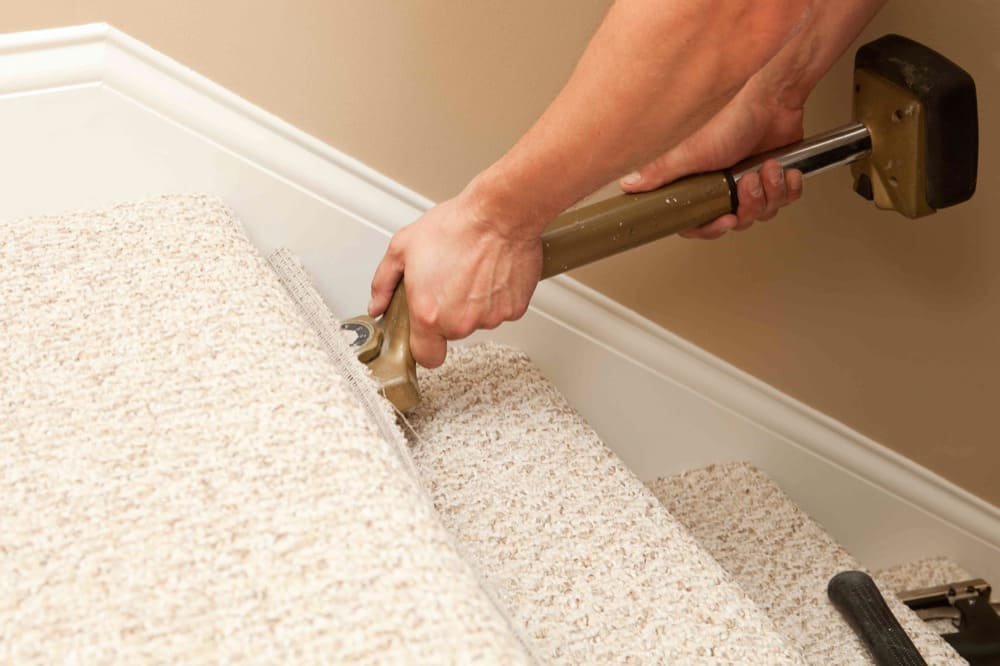
Even perfect materials can fail with poor installation. The U.S. commercial benchmark is ANSI/CRI 104. It covers layout, adhesives, trowel notches, and stair methods.
You can access the 2019 edition here: CRI 104 Installation Standard.
Key points to lock in during shop drawings and pre-install meetings
- Pile direction must run downward with the traffic flow, and that orientation should be documented so landings align with runs and nosings.
- All long edges should be bound or serged to prevent fray, and bound edges must be protected during shipping and handling.
- Choose the stair method—cap-and-band (contoured) or waterfall—based on stair geometry and product construction; cap-and-band typically gives tighter nosing control in commercial settings.
- Use manufacturer-approved adhesives for the specific backing and follow trowel notch/open-time guidance; improper spread is a common root cause of buckling.
- Install durable nosing profiles where required by design/traffic, wrapping the carpet cleanly over the nosing and mechanically securing as specified.
- Keep transitions at landings flush; where height changes are unavoidable, use reducers to prevent trip hazards.
If you remember one thing: most “mystery” failures trace back to surface prep, adhesive selection/spread, and edge protection. CRI 104 gives you the playbook—enforce it.
5) Frequent failure modes—and how to prevent them
Wrong pile orientation increases slip risk at nosings, so annotate drawings and run a pre-install mockup to confirm feel and appearance.
Unbound edges fray and ravel under traffic; binding/serging and protective packaging stop this before it starts.
Delamination or buckling usually comes from incompatible adhesive/backing or poor prep; require adhesive compatibility letters and follow CRI 104 trowel/open-time guidance.
Pattern skew or bow across landings creates visual misalignment and punch-list friction — plan pattern repeats in the shop drawings and dry-lay to verify alignment before final fix.
Premature wear at step edges often signals that tuft bind is too low for the application; set minimum tuft bind values in the spec and verify with test data for the exact SKU and backing.
6) Procurement toolkit: documents to require and how to read them

Here’s a compact, audit-ready checklist you can drop into your RFQ. One set of documents should cover the exact face fiber, pile construction, and backing you will install on stairs and landings.
- Fire performance: U.S.—ASTM D2859 pill test and ASTM E648/NFPA 253 radiant panel classification for the product construction; EU/UK—EN 13501-1 classification with EN ISO 9239-1 and EN ISO 11925-2 reports.
- Appearance retention: ISO 10361 and/or ASTM D5252 results with cycles and ratings suitable for heavy traffic.
- Structural integrity: Tuft bind (ASTM D1335) and delamination strength (ASTM D3936) values, particularly for stair use.
- Installation standard: Confirmation of compliance with ANSI/CRI 104 and installer qualifications.
- Indoor air quality/transparency: CRI Green Label Plus for carpet and adhesive; EPD/HPD or NSF/ANSI 140 if required by the owner.
- Packaging and sequencing: Plan for bound-edge protection, labeled runs, and landing pieces; document the shipping method and Incoterms.
Two-minute decoder for your spec and submittals:
| Requirement | Test/Classification | Typical heavy-traffic target or note |
|---|---|---|
| Ignition resistance (US) | ASTM D2859 (pill test) | Pass required for carpet floor coverings |
| Radiant flux (US) | ASTM E648 or NFPA 253 | Class I (≥0.45 W/cm²) often specified in exit corridors/stair enclosures; confirm with AHJ |
| Euroclass (EU/UK) | EN 13501-1 via EN ISO 9239-1 + 11925-2 | Bfl-s1 or Cfl-s1 commonly specified in hospitality circulation |
| Appearance retention | ISO 10361 / ASTM D5252 | Ratings around ≥3.0–3.5 at 20–22k cycles for heavy commercial |
| Structural integrity | ASTM D1335 (tuft bind); ASTM D3936 (delamination) | Include minimums appropriate to product; verify for stair backing |
| Installation | ANSI/CRI 104 (2019) | Use manufacturer-approved adhesives; enforce trowel/open time and stair methods |
| IAQ | CRI Green Label Plus | Certificates current for carpet and adhesive |
References for deeper reading: IBC 2024 Chapter 8, NFPA 253 overview, and the CRI 104 installation standard (PDF).
7) Supplier and logistics readiness

Beyond specs, your supplier must execute: documentation control, pre-shipment QC, protective packaging for bound edges, and clear labeling for stair runs and landings. For global teams, align lead times and customs milestones with site dates and installation windows—and have a plan for overage and rapid replacements if a piece is damaged during install.
- Supplier credibility and scope: Review corporate capabilities and international project scope on the ChinaBestBuy About page.
- One-stop execution: See how design support, factory-direct sourcing, QC, and logistics come together on the Service overview.
- Real-world outcomes: Browse representative work on the Projects gallery and align expectations for sequencing and finish quality.
A practical tip: request pre-production mockups (one flight and a landing), then lock the orientation, nosing detail, and binding before authorizing full production. It’s a small step that can save weeks.
Wrap-up: get to handover without surprises
- Specify the right tests for your jurisdiction (IBC/NFPA in the U.S.; EN 13501-1 in EU/UK) and collect the lab reports for the exact build you’ll install.
- Engineer traction with construction and orientation—don’t chase hard-surface DCOF numbers for carpet.
- Use carpet-appropriate durability metrics (ISO 10361/ASTM D5252) and integrity tests (tuft bind/delamination), not upholstery “double rubs.”
- Enforce ANSI/CRI 104 on site. Most failures trace to installation controls you can manage upfront.
- Vet the supplier’s QC, packaging, and logistics plan so bound edges arrive protected and runs are install-ready.
One question to leave with your team: if you walked this stair 100 times a day, would every step feel the same underfoot?
If the answer is anything but “yes,” revisit the spec and mock up again — before the punch list does it for you.