Benefits of Custom Furniture for Commercial Projects Explained
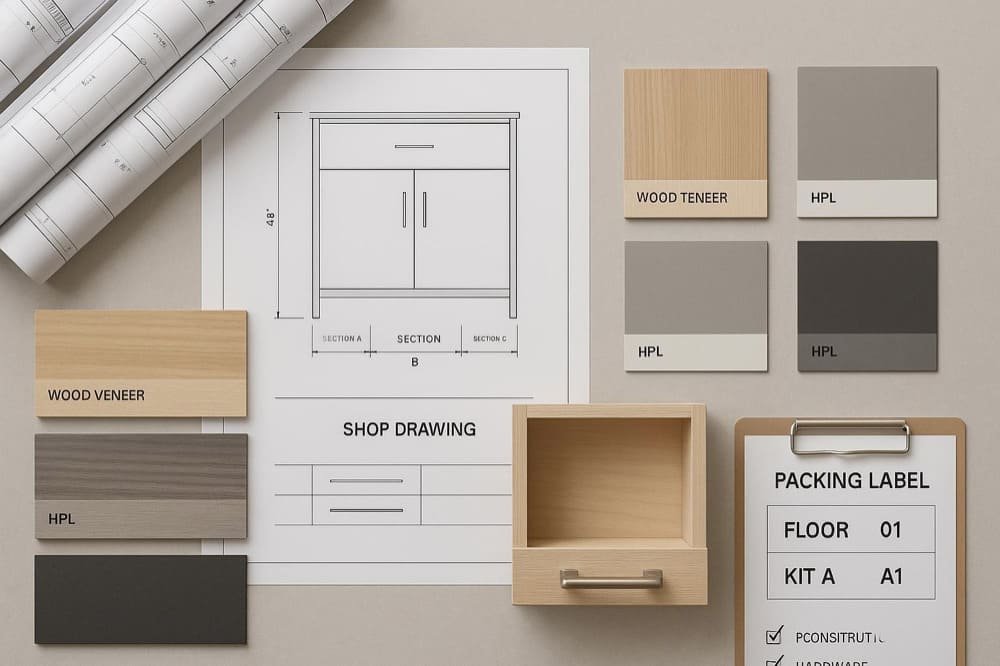
Custom furniture, in a commercial sense, means FF&E and built-ins engineered to project drawings, manufactured at scale, and verified against recognized standards for safety, durability, emissions, and fire.
Think contract-grade casegoods, seating, tables, wardrobes, vanities, reception desks, and millwork—made to your dimensions and finish schedule rather than pulled from a catalog.
Authoritative programs such as the Business and Institutional Furniture Manufacturers Association organize the relevant performance and sustainability benchmarks for business and institutional furniture, including a family of product standards and the e3 sustainability framework that supports the LEVEL program for buyers.
What it isn’t: purely artisanal one‑offs without performance testing, or generic retail/residential pieces not designed for heavy use. In development and capital projects, “custom” is a disciplined manufacturing and logistics process—not a gamble.
Key takeaways
- Custom excels when you need precise fit, brand‑consistent finishes, and compliance backed by recognized standards (BIFMA, emissions/fire, ADA, stability).
- A shop drawing → mock‑up → staged QC flow reduces rework and total cost of ownership.
- Schedule gains come from pre‑assembly, kitting, and sequenced deliveries aligned to site readiness.
- Formal documentation (AQL inspections, packaging tests, emissions/fire labels) transforms perceived risk into managed risk.
Why it matters: the benefit stack
1) Space and design performance
- Precise fit to tight footprints and MEP constraints: built‑ins, vanities, and wardrobes are dimensioned to field measurements and coordinated clearances, including accessibility where required. The Access Board’s official 2010 ADA Standards outline clear floor space (§305), knee/toe clearances (§306), and reach ranges (§308) that inform accessible layouts in guestrooms, apartments, and public areas.
- Brand consistency across properties: finishes, veneers, laminates, and hardware are controlled through a master finish schedule and retained control samples so lobbies, rooms, and amenities match even across phases.
- Stability and safety for casegoods: anti‑tip designs and restraints reduce hazards in residential and hospitality settings—anchored by the current ASTM F2057 safety specification for clothing storage units, with restraints referenced in ASTM F3096.
2) Cost and commercial outcomes
- Lower TCO via the right specs: contract‑grade seating, tables, and storage validated to BIFMA product standards are built for high utilization, supporting longer service life and fewer replacements. BIFMA maintains category standards and a buyer‑facing registry for conformance listings; its ANSI/BIFMA e3‑2024 sustainability standard underpins the LEVEL program many procurement teams reference.
- Value engineering without aesthetic compromise: switching from solid wood to durable HPL with solid‑wood accents or metal reinforcements can preserve design intent while reducing capex and maintenance.
- Fewer change orders: coordinated 3D/shop drawings, finish samples, and pilot units align stakeholders before production, eliminating on‑site surprises.
- Consolidated procurement and shipping: containerized, batched deliveries and fewer vendors can cut administration and logistics costs compared with piecemeal sourcing—consistent with institutional FF&E guidance that emphasizes coordinated delivery windows, protection plans, and floor‑by‑floor installation sequencing.
3) Quality and durability
- Contract testing and construction: match product categories to BIFMA standards (e.g., X5.1 for general office seating; X5.4 for public/lounge seating; X5.5 for desks/tables; X5.9 for storage; X6.4 for stability) so durability targets are explicit and verifiable. BIFMA’s buyer resources and the BIFMA Compliant registry help teams verify claims.
- Surface and environmental performance: specify wear/abrasion targets and moisture/termite‑resistant substrates as project conditions warrant; pair with low‑emission strategies.
- Emissions and IAQ: in the U.S., composite‑wood components must meet the EPA’s TSCA Title VI formaldehyde limits aligned with CARB Phase II; the EPA’s stakeholder FAQs updated in 2024 clarify the laminated‑products provisions and labeling. For California comparisons, CARB’s January 2024 table details alignment points. In the EU, many teams cite EN 717‑1 test methods; note that “E0” is a market term, not a harmonized legal class—use numeric limits established by Commission Regulation (EU) 2023/1464 (0.124 mg/m³ for furniture and wood‑based articles).
- Upholstery fire safety: TB117‑2013 focuses on smolder resistance for cover fabrics, barrier materials, fillings, and decking, and requires a permanent label that includes a flame‑retardant chemical statement; California BHGS provides official labeling guidance.
4) Schedule and execution
- Faster installs through pre‑assembly: factory pre‑assembly, labeled kitting, and clear installation drawings reduce site labor and rework. Institutional FF&E specifications highlight the value of delivery/installation coordination (elevators, docks, protection, floor sequencing) for schedule reliability.
- Sequenced deliveries and multi‑site rollouts: floor‑by‑floor drops meet areas as they become ready; finish sets are preserved across phases via control samples and documentation.
- Spare parts and O&M: include consumables and maintenance documents with closeout to simplify operations.
Standards and compliance that matter (with buyer‑side meaning)
- BIFMA performance and sustainability: Use BIFMA’s family of category standards to set durability/safety expectations and the ANSI/BIFMA e3‑2024 sustainability standard to align with procurement frameworks like LEVEL. See BIFMA’s standards overview and the LEVEL program resources for designers and buyers.
- Casegoods stability: specify compliance with ASTM F2057 for clothing storage units and, where provided, restraints per ASTM F3096.
- Emissions: for U.S. projects, confirm EPA TSCA Title VI compliance, including the 2024 laminated‑products provisions; for California alignment questions, consult CARB’s January 2024 comparison. For EU work, state the EN 717‑1 test method and numeric limit per the 2023 EU restriction.
- Upholstery fire: reference TB117‑2013 component testing and labeling requirements common to U.S. markets.
- Accessibility: apply ADA reach/clearances to accessible units and public areas; review the Access Board’s 2010 ADA Standards and technical chapters at design and shop‑drawing stages.
- IAQ programs: UL’s GREENGUARD and GREENGUARD Gold validate low chemical emissions from furniture/building products and align with CDPH Standard Method 01350, supporting IAQ credits.
- Responsible wood: if required, specify FSC Chain of Custody and request certificate codes per FSC‑STD‑40‑004.
How the commercial custom furniture workflow actually runs
1) Brief and measurements: confirm scope, unit types, counts, and field dimensions; align on applicable standards (BIFMA, emissions, fire, ADA) and documentation.
2) Concept and 3D/shop drawings: develop dimensioned drawings with sections, hardware, and finish callouts; coordinate with MEP and architectural details.
3) Material/finish selections and samples: send/approve veneers, HPLs, fabrics, metals, and hardware; retain control samples for finish matching across production.
4) Mock‑up/pilot unit: build one room set or unit family for sign‑off. For focused pilots, expect roughly 2–3 weeks; broader pilots can take 4–8 weeks depending on scope and capacity. Institutional FF&E guidance typically plans overall cycles across multiple months from design freeze.
5) Production with stage QC: run incoming, in‑process, and final inspections; define acceptance criteria via AQL plans (e.g., ANSI/ASQ Z1.4 or ISO 2859‑1) with photo/video reporting.
6) Pre‑shipment inspection and packing: verify dimensions/finishes/hardware; use appropriate ISTA test protocols for package type to reduce transit damage.
7) Global shipping and customs: consolidate by floor/zone; prepare customs paperwork; track shipments and staging.
8) Site delivery, installation coordination, and after‑sales: deliver labeled kits, provide installation drawings, support punch and warranty; include spare parts and O&M documentation.
As of 2025‑09‑10, the standards and resources referenced above are current on their official program pages.
Myths vs. reality
- “Custom is always more expensive.” Not when you combine factory‑direct sourcing, value engineering on materials/finishes, and contract‑grade construction targeted to use. Eliminating rework and change orders through shop drawings, samples, and pilots often offsets premium elements over the lifecycle.
- “Custom has unpredictable lead times.” Using disciplined milestones—design freeze → pilot → mass production—creates predictable windows. Focused pilots can complete in ~2–3 weeks; mass production for typical casegoods/loose items often runs ~4–8 weeks depending on scope, with total FF&E cycles commonly planned across several months in institutional guidance.
- “Quality risk is higher.” It’s higher only if you skip process. BIFMA category standards, TB117‑2013 labeling for upholstered components, AQL sampling per ANSI/ASQ Z1.4 or ISO 2859‑1, and ISTA packaging protocols are established controls for performance and transit risk.
Practical example: how a provider coordinates drawings, QC, and shipping
A provider receives the BOQ and drawings, issues consolidated shop drawings, and ships finish/hardware samples for sign‑off.
It builds a pilot unit, shares photo/video, then locks the master finish schedule. During production, incoming and in‑process inspections are documented; a pre‑shipment AQL inspection verifies dimensions, finishes, and hardware.
Packaging follows relevant ISTA protocols, and goods are kitted and labeled by floor/zone for faster installation.
This mirrors the process used by providers such as ChinaBestBuy.
Mini‑cases (illustrative)
- Hospitality (200‑key hotel): Pre‑assembled vanities and wardrobes shortened on‑site install by about 20%. A master finish schedule and retained control samples kept veneers and laminates consistent across guestrooms and public areas, helping avoid patchwork replacements.
- Multifamily (500 units): Value engineering swapped solid wood for HPL with solid‑wood accents, saving roughly 12% capex while improving wear resistance in high‑touch zones. Standardized closet modules reduced site carpentry and punch‑list items by about 30%.
- Office fit‑out: A custom reception desk and wall paneling were delivered with matched grain, coordinated with lighting and MEP penetrations, helping the team hand over 10 days ahead of the baseline schedule.
These are illustrative scenarios to show what’s achievable when specifications, QC, and logistics are aligned—not guarantees.
Buyer checklist (specify and verify)
- Standards and safety: identify applicable BIFMA category standards; require casegoods stability per ASTM F2057 and restraints per ASTM F3096 where relevant.
- Emissions and fire: require EPA TSCA Title VI compliance (and CARB alignment as applicable), and TB117‑2013 labeling for upholstered components; for EU work, state EN 717‑1 test method and numeric limit per the 2023 restriction.
- Accessibility: document ADA reach ranges, clear floor spaces, and knee/toe clearances for accessible units in drawings.
- IAQ and sustainability: set GREENGUARD/GREENGUARD Gold targets if pursuing low‑emission credits; request FSC Chain of Custody when responsible sourcing is part of the brief.
- Documentation and QC: insist on shop drawings, retained finish samples, pilot unit criteria, and an AQL plan (standard, level, and AQL values); require packaging tests aligned to ISTA protocols.
- Logistics and installation: define floor‑by‑floor sequencing, elevator/dock constraints, protection plans, installation drawings, and spare parts/O&M deliverables.
Alternatives and trade‑offs
- Local millwork shops: excellent for bespoke details and rapid on‑site adjustments; scalability and cross‑property finish matching can be challenging.
- Regional contract furniture brands: strong catalogs and replenishment; customization is limited and pricing may include brand premiums.
- Global FF&E procurement/PMC firms: broad vendor networks and program management; added coordination layers and fees may extend decision cycles.
When not to choose custom
- Single‑unit or small purchases where in‑stock dimensions are flexible.
- Ultra‑accelerated projects that cannot accommodate design freeze, pilot, and production windows.
- Jurisdictions with complex compliance regimes where third‑party testing and approvals require schedule float.
Sources and references
- Explore the landscape of product performance and sustainability via the BIFMA standards overview, the ANSI/BIFMA e3‑2024 sustainability standard, and the LEVEL program resources for designers and buyers.
- For U.S. emissions compliance (including the March 22, 2024 laminated‑products provisions), see the EPA TSCA Title VI program page and the EPA stakeholder FAQs updated 2024, and for comparisons with California, consult CARB’s January 2024 alignment table.
- For EU numeric limits and scope, reference Commission Regulation (EU) 2023/1464.
- For stability and restraints, see ASTM F2057‑23 and ASTM F3096‑23.
- For upholstered component labeling and smolder resistance, use the California BHGS TB117‑2013 labeling FAQ and AB 2998 FAQ.
- For accessibility criteria, reference the 2010 ADA Standards (Access Board).
- For low‑emission programs, see UL GREENGUARD and GREENGUARD Gold.
- For responsible sourcing, consult FSC‑STD‑40‑004 v3‑1 Chain of Custody and the FSC Chain of Custody program page.
- For QC sampling and logistics/installation best practices, see ANSI/ASQ Z1.4, ISO 2859‑1, the ISTA 3‑series overviews, and institutional FF&E specifications like UFGS 12 00 01.00 20 — FF&E.
Next steps
If you want our team to translate this into your project context:
- Upload your drawings/BOQ for a 72‑hour value engineering proposal
- Request a free finish/sample kit (ships in ~7 days)
- Book a 30‑minute design consultation
Start here: ChinaBestBuy — factory‑direct custom FF&E, integrated shop drawings through pre‑shipment QC, and consolidated global shipping.