Hotel Carpets: Meaning, Features, Cleaning Time, and Types
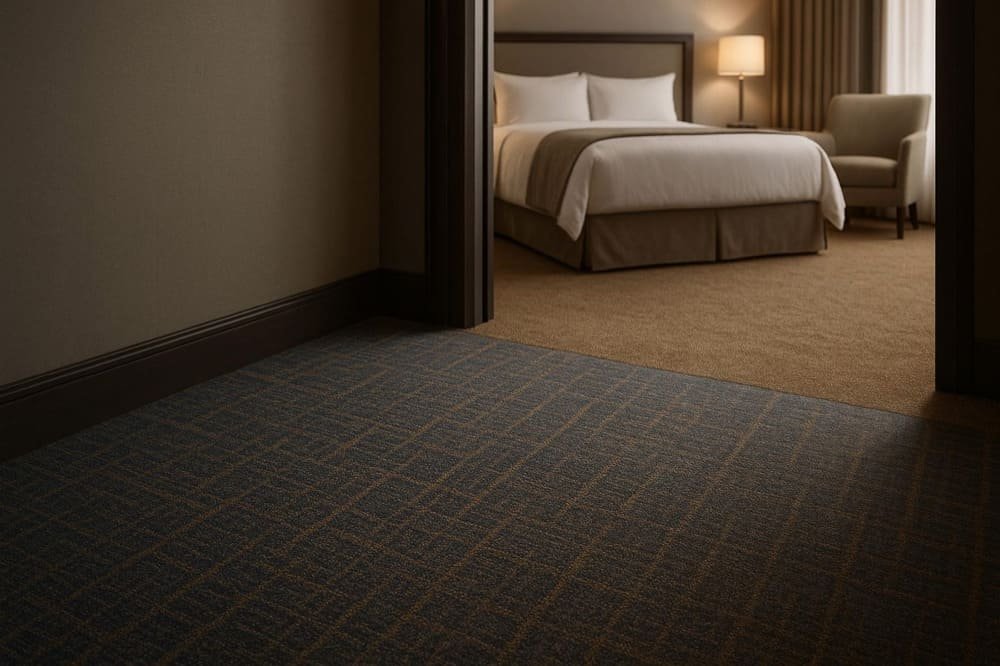
Hotel carpets do more than “set the mood.”
In guestrooms and corridors, they carry the load for comfort underfoot, acoustic control, durability, and safety compliance—while also translating a brand’s design language into pattern, color, and texture.
Getting the specification right early saves budget, reduces downtime, and keeps maintenance predictable.
What “hotel carpet” means in practice
A hotel carpet is a performance product engineered for specific zones and traffic levels. Its construction (woven vs tufted), fiber system (nylon, wool, blends), face weight, pile height, density, and backing all work together to meet durability and comfort targets.
- Construction: Woven Axminster and Wilton deliver precise pattern fidelity and dimensional stability; tufted broadloom offers cost-versatility and comfort; carpet tiles enable modular replacement. Authoritative hospitality overviews detail these use patterns and trade-offs, such as Bloomsburg’s guides to hotel carpet types and woven constructions in “The Top 5 Best Carpet Types for Hotels” (2024) and “Wilton vs Axminster Carpets” (2025).
- Fibers: Nylon is widely specified for resilience in corridors; wool and wool blends are favored in luxury woven programs for hand and acoustic behavior; solution-dyed synthetics improve stain and fade resistance. These patterns are consistent across manufacturer and hospitality resources.
Think of it this way: construction and fiber choices set the performance “ceiling,” while face weight, density, and backing tune how the carpet behaves in a guestroom versus a corridor.
Types used in hotels—and where they fit
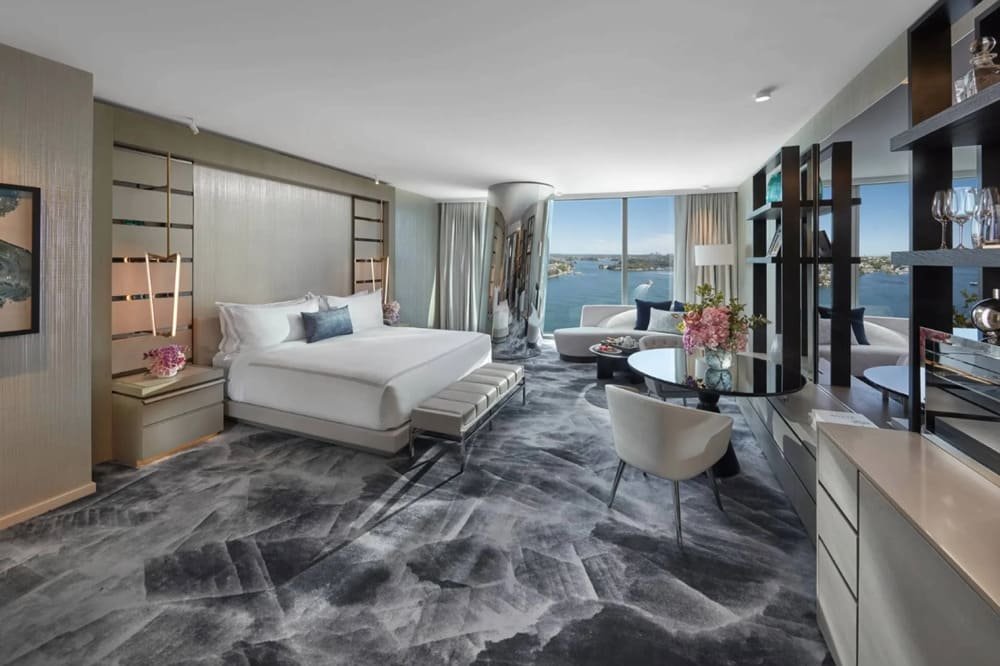
Axminster (woven)
Individually selected tufts under Jacquard control allow intricate, multi-color patterns with strong wear performance—common in upscale corridors or signature areas where pattern clarity matters.
Wilton (woven)
Continuous yarns create loops that can be cut, producing dense piles and excellent tonal control—often chosen for refined textures and consistent hand.
Tufted broadloom
Rows of needles drive yarn into a primary backing, stabilized with latex and a secondary backing. It dominates many guestrooms thanks to comfort, versatility, and cost efficiency.
Carpet tiles
Modular units (tufted or woven) designed for rapid replacement and phased maintenance in corridors or back-of-house zones where downtime must stay low.
Printed broadloom
Pattern applied by dye/print rather than woven placement—flexible for design, typically selected for decorative areas with moderate wear demands.
Read more about construction methods and hotel use cases in Bloomsburg’s hotel carpet overview (2024) and the woven comparison in “Wilton vs Axminster Carpets” (2025).
Guestroom vs corridor: performance, specs, and acoustics
Guestrooms prioritize comfort, a soft hand, and acoustic attenuation.
Corridors prioritize wear resistance, soil concealment, and low pile to reduce trip risk and improve cleaning speed.
Backing and underlay play a major role in both zones: cushioned systems under guestrooms can damp footfall noise; reinforced backings in corridors support dimensional stability and longevity.
Below are indicative specification bands used by procurement and design teams. Treat them as guidance and verify against manufacturer datasheets and local brand standards.
| Parameter | Guestroom | Corridor |
|---|---|---|
| Pile height | About 8–13 mm (3/8–1/2 in) | About 6–10 mm (1/4–3/8 in) |
| Face weight | About 24–32 oz/yd² (≈815–1085 g/m²) | About 28–36 oz/yd² (≈950–1220 g/m²) |
| Density (calc) | ≈2,500–3,500 lb/ft³ | ≈3,000–4,000 lb/ft³ |
| Backing | Cushion or IAQ-compliant latex/polyurethane | Reinforced, IAQ-compliant latex/polyurethane |
| Construction | Cut or cut-and-loop for comfort | Loop/multi-level loop for wear and soil hiding |
For federal/commercial specifications and sustainability criteria, the UFGS 09 68 00 (2024) carpeting guide provides a useful scaffolding for performance, IAQ, recycled content, and installation considerations.
Fire, safety, and compliance: what to check
United States
Interior floor finish classification in the International Building Code is organized under Chapter 8 and references ASTM E648 (Radiant Panel) for critical radiant flux. Class I is ≥0.45 W/cm² and Class II is ≥0.22 W/cm²; corridor and exit access requirements vary by occupancy and authority having jurisdiction (AHJ).
Many commercial carpets also document smoke density via ASTM E662 (often ≤450), and carpets/rugs must comply with 16 CFR 1630/1631 (methenamine pill test).
See the IBC 2024 Chapter 8 overview and the context provided in UFGS 09 68 00 (2024).
European Union
Reaction-to-fire classifications for floor coverings are defined in EN 13501-1. Hospitality projects commonly target Cfl-s1; Bfl-s1 represents a higher threshold.
The classes derive from EN ISO 9239-1 (radiant panel) and EN ISO 11925-2 (small flame).
A clear explainer is available in Measurlabs’ EN 13501-1 guide (2024), while durability classifications in EU contexts often reference EN 1307 contract classes, summarized in SisalCarpet’s commercial classification guide (2023).
Practical point: always confirm the target fire class and test method with your AHJ and brand standards. Manufacturers’ technical sheets typically list E648 class, E662 smoke values, and EN 13501-1 class for globally marketed SKUs.
Cleaning cadence and realistic drying windows (guestrooms and corridors)
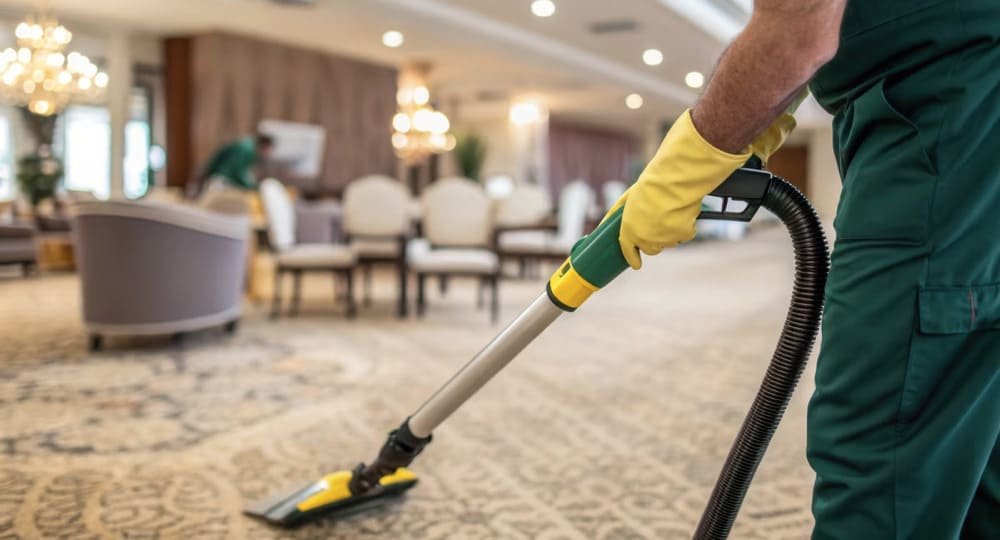
Routine maintenance does most of the work.
Proper vacuuming removes the majority of dry soil; industry guidance across hospitality programs emphasizes daily or near-daily vacuuming coupled with immediate spot treatment.
See Shaw Contract’s Marriott LATAM maintenance guidance for an operations-friendly overview.
Deep cleaning cadence depends on traffic and soil profile:
- High-traffic corridors/lobbies: monthly to quarterly deep cleaning.
- Guestrooms: typically every 2–3 months in busy properties.
- Whole-property cycles: often every 3–6 months, scheduled to minimize disruption.
These ranges align with hotel cleaning advisories such as Scher Flooring’s hotel cleaning guide (2025) and commercial cadence overviews like Stratus Clean’s frequency guide.
Drying time windows by method:
- Encapsulation (low-moisture): typically 30–60 minutes to dry, enabling frequent maintenance in guestrooms and avoiding corridor closures.
- Hot water extraction (restorative): plan for roughly 4–8 hours to dry; schedule overnight or off-peak windows to reopen floors by morning.
This split lets operations teams balance appearance retention with deeper soil removal on a predictable schedule.
Factory-direct customization for Axminster/Wilton: pattern, color, and approval
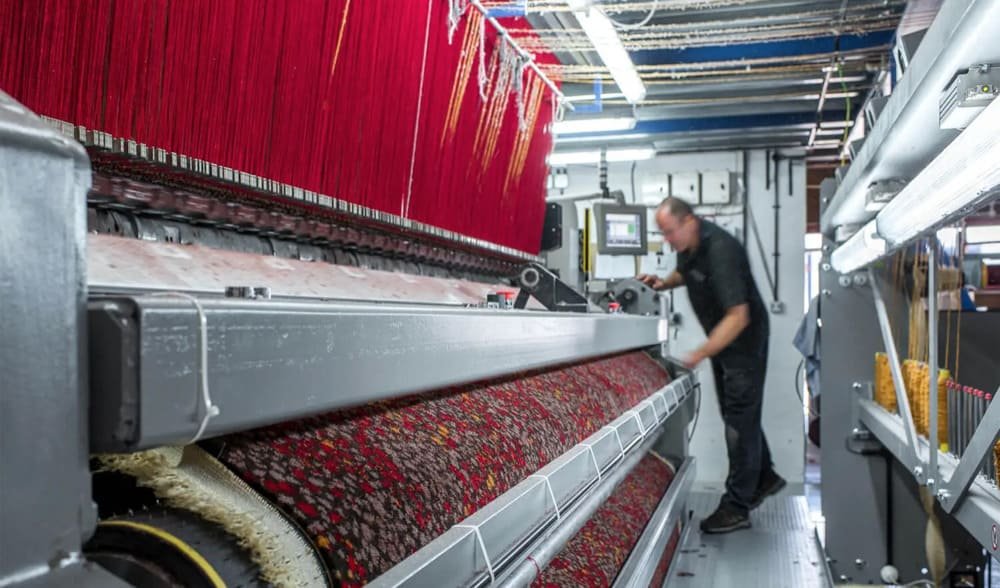
Custom woven programs shine when you need brand-specific pattern fidelity and color control.
Design scoping and color control
Axminster supports intricate multi-color patterns; Wilton often uses fewer colors but excels at tonal and texture uniformity.
Establish color references via lab dips and shade cards; engineer pattern repeats to minimize waste in typical room dimensions and long corridor runs.
For authoritative craft background and distinctions, see “What Is Axminster Carpet” (Bloomsburg, 2024) and “Wilton vs Axminster Carpets” (Bloomsburg, 2025).
Sampling and approval
Strike-offs (hand or loom trials) verify real weave, pile construction, and color accuracy before production.
Iterations may adjust shades or yarn lots until the approved panel meets the design and performance brief.
MOQ and lead time realities
Because of loom set-up and dye lot economics, custom woven projects frequently carry minimums in the hundreds of square meters/yards.
Typical lead times are on the order of 12–20 weeks from final approval to delivery, depending on pattern complexity and mill scheduling.
Regional examples from hospitality mills corroborate months-long cycles.
Spec-to-quote RFQ checklist: what to include

To receive accurate, comparable quotations, share a clear specification package. At minimum, include:
- Area schedule by zone (guestrooms, corridors) with square footage.
- Target construction and texture (Axminster/Wilton/tufted/tile; cut, loop, cut-loop).
- Fiber system (wool, wool blend, nylon, solution-dyed synthetic) and yarn count.
- Performance bands: pile height, face weight, density, gauge/stitch rate (acceptable ranges).
- Backing/underlay preferences and acoustic targets; installation method (direct-glue vs cushion).
- Compliance targets: U.S. ASTM E648 class, ASTM E662 smoke value, 16 CFR 1630/1631; EU EN 13501-1 class if relevant.
- Sampling and color approval steps (lab dips, strike-offs) and brand palette references.
- Logistics and phasing (lead time targets; delivery windows to minimize downtime).
Using a framework like UFGS 09 68 00 (2024) as a reference helps align sustainability, IAQ, and performance requirements across vendors.
Two quick hotel scenarios
Guestroom comfort uplift
A 4-star property targets quieter rooms after guest feedback on footfall noise. The team specifies cut-pile tufted broadloom at ~10 mm pile, ~28 oz/yd² face weight, cushioned backing, and low-VOC adhesive.
After installation, daily vacuuming plus monthly encapsulation keeps rooms in rotation with minimal downtime.
Corridor wear and downtime control
A busy mid-scale corridor needs dense, low-pile coverage that hides soil and dries fast after cleaning. The team selects multi-level loop construction ~7 mm pile, reinforced backing, and carpet tiles at pinch-points to enable rapid replacement.
Monthly encapsulation with overnight hot water extraction every quarter keeps the corridor open by morning.
Next steps
Disclosure: ChinaBestBuy is our product.
If you’re ready to get a specification-based quotation, share your project’s zone schedule, target construction (Axminster/Wilton/tufted/tile), fiber system, performance bands (pile height, face weight, density), backing/underlay preferences, and compliance targets (ASTM/EN).
We’ll review your spec, confirm practical ranges, and return a formal quote with fire rating documentation and delivery windows aligned to your phasing.