Hotel Remodeling Solutions: Practical Ways to Upgrade Hotel Spaces
The “Looks-Good-But-Hurts-Operations” Trap
If you manage hotel upgrades while staying open, the costliest mistake I see is aesthetic-driven renovation without operational sequencing. Designs that photograph beautifully can wreak havoc on phasing, service continuity, and MEP realities. Three patterns show up repeatedly:
- Finishes that require long curing times or heavy on-site fabrication turn “two nights per room” into week-long closures. Natural stone corridor flooring and site-built millwork are typical culprits.
- Non‑modular decisions (like wet wall bathroom rebuilds) disrupt plumbing cores and extend room‑out‑of‑order days.
- Architect‑only decisions made without early procurement and facilities input cause rework, punch‑list bloat, and guest complaints.
A practical example: swapping natural marble corridor floors for prefabricated SPC or large-format porcelain panels cuts install time dramatically—often near 3× less labor, with reduced dust, noise, and downtime. The result is not just a faster schedule; it is fewer operational headaches, cleaner work zones, and more rooms available.
Remodeling Philosophy (One Line)
“Guest‑first, zero‑downtime remodeling—designed for rapid install, long life, and minimal mess.”
This philosophy guides sourcing, sequencing, and logistics: upgrade faster, cleaner, and smarter—not just prettier. In practice, it means prioritizing dry systems, modular/pre‑finished components, night‑shift work, and installation‑sequence packing.
A Step‑by‑Step Upgrade Framework That Holds Up Under Occupancy
Below is the seven‑phase playbook I’ve used to refresh guestrooms, bathrooms, and corridors with minimal disruption.
Phase 1: Pre‑Planning
- Map renovation zones, e.g., 20 rooms per week in 3‑room clusters.
- Lock swing rooms to maintain occupancy and manage guest relocations.
- Pre‑approve mock‑up rooms and finish matrices before purchase orders.
- Tools: BIM coordination, visual boards, and a cross‑functional plan review with operations, engineering, and procurement.
Why this works: It prevents late design changes and sets realistic throughput targets aligned with staffing and guest load.
Phase 2: Pre‑Fabrication
- Source modular/pre‑finished items wherever feasible: wall panels, vanity kits, door sets, LED packages, case goods.
- Approve a Golden Sample before the bulk run; document every spec.
- Run in‑line inspections at ~30% and ~80% completion to catch defects early.
- Tools: Factory QA/QC with photo logs; floor/room packaging specs.
Evidence and rationale: Prefab and modular approaches consistently reduce onsite time and variability. Industry analyses report 20–50% schedule reductions in projects leveraging modular components, primarily in new builds/additions, with similar principles accelerating renovation workflows when adapted to dry systems, sequence packing, and off‑site fabrication—see the McKinsey modular construction report (2019).
Phase 3: Logistics Scheduling
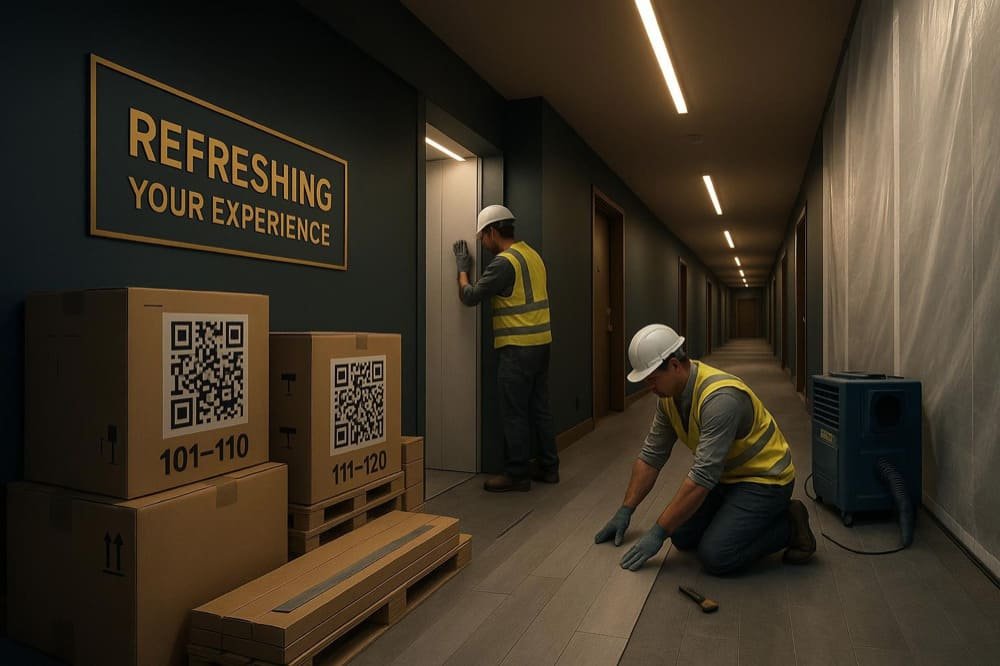
- Ship in installation sequence: pallet 1 → rooms 101–120; pallet 2 → rooms 121–140, etc.
- Use just‑in‑time containers with a buffer—avoid overwhelming the site or starving crews.
- Label everything with QR codes and zone/room IDs.
This reduces mis‑handling and speeds nightly setup. Experienced modular contractors emphasize logistics discipline as the hidden driver of schedule success.
Phase 4: Night‑Shift Installation
- Start after 10 p.m.; focus on dry systems only: click‑lock flooring, panelized walls, pre‑hung doors, LED kits.
- Deploy two‑shift rotations when feasible to compress timelines without overrunning quiet hours.
- Use negative‑air machines to contain dust; keep corridors serviceable by morning.
Contractor guidance across hospitality projects points to phased, off‑peak scheduling and careful isolation of work zones to maintain occupancy; night work, containment, and air scrubbing are common tactics to minimize disruption.
Phase 5: Dust & Noise Control
- Seal work zones; isolate elevators and stair cores serving the renovation floors.
- Add HEPA air scrubbers and vacuum attachments; maintain negative pressure.
- Post clear signage: “Refreshing your experience”—avoid the word “construction.”
- Train crews for compliance with OSHA’s respirable crystalline silica standard (29 CFR 1926.1153); dust control isn’t optional—see OSHA silica regulations (updated continuously; referenced here for 2025 compliance).
Phase 6: Guest Communication
- Coordinate digital notifications and in‑room messaging that frame activities as upgrades.
- Offer relocation to quieter zones if noise is expected.
- Provide an ETA: “Your floor upgrade completes by Thursday morning.” Transparency earns goodwill.
Phase 7: Turnover & Punch List
- Perform a daily inspection before morning opening.
- Run a shared cloud snag‑list with photos and owner/operator sign‑off.
- Keep a rolling punch list per cluster to avoid backlog.
With modular systems, a guestroom refresh—including select bathroom and corridor elements—can be turned in 48–72 hours under the right conditions (dry systems, sequence packing, night shifts, mock‑up freeze, trained crews). Public, peer‑reviewed case documentation at this speed is limited, but the target is achievable when the above controls are in place.
Fastest‑Impact, Least‑Disruption Categories (Factory‑Direct Sourcing)
These categories consistently deliver rapid install and high guest impact:
- Modular Bathroom Kits (30–45 days ex‑works): QC focus on water sealing and joint alignment; logistics: load per unit, protect fittings.
- Prefinished Doors/Frames (25–30 days): QC on edge banding and fire rating; logistics: stack vertically, foam separation sheets.
- SPC/LVT Flooring (15–20 days): QC on locking strength and flatness; logistics: ship by room batch.
- Acoustic Panels (20–25 days): QC for NRC and fire performance; logistics: keep dry, label by wall area.
- LED Packages (10–15 days): QC on color temperature consistency; logistics: pack by zone (corridor/room).
- Case Goods/Wardrobes (30–40 days): QC on laminate adhesion and hardware; logistics: cartonized, corner‑protected.
Quality checkpoints to institutionalize:
- Golden Sample approval before mass production.
- 30% and 80% in‑line inspections with photo logs.
- Final pre‑shipment QC with carton checklists and sealed packs.
- Installation sequence packing—never random bulk cartons.
Compliance & Risk Checklist: Prevent Expensive Rework
Compliance failures are schedule killers. Build these controls into the design freeze and QC.
- Fire Rating: For North America, reference ASTM E84 classifications (Class A/B/C) with flame spread and smoke indices; see the ASTM E84 official page (2021a). For Europe and international chains, align with EN 13501‑1 Euroclass A1/A2 to F and associated smoke/droplet criteria; see the EN 13501‑1:2018 standards portal. Always confirm brand standards and local jurisdiction requirements.
- ADA/Accessibility: For U.S. properties and brands, the 2010 ADA Standards require a minimum 32‑inch clear door opening (Section 404.2.3) and 60‑inch turning space (Section 304.3) in applicable areas; review alterations provisions in lodging contexts via the DOJ 2010 ADA Standards PDF.
- Slip Resistance: Avoid reliance on ASTM D2047 for wet areas. Use ANSI A326.3 DCOF guidance, commonly ≥0.42 for interior wet areas depending on conditions; authoritative overview via TCNA DCOF resource (2022). European projects can reference DIN 51130 ramp classifications (R9–R13) matched to exposure.
- Waterproofing: In bathrooms/showers, specify membranes compliant with ANSI A118.10 and follow TCNA wet area practices; see TCNA ANSI standards catalog for the A118.10 membrane reference.
- Acoustics (Corridors): While prescriptive hotel‑corridor NRC targets aren’t codified, practical guidance from WELL v2 encourages high‑NRC ceilings/panels to manage reverberation; see WELL v2 sound design overview. Use RT60 modeling via an acoustical consultant, and add carpet with underlayment and fabric‑wrapped panels to tame echo.
Approval protocol: Always submit a mock‑up room for owner + code consultant review before production release. In practice, this single step eliminates most downstream rework.
Case Example: Mid‑Scale Business Hotel (Southeast Asia)
- RevPAR: $68 → $84 (+24%) in 90 days.
- Guest Satisfaction (Booking.com): 7.9 → 8.7 (+10%).
- Maintenance cost: ‑18% annually.
- Energy use/room: ‑22%.
Scope and methods:
- Guestroom: Modular wall panels, prefinished doors, LED lighting package.
- Bathroom: Pre‑assembled vanity with quartz top, compact waterproof SPC flooring, anti‑scale shower glass.
- Corridors: Acoustic vinyl wallcovering and continuous linear LED strips.
Scheduling:
- Rooms executed in 3‑room clusters, 2‑night turnaround.
- Pre‑assembled FF&E shipped from China in sequence‑labeled cartons.
- No visible construction waste on site; dry systems only.
Sourcing and logistics:
- China factories pre‑packed sets room‑by‑room (QR‑coded) → local crews unboxed and installed without cutting or wet work.
Note: Results vary by market and segment. Industry research shows that well‑executed renovations typically lift ADR/RevPAR once construction noise subsides. For context, a documented case found NOI improved following renovation, with ADR/RevPAR exceeding pre‑renovation levels after completion; see the CoStar feature on an HVS hotel renovation case (2019). Reputation gains matter too—Cornell research associates online review improvements with rate and RevPAR gains; summarized in Travel Weekly’s coverage of the Cornell study (2014).
Example: How ChinaBestBuy Executes a Rapid Guestroom Refresh
ChinaBestBuy provides factory‑direct, modular sourcing tailored to occupied hotel renovations. Disclosure: This is an example of a provider approach; evaluate multiple vendors and verify compliance locally.
- Installation‑sequence packing: Cartons/pallets are labeled by floor and room (e.g., 101–120 → pallet 1), minimizing on‑site sorting and handling.
- QC milestones: Golden Sample approval, 30% and 80% in‑line inspections, and final pre‑shipment QC with carton checklists and photo logs.
- Dry‑system focus: Click‑lock flooring, panelized wall sets, pre‑hung doors, and LED kits shipped pre‑kitted per room.
- Night‑shift alignment: Materials arrive in weekly batches matched to a 2‑shift rotation; negative‑air machines and HEPA filtration keep guest corridors clean by morning.
- Guest‑first communication: “Refreshing your experience” signage replaces construction warnings; crews work behind containment with low‑noise tools.
In practice, this approach supports 48–72‑hour guestroom refresh targets when site conditions, staffing, and approvals are aligned.
ROI, Benchmarking, and Planning Assumptions
- Market context: 2025 outlooks suggest modest to flat RevPAR growth overall, with upper‑tier segments outperforming; properties that finish upgrades cleanly can capture ADR gains above local baselines. See the PwC US Hospitality Directions (May 2025) for macro trends.
- Reputation mechanics: Post‑renovation guest experience should be reflected in online scores; incremental increases in review ratings tend to support rate and RevPAR growth (as the Cornell study highlights). Plan for a communications and marketing push post‑completion to capitalize on refreshed product.
- Throughput planning: Model throughput as rooms‑per‑night based on installer count, material kitting accuracy, elevator access, and quiet‑hours windows. The most common bottlenecks are late design changes, mis‑labeled cartons, and punch‑list surprises.
Implementation Checklist You Can Use Tomorrow
- Freeze a materials matrix: Every surface finish, dimension, and packaging spec documented pre‑PO.
- Approve 1–2 mock‑up rooms and lock owner/code sign‑off before bulk release.
- Schedule weekly QC video calls with factories; validate batches before shipment.
- Align logistics: sequence‑packed pallets, QR labels, and JIT containers with a small buffer.
- Book night‑shift crews and define quiet‑hour boundaries; prep containment barriers and HEPA air scrubbers.
- Issue guest communications: digital notices and in‑room messaging framed as upgrades.
- Run daily punch‑list inspections before morning opening; track via a cloud snag‑list.
- Confirm compliance anchors: ASTM E84/EN 13501‑1 fire, ADA 2010 clearances, ANSI A326.3/DIN 51130 slip, ANSI A118.10 waterproofing, and acoustic targets validated by a consultant.
Trade‑offs and Applicability
- Modular vs. site‑built: Modular/dry systems accelerate timelines and minimize mess, but they require early design freeze and may constrain ultra‑custom finishes. Complex MEP and structure can limit prefabrication extent.
- Night work: Reduces guest impact but may raise labor cost; check local ordinances, union rules, and crew availability.
- Compliance variability: Jurisdictions and brand standards differ; always defer to local code officials and the brand’s technical services team.
- ROI variability: Outcomes depend on market strength, positioning, and the post‑renovation marketing plan. Benchmark against STR comps and your property baseline.
Common Pitfalls to Avoid
- Approving finishes without mock‑up and code consultant review—this alone causes most late changes.
- Skipping in‑line factory inspections (30%/80%)—defects discovered at delivery will derail night‑shift schedules.
- Random bulk packing—sequence packing is the difference between clean corridors and chaos.
- Choosing glossy tiles for wet areas—use ANSI A326.3/DIN 51130‑aligned selections for slip safety.
- Underestimating dust control—plan negative air, HEPA scrubbers, and OSHA‑compliant practices from day one.
Final Notes on Acoustics and Guest Experience
Corridor echo and footfall noise degrade perceived quality even after finishes are upgraded. Practical absorptive strategies—high‑NRC ceiling panels, fabric‑wrapped wall panels, carpet with underlayment, and well‑sealed door assemblies—will often deliver better guest sleep scores than one more layer of aesthetic trim.
Work with an acoustical consultant to set RT60 targets appropriate for your corridors; WELL v2 guidance can serve as a useful reference point during design development.
By centering operational sequencing, modular sourcing, compliance, and clean logistics, hotel teams can deliver high‑impact upgrades with minimal disruption. Start with two mock‑up rooms, lock the materials matrix, enforce QC, and communicate upgrades—not construction.