How Much Does It Cost to Furnish a House? 2025 Updated (Developers & Hospitality FF&E)
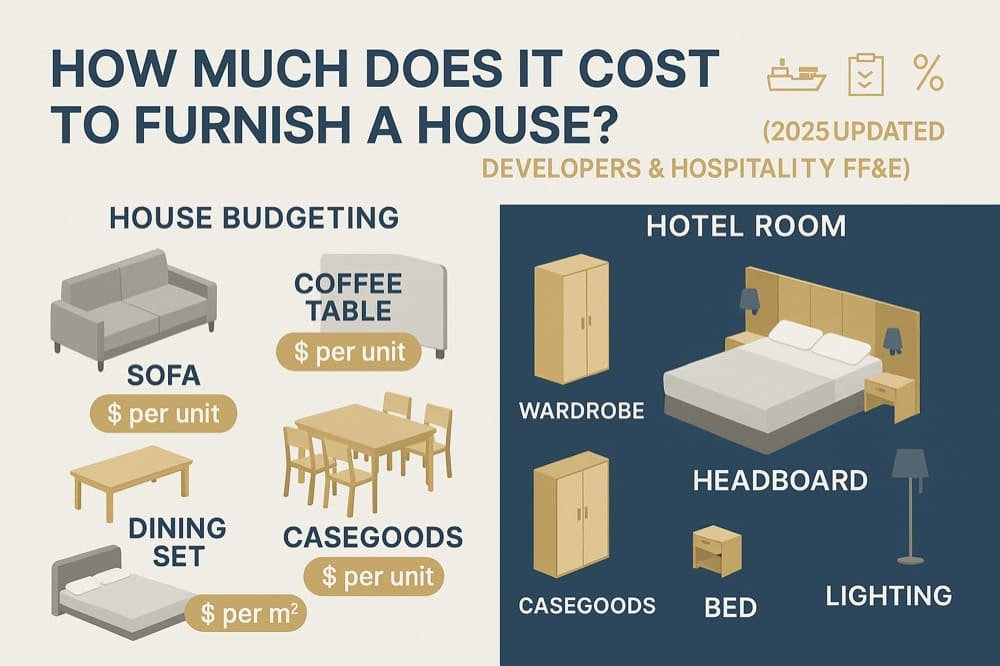
If you manage multi-unit residential, villas, or hospitality fit-outs, “How much will it cost to furnish?” isn’t a single number—it’s a model.
In 2025, that model needs to serve two tracks most project teams run in parallel:
- Furniture-only (loose furniture and soft furnishings)
- Full-house FF&E + built-ins (adds cabinets, wardrobes, doors, flooring, lighting, sanitaryware—and sometimes appliances)
In this guide, I’ll map both tracks using per-sqm and per-unit (and hospitality, per-key) budgets with mid/high/lux tiers.
We’ll also walk through the 80/20 cost drivers, China vs local sourcing math using a total landed cost lens, realistic lead times, QC checklists, and value engineering (VE) levers.
My goal is to help you build defendable budgets and avoid surprises—all in a single, practical reference.
Note: Headline ranges below exclude country-specific duties/taxes, on-site installation labor, and MEP or permitting costs unless stated. I’ll flag exclusions clearly so you can keep apples with apples.
What “furnish” means in a project context
- Furniture-only: Loose items you can move—sofas, beds, dining sets, side tables, wardrobes (freestanding), desks, seating, window treatments, rugs, wall art, mirrors, and basic lighting if it’s plug-in. Residential consumer guides commonly frame “furnishing a home” this way; for context, most U.S. homeowners reported total furniture-only spend around the mid five figures in 2025, with wide variance by quality level, according to the HomeAdvisor furnishing cost overview (2025).
- Full-house FF&E + built-ins: Adds fixed millwork and major interior finishes—kitchen cabinets, bathroom vanities, built-in wardrobes, interior doors, flooring, fixed lighting, sanitaryware, hardware, and sometimes appliances. These built-ins dramatically change the budget curve.
- OS&E vs FF&E (hospitality): OS&E covers consumables and operating supplies (linens, smallwares) and is separate from durable FF&E. This guide focuses on FF&E and built-ins, not OS&E.
Why this matters: A furniture-only budget can be 30–60% of a full-house package at the same quality tier. Built-ins and finishes often dominate both cost and risk.
The directional answer first (with caveats)
These 2025 ranges are directional for planning. Specifics depend on design complexity, material specs, compliance standards (e.g., fire safety), and logistics/duty regimes.
- Furniture-only (residential/multifamily):
- Mid: roughly $120–$220 per sqm; or $8,000–$18,000 per typical 70–90 sqm apartment
- High: roughly $220–$380 per sqm; or $18,000–$35,000 per 80–120 sqm unit
- Luxury: $380–$700+ per sqm; or $35,000–$80,000+ per villa depending on size/specs
- Full-house FF&E + built-ins (residential/villa):
- Mid: roughly $450–$800 per sqm
- High: $800–$1,400 per sqm
- Luxury: $1,400–$2,800+ per sqm (custom millwork, premium stones/metals, designer lighting)
- Hospitality per-key FF&E (ex-OS&E and ex-installation):
- Economy: low five figures per key
- Midscale: often around the low-to-mid teens per key
- Upscale: high teens to low five figures per key
- Luxury: frequently mid-five figures and can exceed $100k per key on high-spec projects
Trade guidance for hotel FF&E budgeting supports this span (e.g., a midscale complete FF&E program is often around the low teens per key, while luxury can climb dramatically), as discussed in Artone MFG’s hotel FF&E budget guidance.
Keep in mind that the HVS U.S. Development Cost Survey aggregates total development costs (far beyond FF&E), but it’s helpful for market context; see the HVS U.S. Hotel Development Cost Survey 2025 for category-level development trends.
We’ll unpack these numbers with assumptions next—and show how design choices, compliance, and logistics shift them.
Track 1: Furniture-only budgets (per sqm and per unit)
Think of furniture-only as “movables + softs.” In a developer or PM context, you want tiered targets and levers to dial up or down.
Typical inclusions
- Living: sofa, lounge chair(s), coffee table, side tables, TV console, media wall shelving (loose), rug, lamps, wall art
- Dining: table, chairs, sideboard/console, pendant (if plug-in) or table lamps
- Bedrooms: bed frames, mattresses, nightstands, dressers/wardrobes (freestanding), desk + chair, mirrors
- Soft furnishings: window treatments, rugs, cushions, basic decor
Tier models (directional 2025)
| Tier | Per sqm | Typical unit target (80–100 sqm) | Materials and design cues |
|---|---|---|---|
| Mid | $120–$220 | $12k–$20k | Laminate/veneer casegoods, engineered wood frames, standard fabrics |
| High | $220–$380 | $20k–$35k | Thicker veneers, better hardware, partial solid wood, branded upholstery |
| Lux | $380–$700+ | $35k–$70k+ | Solid wood, designer pieces, premium stones/metals, custom upholstery |
Context check: Consumer platforms put whole-house furniture-only spends commonly in the $10k–$40k band for average homeowners (U.S., 2025). That lines up with “mid/high” tiers for modest apartments but under-represents luxury or large villas; see the HomeAdvisor 2025 furnishing overview.
Developers and multifamily operators can often beat retail-equivalent costs by standardizing SKUs and purchasing at scale.
Example A — 85 sqm apartment, high tier
Assumptions: living + dining + 2 bedrooms, balcony set; engineered wood casegoods, partial solid-wood accents; mid-tier upholstery; standard lighting (plug-in), no built-ins.
- Target: 85 sqm × $280/sqm ≈ $23,800
- Sensitivity: +$3k if you upgrade fabrics to branded performance textiles; −$2k if you simplify accent pieces and reduce mirrors/wall art volume.
- Logistics: Add shipping/duties separately (see “Landed cost” section).
Example B — 120 sqm villa, luxury tier
Assumptions: living + dining + family lounge + 3 bedrooms; premium veneer casegoods; designer lighting (plug-in); custom rugs; statement stone coffee table.
- Target: 120 sqm × $550/sqm ≈ $66,000
- Sensitivity: +15–25% if you add signature designer pieces or natural stone tops widely; −10–15% if you standardize finishes and opt for engineered stone/HPL-alternative tops.
Pro tip: For multifamily rollouts, a prototype room mock-up and a “pilot purchase” for 3–5 units often surfaces 10–15% VE potential through hardware rationalization and finish consolidation before full-scale procurement.
Track 2: Full-house FF&E + built-ins (per sqm and per unit)
When you add millwork, doors, flooring, lighting, and sanitaryware, the budget steps up materially. Built-ins also introduce new compliance, packaging, and installation realities.
Scope inclusions (typical)
- Kitchens: cabinets, worktops, sinks, faucets, accessories
- Bathrooms: vanities, mirrors, shower enclosures, taps, WCs, accessories
- Bedrooms: built-in wardrobes with interior fittings, headboards (fixed where designed)
- Doors & hardware: interior door sets, handles, closers (project-dependent)
- Flooring: engineered wood, laminate, tile, or LVT with underlayment
- Fixed lighting: ceiling fixtures, downlights, wall sconces (wired)
- Loose furniture: all items from Track 1
Tier models (directional 2025)
| Tier | Per sqm (gross) | What drives the tier |
|---|---|---|
| Mid | $450–$800 | Modular cabinets, HPL/engineered stone, LVT/laminate floors, mid-grade sanitary |
| High | $800–$1,400 | Custom millwork areas, engineered/stone tops, engineered wood floors, branded sanitary/fixtures |
| Lux | $1,400–$2,800+ | Bespoke millwork, premium stones/metals, designer lighting, high-end sanitary suites |
Example C — 95 sqm apartment, high tier full-house
Assumptions: 1 kitchen (linear), 2 bathrooms (vanity + sanitary each), built-in wardrobes in 2 bedrooms, engineered wood floor in living/bedrooms, tile in wet areas, mixed fixed lighting.
- Target: 95 sqm × $1,050/sqm ≈ $99,750 (ex duties, installation labor)
- Composition (indicative): 28% cabinets/wardrobes, 20% flooring, 15% sanitary/fixtures, 12% lighting, 20% loose furniture, 5% hardware/misc.
- Sensitivity: ±12–18% driven by flooring upgrade/downgrade and kitchen length/finish swaps.
Example D — 220 sqm villa, luxury full-house
Assumptions: island kitchen with pantry, 4 bathrooms, extensive bespoke millwork, premium stones/veneers, designer lighting package, engineered wood floors with acoustic underlayment.
- Target: 220 sqm × $1,900/sqm ≈ $418,000
- Sensitivity: +$60k if natural stone is extended to secondary bathrooms and bedrooms; −$45k if you shift to engineered veneers and rationalize door hardware.
Implementation note: Installation labor, site readiness, and MEP coordination become critical. We’ll address buffers and QC later.
Hospitality: per-key FF&E benchmarks (not OS&E, not installation)
If you manage hotels, you likely budget “per key.” Trade literature often frames midscale FF&E around the low teens per room, with economy lower and luxury projects reaching well into the five figures per room depending on brand standards and casegoods complexity.
See Artone MFG’s hotel FF&E budget guidance for a manufacturer’s view on per-key FF&E spans and inclusions. Many owners also set aside reserves on the order of 15–25% to handle refresh and contingencies, as discussed in Artone’s FF&E reserve budgeting guidance.
For macro context on total per-room development costs across hotel classes in 2025 (note: this is total development, not FF&E), review the HVS U.S. Hotel Development Cost Survey 2025 and calibrate your FF&E share accordingly based on your brand and program.
The 80/20 cost drivers you can actually control
- Materials and finishes: Solid wood vs engineered, veneer thickness, finish type (HPL vs lacquer vs natural stone), upholstery fabric grade and performance specs.
- Compliance standards: Fire performance for upholstery/mattresses, electrical certifications (UL/CE/BS). Higher compliance can add cost but is not optional.
- Hardware and fixtures grade: Hinges/slides brand and cycle ratings; sanitary brands and cartridge types; lighting fixture housing materials and optics.
- Standardization: Shared SKUs across units/keys, modular cabinet widths, repeatable finish schedules.
- Engineering and packaging: Flat-pack feasibility, KD joinery, carton/foam selection; export-ready pack improves transport economics and reduces damage.
- Logistics and duties: Route, mode, and tariff exposure shift landed cost; see tariff and freight notes below.
Even before you go to market, freezing the spec strategy (e.g., “engineered-veneer casegoods + HPL tops”) will tighten bid spreads and compress schedule risk.
China vs local sourcing: total landed cost, not EXW price
Comparing suppliers by EXW alone is a trap. Use total landed cost:
- EXW (factory price)
- Inland trucking to port + terminal handling
- Ocean/rail/air freight + insurance
- Duties/tariffs + VAT/GST where applicable
- Customs/brokerage fees
- Last-mile delivery (to site) and inside delivery/handling
- Damage allowance (often 1–3% depending on packaging rigor)
Tariffs and taxes to watch in 2025 (examples)
- United States: Wood and derivative product import adjustments under Section 232 were formalized in late 2025; always verify your HS codes and current rates in the Federal Register, such as the Federal Register Section 232 proclamation (Oct 2025). In parallel, certain China-origin Section 301 exclusions were extended into late 2025; see the USTR 2025 press note on Section 301 exclusions. Some categories may face stacking of 232 and 301; consult your customs broker.
- European Union: MFN duty rates for many furniture categories remain low single digits under HS 9401/9403 (subheading-specific). VAT varies by member state (~17–27% typical); see the European Commission’s VAT overview table as a reference and confirm current local rates (e.g., EC VAT rates compendium).
Freight market and lead time context
Ocean transit times and freight rates move with capacity and demand. For a primer on timelines and cost components, see Freightos’ ocean freight explained.
In 2025, transpacific spot rates fluctuated but trended downward mid-year as capacity normalized, per Freightos’ weekly updates (e.g., July 29, 2025 FBX snapshot). Use buffers rather than fixed promises—more on schedule planning below.
Worked example — apples-to-apples comparison
Assume a 100-sqm high-tier apartment package with a $1050/sqm target for full-house FF&E + built-ins, produced in China.
- EXW subtotal: $105,000
- Inland + consolidation + insurance: $2,800
- Ocean freight (1×40′ HC, consolidated): $3,200 (illustrative; verify current quotes)
- Duties/taxes: U.S. landing, subject to HS and applicable 232/301; placeholder 10–25% blended on dutiable lines for modeling only (replace with your tariff lookup)
- Last-mile + inside delivery: $2,000–$5,000 depending on site
- Damage allowance: 1.5%
Now model a local/regional procurement:
- Local supply bid: +10–35% on comparable spec (varies by market)
- Lower freight and tariff exposure
- Faster lead times and easier installation coordination
Result: In markets with high local labor/material costs, factory-direct can retain a landed cost advantage even after duties; in other markets with moderate local pricing and high tariffs, the gap narrows or flips. The right choice is context-specific—run the math with your HS codes, origin, and destination.
Lead times and schedule planning (what to expect, where to buffer)
A realistic timeline for international sourcing:
- Design freeze and submittals: 1–3 weeks (complex packages can take longer)
- Sampling and approvals: 1–4 weeks (finish boards, prototype pieces where needed)
- Production: 4–12+ weeks depending on volume/spec
- Consolidation and pack-out: 3–10 days
- Ocean transit: China → U.S. West Coast ~23–30 days; East Coast ~32–40; China → EU ~30–45 (route-dependent)
- Customs clearance: 3–7 days typical
- Last-mile and site delivery/positioning: 2–7 days
I plan buffers at the interfaces: approvals, pre-shipment QC, and port/on-carriage. Avoid promising fixed days; rely on current forwarder guidance, and keep an escalation plan if you need air for small critical sets.
Quality control and packaging: where projects win or lose
QC is where you trade pennies for dollars in avoided rework and delays.
- QC checkpoints: Pre-production (drawings/spec verification, material checks), in-process (joinery, finish uniformity), and final (workmanship, dimensions, functional tests). AQL sampling plans (e.g., ISO 2859-1 General Level II; typical AQLs: Critical 0, Major 2.5, Minor 4.0) are common in furniture inspection practice; see an overview in HQTS’s furniture QC guide.
- Packaging and transport tests: Export cartons, edge/corner protection, moisture barriers, and palletization. Many buyers reference ISTA 3A distribution testing to simulate drops, vibration, and compression; for a practical overview of furniture inspection and packaging checks, see Tetra Inspection’s furniture inspection primer.
- Spares and damage allowance: Hold back 1–3% of finishes/hardware, and keep a small spares kit (hinges, pulls, touch-up kits) per building stack.
- Documentation: Inspection reports with photos, measurement logs, and corrective action summaries reduce disputes and accelerate replacements if needed.
Value engineering (VE) that preserves design intent
- Standardize dimensions and finishes: Shared cabinet modules, repeatable veneer species/stain, common hardware SKUs. This simplifies production and installation and typically reduces waste.
- Engineer for flat-pack where feasible: KD joinery, sub-assemblies, and on-site final fit can reduce freight cost and damage risk.
- Material substitutions with intent: Engineered veneers instead of solid wood for large faces; HPL/compact laminate or engineered stone instead of natural stone in secondary areas; performance fabrics vs designer-only textiles where specs permit.
- Rationalize lighting: Use families of fixtures with shared drivers/optics; specify output and CRI instead of brands where appropriate.
- Early VE reviews: Bring procurement into DD—late VE risks rework and supply shocks.
Expectation setting: VE often unlocks several points of savings without changing the look and feel, but the biggest wins come from standardization and scope clarity more than from single-line item swaps.
What headline budgets usually exclude (don’t get caught out)
- On-site installation labor and site readiness (hoisting, protection, waste removal)
- Duties, tariffs, VAT/GST (destination-specific) and customs/brokerage fees
- Last-mile inside delivery, white-glove handling, and assembly
- MEP, electrical wiring for fixed lighting, and any structural works
- Permitting and inspections not related to product conformity
- OS&E (hospitality supplies), IT/AV, and owner-furnished appliances (unless specified)
Put these as separate lines in your capex to avoid silent scope creep.
Putting numbers together: quick-reference budgeting tables
These tables are directional starting points for 2025 planning. Adjust for your market, tier, and sourcing path.
Furniture-only (residential/multifamily)
| Size | Mid | High | Luxury |
|---|---|---|---|
| 70–90 sqm unit | $8k–$18k | $18k–$32k | $32k–$60k+ |
| 100–130 sqm unit | $12k–$24k | $24k–$42k | $42k–$80k+ |
Full-house FF&E + built-ins (residential/villas)
| Per sqm target | Mid | High | Luxury |
|---|---|---|---|
| Directional 2025 | $450–$800 | $800–$1,400 | $1,400–$2,800+ |
Hospitality FF&E (per key, ex-OS&E, ex-install)
| Class | Directional 2025 |
|---|---|
| Economy | Low five figures |
| Midscale | Low-to-mid teens |
| Upscale | High teens to low five figures |
| Luxury | Mid-five figures to $100k+ |
Use these as guardrails, then customize with your BOQ and finishes schedule.
How to brief vendors for accurate, comparable quotes
To get an itemized, apples-to-apples quote within 48–72 hours, share:
- Floor plans and reflected ceiling plans (RCPs)
- Room schedules and counts (unit mixes or keys)
- Finishes and hardware schedule (identify acceptable alternates)
- Brand standards (if hospitality)
- Compliance requirements (fire, electrical, plumbing)
- Target tier and budget model (per sqm/per unit/per key)
- Delivery terms and site constraints (elevator size, delivery windows)
Ask vendors to separate:
- Loose vs built-ins
- Materials/finishes by family
- Packaging specs
- QC checkpoints and reporting format
- Logistics (Incoterms) and estimated freight
- Exclusions and alternates (VE options)
Practical lead-time playbook (buffers that actually help)
- Prototype early: Approve one “golden sample” per major category (casegoods, seating, cabinets) before mass production.
- Consolidation plan: If multiple factories are involved, align completion weeks so you’re not paying storage or split shipments.
- Seasonal risk: Golden Week, Lunar New Year, and year-end surges impact capacity—build 1–2 week buffers around these periods.
- Mode mix: Reserve air for critical small lots (e.g., replacement parts, key fixtures). Keep most volume on ocean.
- On-site readiness: Pre-stage installation tools, protection materials, and waste management; coordinate with MEP to avoid rework.
For deeper logistics context and terminology, Freightos’ primer is a useful reference: Freightos ocean freight explained.
Checklist: risk management and QC gates
- Factory capability: Audit or reference checks before PO
- Pre-production meeting and submittals approval
- AQL plan set (levels and defects defined in PO)
- In-process inspection on first-off and 20–30% progress
- Pre-shipment inspection with carton drop/stack checks
- Packaging spec signed-off (ISTA 3A-style sequence where relevant)
- Container plan (weight balance, stack order, fragile zones)
- Spares and touch-up kits packed and labeled
- Photo logs and measurement sheets attached to inspection reports
These checkpoints reduce the incidence and severity of issues far more than “hoping QC at the end will catch it.”
FAQs
1. Why do my furniture-only quotes vary 2× for the same brief?
Likely different material/hardware assumptions, or different compliance (e.g., FR foams). Ask vendors to declare substrates, veneer thickness, hardware brands, and FR ratings.
2. Can I mix China factory-direct built-ins with locally sourced loose furniture?
Yes, but watch finish matching, hardware spec alignment, and warranty boundaries. Consider sending local vendors a finish/control sample set.
3. How much contingency should I carry for FF&E?
Many hotel owners carry a 15–25% FF&E reserve over project life. For initial fit-out, I often carry 7–12% contingency on procurement packages, depending on design maturity and logistics volatility; calibrate to your risk tolerance and contract type.
Next steps: get a customized, itemized quote in 48 hours
If you have floor plans and a preliminary finishes schedule, you can accelerate budgeting now. Upload your drawings and a material list to request a line-item quote and VE alternates.
- First step: Send your unit mixes/keys, tier target (mid/high/lux), and any brand standards.
- What you’ll receive: An itemized BOQ with loose vs built-ins, QC checkpoints, packaging specs, and a landed cost breakdown (EXW → duties → last mile) with clear assumptions, typically within 48 hours.
Ready to proceed? Visit ChinaBestBuy to request your customized quote.