How to Buy Bar Cabinets from China (for hotel/bar chain procurement managers)
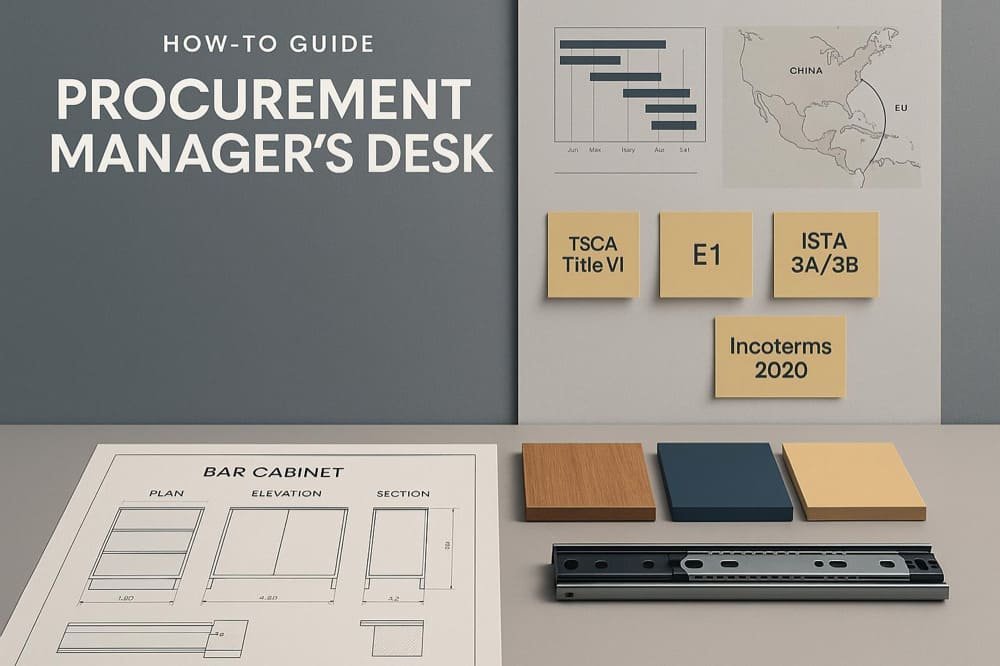
If you manage procurement for a hotel or bar chain, this guide gives you a complete, repeatable workflow to source custom bar cabinets from China—controlling lead times, coordinating multiple SKUs/finishes, and arriving damage‑free. Expect to move from drawings/BOQ to delivered product with clear verification points at each phase.
Difficulty: advanced (cross-functional). Typical duration: 12–20 weeks ex‑factory to site, depending on finishes, routing, and buffers.
Step 1: Gather a complete spec package (and lock what matters)
Do this before you approach factories. Incomplete specs are the top driver of delay and rework.
Prepare and consolidate:
- Drawings: plan, elevation, sections, and exploded views with joinery; show internal carcass material (HWPW/PB/MDF), moisture‑resistant MDF for wet zones, edge banding, and tolerances (miter, reveal, alignment). Include anchoring details and service access panels.
- Finish schedule: substrate, veneer species, stain code, topcoat (lacquer vs HPL/laminate), gloss level (GU), texture, metal trims (material + finish like powder coat or PVD), stone top details (thickness, edge profile, sealer requirement), and any glass components.
- Hardware schedule: hinges and drawer runners (request manufacturer test reports aligned to DIN EN 15338 categories), pulls/locks, soft‑close expectations, corrosion resistance for wet areas.
- Function and MEP: shelf and drawer load requirements, lighting specs (LED type, drivers, wiring paths), power/cable routing, ventilation clearances for refrigeration/ice modules.
- Accessibility (public-facing bars): Map counter heights/lengths to 2010 ADA requirements for sales and service counters; confirm forward/parallel approach and knee/toe clearance where applicable. See the Access Board’s Chapter 9 overview and the DOJ 2010 Standards text to verify the exact dimensional obligations before you finalize drawings (United States, 2010) — refer to the Access Board’s concise chapter page in the sentence “ADA 904 sales and service counters” and the DOJ’s full “2010 ADA Standards PDF” for authoritative language: U.S. Access Board — Chapter 9 overview and DOJ — 2010 ADA Standards.
- Compliance documents by market:
- United States: Require composite wood substrates to meet TSCA Title VI emission limits via EPA‑recognized TPCs; confirm finished‑goods labeling responsibilities and recordkeeping (EPA, 2024). The EPA maintains detailed guidance in its “Frequent Questions” page: EPA — TSCA Title VI formaldehyde FAQs. For rule text and labeling specifics, see eCFR — 40 CFR Part 770.
- European Union: Specify E1 emissions as baseline with a lab report referencing EN 717‑1 or EN 16516; if an “E0” target is requested, define the numeric value and the test method in the contract (market term, not a harmonized class).
Verification before RFQ
- Confirm every item above is present in a “Spec Completeness” checklist and signed by design/procurement.
- Require initial finish plaques (substrate + stain + topcoat) and hardware line items for sign‑off before issuing a PO.
Common pitfalls and how to avoid them
- Late decisions on metal trims and lacquer finish level extend lead time; set a material/finish freeze date and stick to it.
- Missing ventilation/power details for under‑counter equipment cause rework; include manufacturer cut sheets in the spec pack.
Step 2: Vet factories and sample like a pro
Shortlist suppliers with proven casegoods capability and hospitality references.
Evaluate suppliers on:
- Licensing & export readiness; TSCA/E1 compliance experience; ability to supply EPA TPC certificates from panel vendors.
- Finishing lines (dust‑free lacquer booths), veneer press capability, and reliable metal finishing partners.
- Capacity and cadence (monthly output; typical lead times), recent hotel roll‑outs, and sample room/mock‑up capability.
Specify your sampling plan:
- Engineering sample: Focus on joinery, edge treatment, and section details with tolerance sheet (miter/reveal/alignment). Define pass/fail.
- Finish plaques: Approve color, gloss (in GU), and texture on the actual substrate; measure and log plaque IDs.
- Hardware samples: Request manufacturer test reports showing conformity to drawer runner/hinge durability categories (DIN EN 15338 context), plus corrosion tests where relevant.
- “Golden sample”: Assign a unique ID, label, and storage protocol; both parties retain a sealed reference.
How to verify
- Capture photo/video evidence of samples with measurement points and gloss readings.
- Reject or rework if color delta‑E exceeds your agreed threshold vs the golden sample.
Step 3: Contracting & Incoterms 2020 — lock responsibilities and risk transfer
Choose Incoterms deliberately and put the details in writing (rule + version + named place/port + documents + insurance + inspection responsibility). For a concise, ICC‑aligned explainer of responsibilities and risk transfer, see this practitioner guide to Incoterms 2020: Asiaction — Incoterms 2020 complete guide.
Typical choices and what they mean for you
- FOB [Origin Port]: Seller loads on board and clears export. You book ocean freight and handle import; risk transfers on board at origin.
- CIF [Destination Port]: Seller books ocean freight and minimum insurance (Institute Cargo Clauses C). Risk still transfers on board at origin; expect destination charges on your side.
- DDP [Your Site]: Seller bears import clearance and delivery; high admin burden for the seller; ensure they can legally act as importer and handle taxes locally.
Payment milestones and quality gates
- Tie deposits, mid‑payments, and balance to tangible gates: sample approval, first‑article, pre‑shipment inspection (PSI) pass, and proof of compliant packaging.
Filings to plan around (roles vary by lane)
- ISF 10+2 (U.S. importers) must be filed at least 24 hours before loading; AMS (carrier/NVO) and ENS (EU carriers) rely on accurate data handoff. Consult CBP guidance on ISF timing and EU customs pages for ENS context: CBP — ISF overview and European Commission — Customs security/ENS.
Step 4: Control production across multiple SKUs and finishes
Coordinate like a program, not a single PO.
Implement these controls:
- Master matrix: Build a finish and hardware matrix across all SKUs. Publish freeze dates and a change‑order protocol with cutoffs.
- Weekly Gantt: Track critical path (e.g., carcasses → veneer press → finishing → metal trim fit‑up → top installation). Require time‑stamped photo/video evidence at each station.
- Parallel processing: Run carcasses, stone/solid surface tops, and metal trims in parallel to compress the schedule.
- First‑article approvals: Approve one complete unit per SKU before mass run.
If the schedule slips >7 days
- Activate a parallel finishing line for the longest‑path SKUs.
- Re‑sequence batches to start with the bottlenecked finishes.
- For demo/mock‑up rooms, consider air shipping a small subset while the main lots go by ocean.
Example workflow: Coordinating multi‑SKU finishes and consolidated shipping
In a typical 6‑SKU bar cabinet package with two finish families and shared hardware, many buyers coordinate engineering, PSI, and consolidation through an operator.
One option is to use ChinaBestBuy to align the master finish matrix across factories, run a consolidated PSI on a single day (sampling from each SKU family), and load into one FCL with pallet maps matching site sequencing.
The micro‑workflow
- Week 0–1: Freeze finish/hardware matrix; confirm sample IDs and delta‑E thresholds.
- Week 2–5: Parallel carcass/veneer/metal trim processes with weekly evidence packs.
- Week 6: First‑article approvals by SKU; corrective actions logged.
- Week 7: Consolidated PSI (dimensions, finish, hardware function, packaging conformity) with AQL 0/2.5/4.0; defects reworked before load.
- Week 7–8: Load plan by room/phase; prepare documentation pack (commercial invoice, packing list, TSCA labeling evidence for U.S., ISPM 15 pallet certs).
Step 5: Pre‑shipment inspection (PSI) — agree acceptance criteria up front
Scope your PSI to catch show‑stoppers before loading.
Include these checks with measurable thresholds:
- Dimensions & alignment: Verify against drawings; door/drawer reveals within tolerance; plumb/level checks.
- Finish quality: Color match vs golden plaque; record gloss units; adhesion/scratch checks; no dust nibs or orange peel.
- Hardware function: Smooth travel; soft‑close works; cycle sampling for drawers/hinges; torque on fasteners.
- Load tests: Shelves and pull‑outs hold specified loads without permanent deflection beyond limit.
- Electrical: Lighting/wiring function; correct voltage/polarity where applicable.
- Safety edges: No sharp corners; uniform edge radii.
- Labeling and compliance: For U.S. destinations, confirm finished‑goods TSCA Title VI labels and documentation retention (EPA, 2024) per the federal rule text: eCFR — 40 CFR Part 770.
- Packaging conformity: Inspect against your ISTA plan (materials, inserts, corner/edge protection, desiccant, humidity indicators, palletization).
Sampling method
- Apply ANSI/ASQ Z1.4 with typical AQLs: 0.0% critical, 2.5% major, 4.0% minor (adjust to brand standards). For a practical furniture checklist layout, see the 2024 guidance from an inspection provider: Pro QC — Furniture inspection quality control checklist.
Pass/fail and evidence
- Require a PSI report with photos, measurements, and a defects log; release balance only after corrective actions are verified.
Step 6: Engineer the packaging to survive the route
Damage rates above ~2% on arrival usually trace back to under‑engineered cartons or pallets.
Design the packout to an ISTA‑appropriate procedure:
- Protocol selection: For individually shipped parcels, use ISTA 3A; for palletized mixed loads, use ISTA 3B; furniture shippers often validate to ISTA 2C for partial simulation. For a primer on these test families, see this independent lab overview: DDL — ISTA package testing overview.
- Materials: Specify double or triple‑wall cartons; custom EPS/foam; MDF/ply face protectors; corner boards; edge guards; straps and wrap to prevent abrasion; humidity control (desiccant, indicators). Drop/compression/vibration parameters should align with the chosen ISTA profile.
- Pallets and crates: Ensure wood packaging meets ISPM 15 (HT 56°C/30 min); verify IPPC marks on two sides and supplier license details. The IPPC publishes the core requirements: IPPC — ISPM 15 regulation.
Validation and troubleshooting
- Require an ISTA test report/pass certificate for the exact pack design. If transit damage exceeds 2%, upgrade board grade, add corner posts, increase foam density, and re‑run the ISTA drop sequence before next shipment.
Step 7: Plan logistics, buffers, and filings
Book space early, align documentation, and buffer around peak seasons.
Typical ocean transit windows (subject to routing disruptions)
- China → U.S. West Coast: ~20–35 days; China → U.S. East Coast: ~30–55 days; China → North/West Europe: ~30–45 days. See the sea‑freight guide and timeliness trackers for current ranges (Maersk 2023; Flexport ongoing): Maersk — Sea freight guide and Flexport — Ocean Timeliness Indicator.
Buffers and coordination
- Add 7–14 days around late‑summer peak and Chinese New Year. Book vessels at least two weeks before ex‑factory.
- For multi‑SKU sets, consolidate to FCL when possible; label cartons and pallets by room/phase to match site readiness.
Filings to double‑check
- U.S.: ISF 10+2 (importer/agent) ≥24 hours pre‑load; AMS (carrier/NVO). EU: ENS (carrier). Keep data consistent across all filings and documents.
Step 8: Landed cost, HS codes, and U.S. tariff watch (2025)
Build a transparent landed‑cost model so stakeholders understand what’s included.
Landed cost components
- EXW/FOB unit price + tooling + compliance testing + inspections + packaging upgrades + origin drayage + ocean freight + insurance + destination THC/port/handling + duties/tariffs + customs brokerage + last‑mile delivery.
HS codes (examples — confirm with your broker)
- Wooden bar cabinets (non‑kitchen) often fall under heading 9403.60 (Other wooden furniture). Parts can fall under 9403.91 (Of wood), depending on material and function. Consult the U.S. ITC HTS pages for headings and notes: USITC — HTS 9403.60 and USITC — HTS 9403.91.
Tariff awareness (United States, late 2025)
- A 2025 presidential proclamation adjusted imports of timber, lumber, and certain derivative products, with impacts noted for categories including kitchen cabinets/vanities and some furniture segments, effective Oct 14, 2025 (future increases scheduled in 2026 unless modified). Always confirm your product’s HTS subheading coverage and current rates with your customs broker before contracting. See the official text: White House — Sept 29, 2025 proclamation on wood products and a contemporaneous trade analysis summarizing effective dates: Supply Chain Dive — Oct 2025 tariff coverage.
Step 9: Delivery, handover, and punch‑list closeout
Line up closeout so turnover is smooth and sites open on time.
Deliverables to require
- As‑built drawings and materials list; finish plaques and hardware references; maintenance guides and cleaning agents.
- Spare kits: hinges/runners, pulls, fasteners, touch‑up paints/pens, and a small stock of critical panels/trim.
- Warranty and claims: Define photo evidence, time windows, and decision SLAs; confirm process for replacement parts (ocean vs air for critical items).
On‑site checks
- Inspect for transit damage immediately; photograph cartons before opening if external damage exists.
- Validate unit IDs vs room schedule; note defects on a punch list with severity and corrective action owners.
Troubleshooting quick answers
- Finish color variance (ΔE above threshold): Pause shipment or quarantine affected batch; re‑finish a subset, re‑measure gloss units, re‑approve plaque; implement stricter mixing/curing logs for the next run.
- Hardware failures (cycle tests under spec): Switch to an alternative model with a documented test report; pilot on 10 units, then roll out.
- Packaging damage rate >2%: Upgrade board grade (e.g., double → triple wall), add corner posts/edge guards, increase foam density, and re‑run the ISTA test for the exact packout.
- Schedule slip >7 days: Add a parallel finishing line; prioritize longest‑path SKUs; consider air shipping for mock‑up or critical opening sets.
What to do next
If you have drawings and a BOQ ready, consolidate them into a single email or folder and include any finish plaques you’ve already approved. If you prefer an operator to coordinate the finish matrix, inspections, and consolidated shipping, you can engage ChinaBestBuy.
Upload your drawings/BOQ for a consolidated quote, and request sample/PSI/packaging options in the same message so your lead‑time plan is complete from day one.