How To Import Construction And Building Materials From China
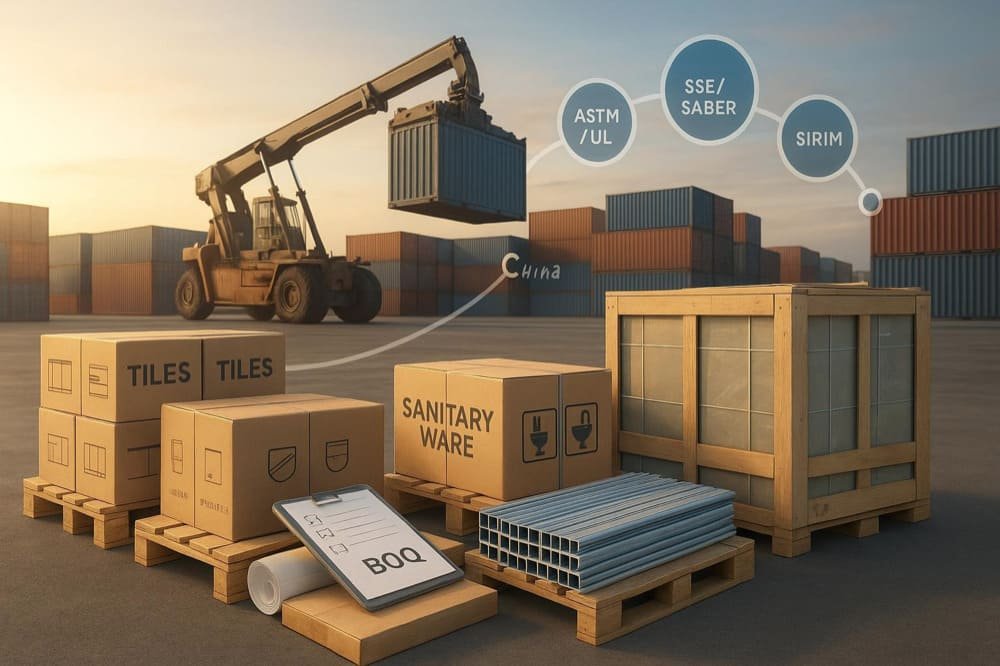
Importing construction and building materials from China can be straightforward when you run it like a controlled project: clear specifications, vetted factories, locked samples, documented compliance, and disciplined logistics.
This step-by-step guide is written for Procurement/Supply Chain Directors and Project/Construction Managers who manage multi-SKU orders and strict delivery deadlines. Expect a pragmatic workflow from BOQ to site delivery, with special attention to quality consistency and international standards compliance.
- Difficulty: Intermediate (familiarity with basic procurement helps)
- Time to implement: 3–8 weeks for routine commodities; longer if certification/testing is required
- Prerequisites: A clean BOQ, target market(s) identified, internal approval on budget ranges, and preferred Incoterms risk posture
Step 1: Prepare a clean, compliance‑ready BOQ
Your BOQ is the blueprint for everything that follows—pricing, quality control, compliance testing, packaging, and logistics.
What to include
- Product names and item codes tied to drawings where applicable
- Dimensions, materials, finishes, performance specs (e.g., fire rating, acoustic rating, slip resistance)
- Applicable test methods and standards (e.g., ASTM, EN/ISO, CE categories, UL where relevant)
- Quantities, delivery batches, and required delivery windows
- Acceptance criteria (tolerance, color/texture range, defect thresholds)
- Packaging and handling requirements (carton strength, corner protectors, moisture control, palletization)
Tips
- Where you’re unsure which standard applies, state the functional requirement (e.g., R‑value, fire class, VOC limits) so suppliers can propose test standards.
- Separate “must‑meet” requirements from “nice‑to‑have” to keep options open and costs manageable.
Watch out for
- Vague specs (e.g., “tile, gray”) create price noise and QC disputes. Be precise about grade, finish, caliber, and performance.
Step 2: Map HS codes and compliance early (by destination market)
Resolve classification and conformity requirements before you source. It prevents costly rework.
Actions
- Assign preliminary HS codes to each BOQ line and verify with your customs broker. Use the official tariff schedule to sanity‑check descriptions via the USITC HTS search.
- Identify compliance pathways per destination:
- United States: Typical reliance on ASTM/UL tests as specified by code or project, plus standard customs documentation and valuation.
- European Union: Determine if your product falls under the Construction Products Regulation (CPR). The updated framework is in the EUR‑Lex text of Regulation (EU) 2024/3110; many obligations apply from 2026, but DoP/CE principles remain central.
- Saudi Arabia: Check the SABER platform for regulated categories and required certificates (PCoC/SCoC) at SABER’s portal.
- Malaysia: Check SIRIM/CIDB requirements for regulated building materials at SIRIM QAS — Building Materials.
Why this matters
- HS accuracy drives duty/VAT and screening for trade remedies; compliance mapping drives your testing plan, labels, and paperwork.
Watch out for
- Misclassification causes delays and penalties. Keep technical sheets ready to justify your HS choice.
Step 3: Build a supplier shortlist and vet factories
Go beyond price. You need capacity, consistency, and traceability.
Vetting checklist
- Legal legitimacy: business license, export license, ownership and site address
- Quality system: evidence of QMS (e.g., ISO 9001), incoming/raw material controls, batch coding/traceability
- Capacity and lead times: real production capacity, peak‑season behavior, tooling constraints
- Past export record: reference customers, test reports relevant to your standards (ASTM/EN/UL, etc.)
- Social/environmental compliance if required by your client
How to verify
- Conduct a remote audit (video walk‑through, document review) followed by an on‑site audit for critical categories.
- Request raw material provenance and supplier certs; confirm that the same inputs will be used in mass production.
Watch out for
- Trading companies posing as factories. A site audit and production flow review typically reveals the truth.
Step 4: Sampling and lock the golden sample
This is your anchor for quality consistency.
Actions
- Issue sample orders with the exact specs and finish expectations; request batch identification.
- Test samples against your stated standard(s) where applicable.
- Approve a “golden sample” and seal/sign across joints or use tamper labels. Store one with you and one at the factory.
- Document first‑article approval criteria and permissible variances.
Why this matters
- Golden samples and first‑article sign‑off prevent drift between sample and mass production.
Watch out for
- Factories substituting materials post‑sample to cut costs. Tie raw material specs to the PO/contract and inspect early during production.
Step 5: Contract and choose Incoterms 2020 deliberately
Align trade terms with your need for control, visibility, and cash‑flow.
Common choices
- FOB: You control freight and insurance; risk transfers on loading. Good for buyers with strong forwarders/brokers.
- CIF: Seller arranges carriage and minimum insurance to destination; risk still transfers at loading.
- DDP: Seller handles import customs and delivery to your named place. Highest convenience, least visibility.
If you need definitions and risk transfer points, review the ICC’s Incoterms 2020 overview.
Contract tips
- Embed your quality plan: DPI timing, FRI/AQL levels, packaging specs, rework/chargeback terms, and documentary requirements (test reports, certificates).
- Stage payments to milestones (e.g., deposit → DPI pass → FRI pass → SCoC issuance → balance).
Watch out for
- DDP with unknown intermediaries may hide duties/taxes in opaque fees and limit your compliance visibility.
Step 6: Plan the compliance program by market
Build a document pack and testing plan tailored to where the goods will be used.
United States (documentation/valuation)
- Typical entry docs: commercial invoice, packing list, B/L or AWB, certificate of origin (if relevant). Many entries are filed via a broker in ACE under the Importer of Record’s bond.
- Bonds: Commercial imports generally need a customs bond; see CBP’s rules in 19 CFR Part 113 and CBP guidance on bond sufficiency. For orientation, review CBP’s bond guidance reference.
- Classification and valuation: Use USITC HTS; ensure transaction value is declared with proper additions/exclusions. Your broker can reference CBP rulings for tricky items.
European Union (CPR — CE/DoP)
- Determine if your product has a harmonised EN or requires an ETA (EOTA route). For the EOTA route and voluntary CE scope, see the European Commission’s note on the EOTA route for CE marking.
- Prepare a Declaration of Performance/Conformity and CE marking when applicable. The updated legal basis is in the EUR‑Lex text of Regulation (EU) 2024/3110. Keep language versions aligned to target Member States. Importer obligations include verifying conformity and keeping technical documentation available.
Saudi Arabia (SABER — PCoC & SCoC)
- Register product and category on SABER, confirm applicable technical regulations, and obtain Product Certificate of Conformity (usually valid for one year) from an accredited body. Then obtain a Shipment CoC per shipment before arrival via the SABER portal.
Malaysia (SIRIM/CIDB)
- For regulated building materials, certification via SIRIM QAS and approvals via CIDB may be required prior to importation or market entry. Start with SIRIM QAS — Building Materials and confirm whether a CIDB Certificate of Approval applies to your category.
Document pack (keep organized by PO and destination)
- Test reports tied to the exact product and factory
- DoP/CE files (EU), SABER PCoC/SCoC (Saudi), SIRIM/CIDB certs (Malaysia)
- Labels/artwork in required languages and formats
- Broker instructions with HTS and valuation notes
Watch out for
- EU shipments lacking a DoP/CE when required can be stopped by market surveillance. Confirm the standard and the notified body role early.
Step 7: Oversee production and run staged inspections
Inspections catch variance before it becomes a shipment‑wide problem.
Recommended cadence
- DPI (During Production Inspection): when 20–30% is complete, validate process controls, materials, and early samples.
- FRI/PSI (Final Random Inspection): when ≥80% is finished and packed, inspect appearance, dimensions, performance where possible, labeling, and packaging.
Sampling plans
- Use AQL‑based sampling (e.g., ISO 2859‑1). As a starting point, many teams set Critical 0, Major ~2.5, Minor ~4.0 and adjust by risk. See ISO’s general explanation of ISO 2859‑1 sampling for the concept.
Packaging specifics for fragile items
- Tiles and stone: thicker cartons, corner/edge protectors, shrink wrap; palletize with banding and corner boards.
- Sanitary ware and glass: custom foam inserts, drop‑test protocol, tilt/shock indicators if needed.
- Wood packaging: ensure pallets/crates comply with ISPM 15; more below.
Watch out for
- Sample-to-mass deviations: lock raw material specs and verify during DPI. If FRI fails, rework and re‑inspect before loading.
Step 8: Pre‑shipment testing, labeling, and certificates
Do not load until the compliance pieces are in place.
Actions
- Complete any required lab tests (ASTM/EN/UL/SASO/SIRIM). Ensure labs are accredited and recognized where the certificate will be used.
- Generate and verify labels/markings (e.g., CE, Arabic labels, importer details) per destination rules.
- Compile certificates: DoP/CE file for EU, SABER SCoC for KSA, SIRIM/CIDB approvals for Malaysia, plus general shipping docs.
- Cross‑check that invoice, packing list, and certificates match model numbers and descriptions.
Watch out for
- Last‑minute changes to SKUs can invalidate certificates. Freeze product codes before applying for PCoC/SCoC or similar.
Step 9: Book logistics, manage consolidation, and prepare for customs
Choose mode and build a container that travels well.
Mode and consolidation
- FCL: More control and lower risk of damage/contamination. Ideal for heavy or high‑volume materials.
- LCL: Useful for smaller lots but higher handling frequency; reinforce packaging.
- Multi‑factory consolidation: Align ex‑works readiness dates; consider a consolidation hub for unified FCL loading.
Moisture and handling
- Use desiccants and humidity indicators for moisture‑sensitive goods. Apply “no stack” cones when boxes aren’t designed to be stacked.
Customs prep
- Ensure importer registrations and bonds are in place (e.g., a U.S. continuous bond for frequent entries per 19 CFR Part 113).
- Wood packaging must meet ISPM 15: heat‑treated or fumigated and marked with the IPPC stamp on at least two sides. For scope and marking rules, see the IPPC/FAO’s ISPM standards index.
Watch out for
- Non‑ISPM 15 pallets lead to holds or re‑export. Verify marks before loading.
Step 10: Inbound receiving and project hand‑over
Treat receiving as your final quality gate.
Actions
- Conduct inbound AQL sampling focused on transit damage, labeling, and spec‑critical dimensions/finishes.
- Record variances with photos and keep packaging for carrier claims if needed.
- File certificates and reports in your project QA pack; hand over DoP/CE, SABER/SIRIM/CIDB docs, and warranties to the project team.
Watch out for
- Skipping inbound checks under schedule pressure. Undetected defects at site create costly rework and claims later.
Practical example: consolidating across factories and markets
For multi-SKU hospitality or residential projects, you might consolidate tiles, sanitary ware, lighting fixtures, and aluminum profiles from several factories into one FCL while managing CE documentation for EU projects and SABER SCoC for a parallel shipment to Saudi Arabia.
A sourcing partner such as ChinaBestBuy can help coordinate factory audits, lock golden samples, schedule DPI/FRI, arrange accredited testing for EN/ASTM where required, and handle document collation for SABER SCoC before loading.
This approach keeps one QC plan across suppliers, centralizes packaging specs, and reduces duplication of testing for identical SKUs going to different markets (when the same production lot is used and destination rules allow).
Troubleshooting quick answers
- Customs hold for HS doubts: Provide technical data sheets, photos, and prior rulings if available; ask your broker to request supervisory review.
- EU market surveillance query: Share your DoP and CE technical file promptly; confirm the harmonised EN or ETA route used and your notified body involvement if applicable.
- SABER SCoC not issued in time: Stop loading; resolve with your Conformity Assessment Body and ensure all documents and Arabic labels match the SABER entries.
- Inbound damage: Document immediately, keep packaging, and notify the carrier within the claim window. Review packing specs for reinforcement before next shipment.
Checklist you can reuse
- BOQ finalized with standards, acceptance criteria, and packaging specs
- HS codes pre-mapped and verified with broker
- Factory vetted and audited; capacity and QMS confirmed
- Golden sample sealed; first-article criteria documented
- Contract includes QC milestones, AQL, packaging, rework terms
- Compliance plan set: DoP/CE (EU), SABER PCoC/SCoC (KSA), SIRIM/CIDB (MY), U.S. entry docs and bond
- DPI and FRI scheduled; AQL sampling plan defined
- Pre-shipment tests passed; labels and certificates in hand
- Logistics booked; ISPM 15 pallets checked; desiccants packed
- Inbound inspection planned; QA pack archived for hand-over
Next steps
If you’re mapping a multi-SKU import for an upcoming project, gather your BOQ, target markets, desired Incoterms, and any known standards (ASTM/EN/UL). Then have your broker pre-check HS codes while you start supplier vetting.
If you’d like expert help, you can submit your BOQ for a complimentary professional review; a team like ChinaBestBuy can assess compliance pathways, propose cost-saving alternates, and outline a QC and consolidation plan aligned to your schedule.