How to Import Sanitary Materials from China: Eliminating Hidden Landed Costs for 50–300 Bathroom Projects
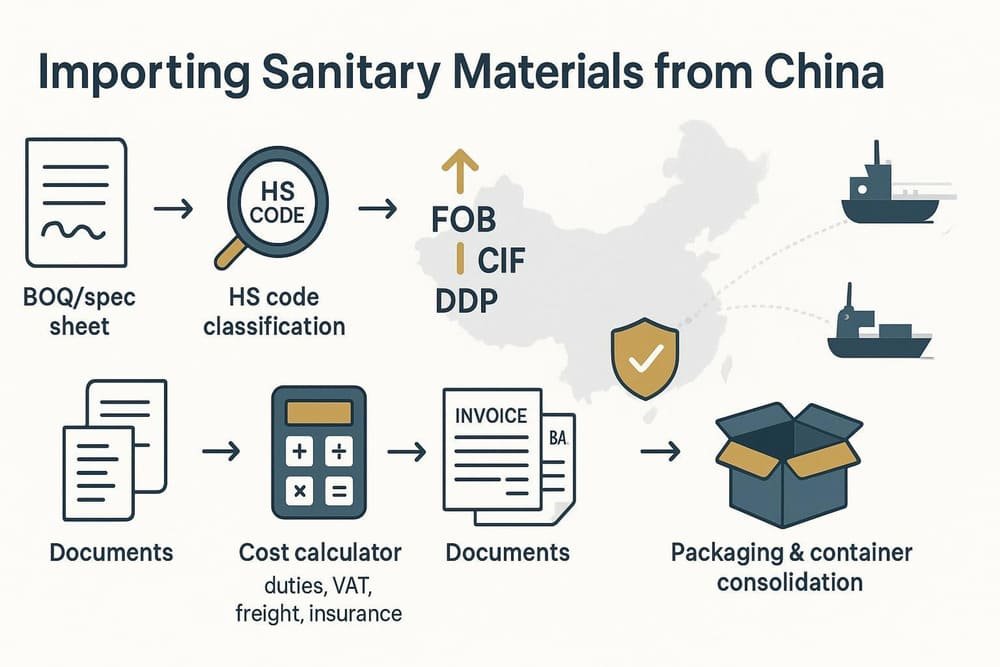
If you manage 50–300 bathrooms for a hotel, apartment, mall, hospital, or residential project, importing sanitary materials from China can protect margins—if you eliminate hidden landed costs.
This how-to guide shows you, step by step, how to classify HS codes correctly, choose the right Incoterms, calculate true landed cost, prepare compliant documents, and package/consolidate for damage-free delivery.
Follow the checkpoints, and you’ll avoid surprise duties, port fees, demurrage/detention, or documentation penalties.
- Who this is for: procurement managers and project engineers at general contractors/fit‑out firms handling multi‑line BOQs (ceramics, faucets, vanities, hardware, tiles).
- What you’ll achieve: a defensible landed cost estimate (±5–10%), a correct Incoterms choice, a clean document pack, and a container plan aligned to your installation schedule.
- Difficulty: intermediate. Time required: 1–2 working days for initial setup per project BOQ; 2–4 hours to finalize once suppliers confirm specs.
Step 1: Build a clean BOQ/spec pack (your import foundation)
Do this before you request quotes or place POs.
- Consolidate scope by room type and quantity: toilets, basins, faucets, showers, mixers, tubs, vanities, mirrors, accessories, tiles, drains, traps, stainless sinks.
- For each line, add: drawings/photos, material, finish, dimensions, pressure/flow requirements, mounting type, SKU or reference, packaging requirements, certification needs (e.g., local plumbing code approvals), and target delivery window.
- Separate fragile items (ceramics, glass mirrors) from metal/plastic components for packaging and AQL planning.
- Mark any destination compliance needs (UPC/cUPC, WRAS, WaterMark). Requirements vary by country—confirm locally with your AHJ or licensed plumber.
Verification checkpoint
- The BOQ item name, model/spec, and unit of measure match how you expect them to appear on invoice and packing list later.
Common pitfall
- Vague product descriptions lead to HS misclassification and customs queries. Use technical terms and photos.
Step 2: Classify HS codes correctly—lock duties before PO
Accurate HS classification is the fastest way to prevent duty surprises, anti‑dumping exposure, and clearance delays.
Typical sanitary headings to evaluate (confirm subheadings in your destination tariff):
- Ceramic sanitary fixtures (e.g., WCs, washbasins, cisterns): HS 6910. See the USITC’s Chapter 69 listing in the 2025 publication under the entry for ceramic products: USITC HTS Chapter 69 (2025, ceramic products). Canadian tariff users can cross‑check the 2025 chapter view at the Canada Border Services Agency: CBSA Chapter 69 (2025, ceramic products).
- Plastic sanitary ware (baths, basins, seats, cisterns): HS 3922. Verify in your national tariff portal for precise subheadings and rates.
- Stainless steel sinks and other sanitary ware of iron or steel: HS 7324. Confirm applicable subheadings nationally.
- Taps, cocks, valves (bathroom faucets, mixers): HS 8481—bathroom faucets often fall under 8481.80; parts under 8481.90. For a structured view of 8481 trade and subheadings, see Flexport HS 8481 taps and valves.
How to classify confidently
- Obtain technical specs and materials for each BOQ line.
- Check your destination’s official tariff portal (e.g., USITC, EU TARIC, CBSA).
- Align invoice/packing descriptions to match the HS scope language.
- If uncertain, consult a licensed customs broker and consider requesting a binding ruling where available.
Verification checkpoint
- Record HS code per line on your BOQ and include source notes (portal, broker email, ruling ID). Keep this record with your PO.
Common pitfalls
- Confusing ceramic sinks (6910) with stainless sinks (7324).
- Classifying faucets under “parts” instead of complete appliances.
Step 3: Choose the right Incoterms for your capacity and risk
Incoterms define cost and risk boundaries. A wrong choice can shift hidden costs to you.
- FOB: Seller clears export and loads goods on the vessel; buyer controls main freight and insurance; risk transfers on board. See the International Chamber of Commerce’s overview of Incoterms 2020 responsibilities: ICC Incoterms 2020 overview.
- CIF: Seller books main freight and provides minimum insurance to the port of destination; risk still transfers at loading; buyer handles destination charges and import clearance.
- DDP: Seller bears all costs/risks to deliver cleared for import to the named destination; buyer unloads. For practical buyer responsibilities by term, see the U.S. International Trade Administration’s guidance: Know Your Incoterms (trade.gov, 2025). For DDP specifics and caveats, compare TradeFinanceGlobal’s DDP explainer and AIT Worldwide’s DDP overview.
Decision helper
- Choose FOB if you have strong forwarder relationships and want freight visibility and control.
- Choose CIF if you want the seller to handle main carriage but you can manage destination fees and customs.
- Choose DDP if your team lacks import compliance capacity and you require door delivery with taxes/clearance handled—verify the seller can legally act as importer where required.
Verification checkpoint
- State Incoterms 2020 term and named place/port on the PI/PO (e.g., “FOB, Ningbo, Incoterms 2020”).
Common pitfalls
- Assuming CIF covers all destination terminal handling—typically it does not. Budget for THC and local delivery separately.
Step 4: Calculate true landed cost—no surprises
Use this formula and verify each component.
Landed Cost = Product Cost + International Freight + Insurance + Duties/Trade Remedies + VAT/GST + Customs Brokerage/Clearance + Port/Terminal Handling + Inland Trucking + Documentation/Admin + Inspection/QC + Contingencies (demurrage/detention/storage)
Authoritative breakdowns of landed cost components are outlined by trade experts in 2024–2025: see Global Trade Magazine – Managing Landed Costs and Visco – Components of landed cost.
Planning ranges (validate locally)
- Insurance: ~0.3–0.5% of CIF value (coverage and route dependent).
- Duties: varies by HS and country (5–25%+). Verify on national tariff portals or with a licensed broker.
- VAT/GST: typically 5–20% applied to a taxable base defined by your country.
- Customs brokerage: fixed fee or ~0.1–0.5% of value.
- Terminal handling/port fees: often several hundred USD per container; check port schedules.
- Inspection/QC: ~0.5–2% of product value depending on scope.
Worked example (illustrative numbers for one 200‑bathroom project)
- Product cost (FOB): $280,000 for ceramics, faucets, accessories, vanities.
- Ocean freight (FCL, 2×40’HC): $5,600.
- Insurance (0.4% of CIF ≈ $1,150).
- Duties (average 8% across blended HS): $22,400 (verify by HS and destination).
- VAT/GST (say 10% on taxable base as defined locally): ~$31,000 (example only; compute per your regime).
- Brokerage/clearance: $950.
- Destination THC and port fees: $1,200.
- Inland trucking to site: $2,800.
- Documentation/admin/courier: $250.
- Inspection/QC (AQL + pre‑shipment): $3,000.
- Contingency (D&D risk buffer): $1,500. Estimated landed cost ≈ $350,850. Divide by 200 bathrooms to benchmark per‑bathroom landed cost. Adjust inputs to your project.
Verification checklist
- Confirm duty rates by HS code and country using official portals; attach screenshots to your file.
- Confirm VAT/GST rules for the taxable base and reclaimability with your tax advisor.
- Ask your forwarder for a written quote that itemizes ocean/air, surcharges, and terminal fees.
- Validate insurance coverage scope (ICC A or equivalent), valuation basis, and exclusions.
Step 5: Prepare a clean document pack—avoid customs holds
Create, review, and cross‑check documents before cargo readiness.
Required documents (typical)
- Commercial invoice with HS codes, Incoterms, currency, full consignee, and accurate product descriptions.
- Packing list with carton/pallet counts, weights, and dimensions.
- Bill of lading (or AWB) with shipper/consignee, notify party, and Incoterms reference.
- Certificate of origin if preference or local rules require it.
- Insurance certificate (if applicable).
- Test/certification docs if required by destination plumbing codes.
According to the U.S. International Trade Administration’s guidance on import documentation (2024–2025), completeness and consistency across invoice, packing list, transport document, and certificates are essential for smooth clearance: see trade.gov’s Import Requirements & Documentation.
Cross‑check matrix
- Descriptions, quantities, unit of measure, HS codes, and Incoterms match across invoice, packing list, and B/L.
- Party names and addresses are consistent and correct.
- Dates align to your intended ETD/ETA.
Troubleshooting
- If customs queries HS, provide technical sheets, photos, and prior rulings; engage your broker promptly.
Step 6: Engineer packaging and consolidation for fragile goods
From experience, most cost blow‑ups come from damage or poor consolidation—not just duties.
Packaging specifications
- Cartons: double‑wall corrugated (ECT 44+), foam or molded pulp inserts, edge/corner protectors.
- Moisture: desiccants, poly liners; VCI for metal finishes.
- Pallets: ISPM‑15 heat‑treated; full shrink wrap and strapping with edge protectors; avoid overhang.
- Labeling: match BOQ line IDs, HS code references, and room/area where feasible to speed receiving.
Testing cues
- For parcel‑like packs or small units, consider ISTA 3A; for unitized loads, ISTA 3E. Have your factory perform drop/vibration tests and retain reports.
Consolidation & container planning
- Align ETDs across factories; if they drift, consolidate at an origin warehouse and run a pre‑packing inspection.
- Use the CTU Code principles for container blocking/bracing; plan load sequencing by installation schedule.
- Decide FCL vs LCL per volume: for 50–300 bathrooms, aim for FCL to reduce handling and damage risk.
Internal deep dives to publish and reference later
- For detailed export packaging practices for sanitary goods, see our upcoming guide: export packaging for sanitary items.
- For logistics and consolidation workflow specifics, see: logistics and consolidation workflow.
Step 7: QC/AQL and pre‑shipment inspection—prevent rework costs
Apply ISO 2859‑1 AQL sampling suitable for fragile and functional items.
- Suggested thresholds (tune to risk): Critical 0–0.1%; Major 1.5–2.5%; Minor 4.0–6.5%.
- Ceramic checks: cracks, chips, glaze defects, dimensions, water‑tightness.
- Faucet checks: valve function, pressure/leak tests, finish/abrasion.
- Packaging audit: carton strength, inserts, labels matching BOQ.
Inspection timing
- Pre‑packing or during loading for consolidated containers to verify labels and palletization.
Internal deep dives to publish and reference later
- For a step‑by‑step sanitary AQL guide, see: quality inspection for sanitary materials.
- For a customs/document checklist template, see: customs and documentation checklist.
Step 8: Prevent demurrage/detention and terminal fee surprises
Demurrage and detention are carrier‑defined penalties that can erase savings. Maersk explains the differences and prevention strategies in their 2023–2025 logistics explainers: see Maersk demurrage/detention guide and their FAQs on free time and charges: Maersk D&D FAQs.
Prevention checklist
- Pre‑clear documents and submit to your broker before vessel arrival.
- Arrange truckers and delivery appointments early; monitor ETA.
- If risk is high, negotiate extended free time with carriers or terminals.
- Ensure container load plans allow quick devanning without extra handling.
If delays occur
- Escalate with your forwarder and terminal; request fee mitigation if delays were outside your control and documented.
Practical example: From BOQ to one consolidated RFQ (and back to landed cost)
Here’s how one mid-size project team turns a 180-bathroom package into a defensible landed cost and a clean shipment plan.
- BOQ/spec pack is cleaned with HS assumptions and certification notes per line.
- Suppliers quote per HS line; you verify rates on your national tariff portal.
- You select FOB for freight control and request a single forwarder quote itemizing ocean, surcharges, and THC.
- You run AQL and packaging specs, align ETDs, consolidate at origin, and finalize the container plan.
- You assemble the invoice, packing list, B/L, COO, and insurance certificate for pre-clearance.
If you prefer a single partner to orchestrate these steps, ChinaBestBuy can consolidate your BOQ across ceramics, faucets, and accessories, align HS verification with your broker, and prepare the export documentation and packing/consolidation plan.
Next steps
- Finalize your HS codes and verify duty/VAT on your destination portal or with a licensed broker.
- Choose FOB, CIF, or DDP based on your team’s capacity and risk profile.
- Request one consolidated RFQ from your BOQ/spec list to streamline pricing, packaging, and logistics planning. You can upload your BOQ and request a packaged quote here: Request a consolidated RFQ from your BOQ/spec list.
Tip: Save your landed cost worksheet and document cross‑check matrix as templates for all upcoming projects.