How to Remove and Prevent Bathroom Ceiling Mould (Commercial & Multi-Unit Projects)
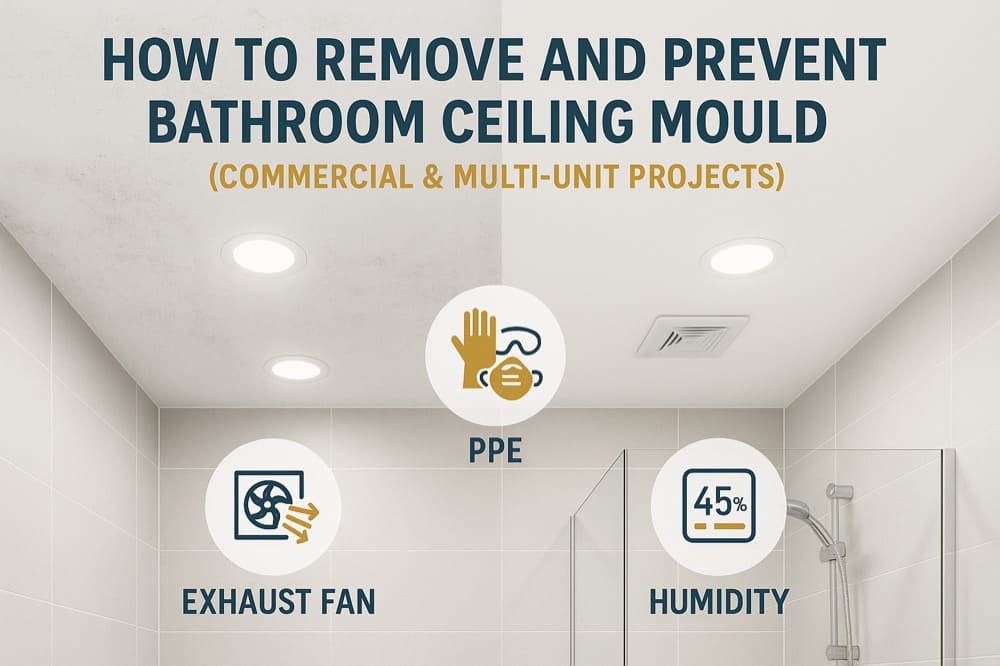
Bathroom ceiling mould is more than a cosmetic issue—it signals excess moisture and inadequate ventilation. In multi‑unit or commercial properties, isolated fixes rarely last unless you pair safe removal with system‑level prevention you can standardize across units.
This guide gives you a step‑by‑step SOP, clear decision thresholds, and procurement‑ready prevention measures for consistent results.
- Difficulty: Moderate for small areas; professional remediation advised beyond small patches
- Time: 1–3 hours per bathroom for small cleanups, plus drying and verification
- Prerequisites: Basic PPE, access to exhaust fans and electrical controls, ability to repair minor leaks
- Works best for: Small mould areas on ceilings and nearby surfaces; for large or recurring issues, escalate to certified remediators
Before You Start: Safety, Scope, and Decision Thresholds
- Put on PPE: wear gloves, goggles, and at least an N95/FFP2 respirator. Guidance from the U.S. Environmental Protection Agency (EPA, 2024) and the Centers for Disease Control and Prevention (CDC, 2024) emphasizes this minimum protection per EPA A Brief Guide to Mold and CDC Mold Clean Up.
- Isolate the area if feasible: increase ventilation; keep occupants out until cleanup completes.
- Fix moisture sources first: leaks, failed seals, or exhaust fans that don’t vent outdoors must be repaired before cleaning. As EPA notes (2024), moisture control is the cornerstone of mould control per Mold Cleanup in Your Home.
- Don’t mix chemicals: never mix bleach with products containing ammonia; toxic fumes can result, per EPA guidance (2024).
- Decide whether to escalate:
- If the contaminated area is larger than about 10 square feet, recurrent, or you suspect hidden moisture, engage certified remediation professionals. EPA remediation guidelines for schools and commercial buildings support escalation beyond small areas; see EPA Remediation Table (PDF, 2024).
Step‑by‑Step Removal (Small Areas)
1. Identify and repair moisture sources
- Inspect for plumbing or roof leaks, failed caulk or grout, and inadequate exhaust. Repair these before any cleaning to avoid immediate regrowth.
2. Prepare the space
- Enhance ventilation (open windows if available; run the exhaust fan if it vents to exterior). Protect nearby finishes and fixtures; cover or remove items below the ceiling.
3. Clean non‑porous surfaces (tile, glass, metal, some painted finishes)
- Scrub with a mild detergent and water; rinse and dry thoroughly. EPA guidance (2024) recommends detergent and water for hard surfaces per Mold Cleanup in Your Home.
- For stubborn staining on painted ceilings, consider repainting after full drying and primer; do not rely solely on paint to “kill” mould.
4. Handle porous or absorbent materials (ceiling tiles, standard drywall, insulation)
- Remove and discard visibly mouldy or water‑damaged porous materials; double‑bag, seal, and dispose per local rules. EPA notes porous materials may need removal when mouldy per Mold Cleanup in Your Home (2024). Industry standards such as IICRC S520 reinforce removal of contaminated porous materials; see IICRC S520 overview (2024).
- Replace with moisture‑resistant assemblies as part of prevention (see next section).
5. Dry thoroughly within 24–48 hours
- Use fans and dehumidification if needed; verify dryness with a moisture meter. EPA training materials recommend drying promptly to inhibit regrowth; see EPA Mold Course (Chapter 9, 2024).
6. Verify immediate success
- Visual: no visible mould or staining remains.
- Odour: no musty smell.
- Measurements: indoor relative humidity (RH) ideally ≤50% and always <60%. EPA and CDC both advise keeping RH in the 30–50% range and below 60% to discourage mould per EPA Mold Course (2024) and CDC Mold Prevention (2024).
Prevent Recurrence: Ventilation, Materials, and SOPs You Can Standardize
A. Ventilation and Humidity Control
- Vent to exterior only: ensure bathroom fans discharge outdoors, not into attics or interstitial spaces. EPA advises routing moisture outside per Moisture Control basics (2024).
- Size the exhaust fan correctly:
- For bathrooms up to 100 sq ft, a common rule is about 1 CFM per square foot. Larger rooms often require fixture‑based sizing (e.g., add 50 CFM each for toilet, shower, tub; 100 CFM for jetted tubs) as summarized in housing ventilation references and consumer guides like HVI Bathroom Exhaust Fans guide and DOE/industry summaries.
- Code minimums are typically 50 CFM intermittent or 20 CFM continuous for bathrooms in many jurisdictions; confirm local code and standards summarized by DOE and ASHRAE references such as DOE Energy Saver ventilation (2024) and Building America resource guide.
- Control moisture after use:
- Run the fan during showers and for 20–30 minutes afterward. In high‑use facilities, consider 30–60 minutes or humidity‑sensing controls set around 50–60% RH.
- Choose quiet, efficient fans (ENERGY STAR labeled) with ≤2 sones for intermittent use. ENERGY STAR’s 2024 specification covers sound and efficiency; see ENERGY STAR Ventilating Fans v4.2 (2024).
- Ducting and installation tips
- Use rigid, smooth duct where possible; minimize bends; seal joints; insulate ducts through unconditioned spaces; confirm termination is outdoors. Multifamily guidance such as NYCHA Design Guidelines for Exhaust Fans highlights proper venting and controls.
- Monitor humidity
- Install RH sensors in representative units and bathrooms; aim for 30–50% routine RH and keep it under 60% at all times. Review logs monthly and trigger corrective action if RH persists above target.
B. Materials and Coatings for Ceiling Durability
- Moisture‑resistant ceiling surfaces
- Consider non‑porous panels (PVC, fiberglass‑reinforced, aluminium) in high‑use bathrooms; they are easier to clean and resist moisture ingress.
- Where using drywall, specify mould‑resistant products within approved assemblies and ensure proper sealing at penetrations.
- Caulks and sealants
- Use silicone caulks with mildewcides around ceiling penetrations and trim; inspect and re‑seal annually in high‑use settings.
- Anti‑mould coatings
- Apply ceiling paints/coatings formulated with mildewcides. Follow manufacturer data sheets for surface prep and recoating intervals; verify RH is ≤50% before coating to avoid trapping moisture.
- Replacement policy for porous materials
- If porous ceiling materials become mouldy or water‑damaged, plan for removal and replacement rather than “surface cleaning,” consistent with EPA and IICRC guidance linked above.
C. Maintenance SOPs at Project Scale
- Monthly
- Inspect fan operation, clean grilles, spot‑check RH sensors; review maintenance logs.
- Quarterly
- Audit RH trends across units; clean ducts where performance declines; re‑balance airflow as needed; verify exterior terminations are unobstructed.
- Annually
- Reseal joints and penetrations; verify coating integrity; conduct an airflow test (CFM) against spec; calibrate or replace RH sensors.
- Leak response
- Dry wet areas within 24–48 hours; remove water‑damaged porous materials that cannot be dried within that window per EPA Mold Course guidance (2024).
- Tenant/guest communications
- Provide simple instructions: run the fan during/after showers; report leaks promptly; wipe standing moisture when practical. EPA’s commercial buildings guidance includes communication frameworks useful for facilities teams; see EPA Appendix C (2024).
Verification Checklist (Use After Cleanup and Quarterly Audits)
- RH readings in bathrooms are ≤50% (and under 60% at worst case).
- Exhaust fan airflow meets or exceeds design CFM; noise levels within spec (≤2 sones for intermittent systems).
- No visible mould or musty odour in the ceiling area after 2–4 weeks.
- Moisture meter readings confirm ceiling materials are dry.
- Duct terminations verified outdoors; no leaks or backdrafting.
- Logs updated: actions taken, readings, and next inspection dates.
Troubleshooting: If Problems Persist
RH stays above 60%
- Check fan capacity and controls; confirm duct runs are not kinked or overly long; insulate ducts in unconditioned spaces; consider upsizing fans or adding humidity‑sensing/timer controls.
Mould returns within 2–4 weeks
- Investigate hidden moisture: roof or plumbing leaks, failed waterproofing behind tiles, or thermal bridges causing condensation.
- Escalate: For larger areas or repeated outbreaks, engage certified remediators. Industry standards such as IICRC S520 outline professional source removal and post‑remediation verification protocols; review the IICRC S520 standard overview (2024).
Standardize Across Units: Sample SOP Outline
Pre‑cleanup
- PPE check; isolate area; confirm repair orders for moisture sources.
Cleanup
- Hard surfaces: detergent + water scrub; rinse and dry.
- Porous: remove/replace if mouldy; bag and dispose.
Drying
- Achieve dry‑out within 24–48 hours; verify with moisture meter.
Verification
- RH ≤50%; airflow meets spec; no visible mould/odour after 2–4 weeks.
Prevention package
- Properly sized, quiet exhaust fans vented outdoors; RH sensors; moisture‑resistant ceiling materials; anti‑mould coatings; silicone caulks with mildewcides.
Maintenance cadence
- Monthly fan checks; quarterly RH audits; annual resealing; leak response within 24–48 hours.
Next Steps (Procurement Support)
For multi‑unit projects, standardizing ventilation, waterproofing, ceiling finishes, and QC/logistics will save time and reduce lifecycle costs.
ChinaBestBuy can be used to coordinate a one‑stop package of mould‑resistant bathroom materials, ventilation components, quality inspection, and global shipping for project rollouts.
Before specifying, confirm local code requirements and engage certified professionals for large or complex remediation. Align selections with recognized standards and references such as EPA, CDC, ENERGY STAR, HVI, and IICRC.