10 Living Room Ceiling Fan Design Ideas for Any Decor
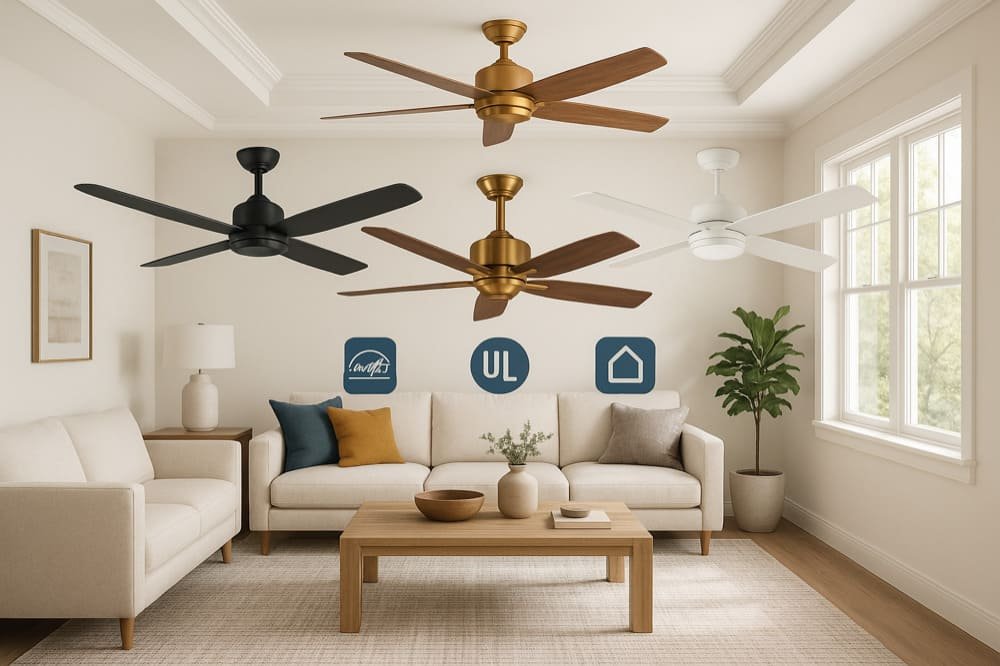
When you’re specifying fans for dozens—or hundreds—of living rooms across a project, “nice looking” isn’t enough.
You need fixtures that look cohesive across unit types, move air efficiently, meet safety and energy standards, install cleanly under varied ceiling conditions, and arrive on time with compliant packaging.
This list pairs design-forward fan ideas with the practical specs procurement teams need: size and airflow targets, mounting and clearances, compliance, smart controls, and bulk sourcing notes.
How we chose (and what to check)
We scored ideas against criteria that matter on multi‑unit projects: airflow performance and efficiency, installation feasibility, compliance, aesthetic versatility, smart control options, and procurement scalability.
For efficiency, the current U.S. procedure weights fan speeds to calculate CFEI per DOE Appendix U—see the concise explainer in the AMCA overview of the Ceiling Fan Energy Index (2025).
For high‑performers, some models will meet the ENERGY STAR Most Efficient 2025 — Ceiling Fans criteria (EPA PDF), which use formulas tied to blade span. Safety-wise, residential fans are evaluated to UL 507/CSA equivalents; Intertek’s notice summarizes the current UL 507 electric fans safety standard overview (2024).
For sizing, use room area to guide blade span and airflow bands; City Lights’ guide lays out practical ranges in its room size to fan diameter and CFM chart. Downrod choices depend on ceiling height; see Hunter’s downrod length guidance.
If humidity is a factor (coastal or tropical projects), check damp/wet ratings as explained in Consumer Reports’ damp vs. wet rating explainer (2024).
Notes on numbers and ranges: airflow (CFM) and efficiency vary by model and test method; treat the bands below as targets to request on spec sheets. Maintain minimum blade height of 7 ft and typical wall clearance around 18 in or per the specific installation manual.
1) Minimalist matte black — timeless modern for most schemes
- Size & airflow: 48–56 in for 150–325 sq. ft. living rooms; target ~4,000–5,500 CFM. Efficiency: prioritize DC motors with strong CFEI values (ask for weighted efficiency per DOE Appendix U).
- Motor & noise: DC motor for quieter operation and better speed control; request dB data if available.
- Mounting & clearances: Flush for 8 ft ceilings; 3–6 in downrod for 9 ft; keep blades ≥ 7 ft above floor and ~18 in from walls.
- Controls: Handheld remote plus app control preferred; many models support Alexa/Google via native apps or Matter bridges.
- Safety & compliance: UL/ETL listing; ENERGY STAR certification for efficiency where possible.
- Finishes/materials: Matte black housing and blades; ABS or composite blades maintain finish consistency across batches.
- Sourcing notes: Common MOQs 100–500 units; standard lead times ~3–6 weeks for bulk runs; request ISTA‑rated packaging and palletization.
- Best for: Contemporary and transitional palettes; repeated spec across unit tiers. Not for: Low‑contrast light‑only interiors where black feels too stark.
- Budget cue: From ~$60–$120 per unit in bulk, subject to spec, volume, and certification costs (subject to change).
2) Coastal white (damp‑rated) — bright, airy, salt‑friendly
- Size & airflow: 52–60 in for 180–350 sq. ft.; airflow target ~4,500–6,000 CFM in open, sunlit rooms.
- Motor & noise: DC motor preferred; sealed housings help resist moisture.
- Mounting & clearances: Downrod as needed to keep blades ~8–9 ft off floor; verify canopy sealing for damp areas.
- Controls: App + voice control simplifies uniform presets across units in coastal developments.
- Safety & compliance: UL Damp (or Wet if exposed), UL/ETL listing; ENERGY STAR for energy budgets.
- Finishes/materials: UV‑resistant powder‑coated white; ABS blades; marine‑grade fasteners.
- Sourcing notes: Specify corrosion‑resistant hardware and finish tests; allow extra time for coated finish QC.
- Best for: Beach/coastal, bright Scandinavian schemes. Not for: Dark, moody interiors where white reads clinical.
- Budget cue: From ~$70–$130 in bulk, depending on damp/wet rating and finish spec (subject to change).
3) Rustic wood‑look blades — warmth without maintenance
- Size & airflow: 52–60 in; target ~4,500–6,000 CFM for medium‑large living rooms.
- Motor & noise: DC motor recommended; consider 6–8 selectable speeds for tuning across unit types.
- Mounting & clearances: Standard downrods for 9–12 ft ceilings; ensure tip‑to‑wall clearance ~18 in or as manual specifies.
- Controls: Remote with wall‑control option for rentals; optional smart module for premium units.
- Safety & compliance: UL/ETL listing; ENERGY STAR on higher‑efficiency models.
- Finishes/materials: Wood‑look ABS blades (walnut, weathered oak) maintain consistency across large batches; real wood can vary.
- Sourcing notes: Request batch‑to‑batch color tolerance; verify carton drop testing for blade edge protection.
- Best for: Farmhouse, rustic modern, mountain hospitality. Not for: Ultra‑minimalist palettes.
- Budget cue: From ~$65–$125 in bulk, subject to change.
4) Brass + walnut — subtle luxury for premium tiers
- Size & airflow: 52–56 in; target ~4,500–5,500 CFM to balance comfort with quiet.
- Motor & noise: DC motor; stress smooth ramping and low‑speed stability for upscale feel.
- Mounting & clearances: Downrod to position blades ~8.5–9 ft; confirm canopy finish quality at scale.
- Controls: App + voice; consider scene presets (evening, energize) across premium units.
- Safety & compliance: UL/ETL listing; ENERGY STAR where feasible (finish weight can affect efficiency).
- Finishes/materials: Brushed or satin brass housings; walnut or walnut‑look blades; ensure anti‑tarnish coating spec.
- Sourcing notes: Require finish samples under project lighting; specify QA for color consistency on brass plating/anodizing.
- Best for: Luxury rentals, executive floors, boutique hospitality. Not for: Coastal salt‑spray zones unless protected.
- Budget cue: From ~$90–$160 in bulk, finish‑dependent (subject to change).
5) Low‑profile “hugger” — tight clearances, clean lines
- Size & airflow: 44–52 in for smaller living rooms or low ceilings; target ~3,500–5,000 CFM.
- Motor & noise: DC motor helps maintain airflow in shallower profiles.
- Mounting & clearances: Flush mount for 8 ft ceilings; maintain ≥ 7 ft blade height.
- Controls: Remote plus wall control; smart module optional for uniformity.
- Safety & compliance: UL/ETL listing; note that some hugger categories have different efficiency formulas in ENERGY STAR Most Efficient criteria; confirm the model’s classification against the ENERGY STAR Most Efficient 2025 — Ceiling Fans criteria (EPA PDF).
- Finishes/materials: Matte white, matte black, brushed nickel.
- Sourcing notes: Confirm carton height constraints for pallet density; request compact, ISTA‑tested packaging.
- Best for: 8 ft ceilings, renovations avoiding downrod changes. Not for: Vaulted spaces.
- Budget cue: From ~$55–$110 in bulk (subject to change).
6) Open‑plan 60–72 in — big rooms, fewer fixtures
- Size & airflow: 60–72 in for 325–400+ sq. ft.; airflow target ~5,500–8,000+ CFM. Consider two fans if room geometry is irregular.
- Motor & noise: Efficient DC motor with high‑speed stability; ask for CFEI details (weighted efficiency) per the AMCA overview of the Ceiling Fan Energy Index (2025).
- Mounting & clearances: Downrods scale with ceiling height (e.g., ~12 in for 10 ft, ~24 in for 12 ft); confirm per Hunter’s downrod length guidance.
- Controls: Group control by zone via app; scene scheduling helps balance comfort with energy.
- Safety & compliance: UL/ETL listing; ENERGY STAR on qualifying models; check tip‑height over traffic paths.
- Finishes/materials: Matte black, graphite, or warm wood‑look blades to scale visually.
- Sourcing notes: Verify blade packaging reinforcement; request pallet tests for long‑span SKUs.
- Best for: Great rooms, leasing lounges, large condos. Not for: Small rooms with tight circulation paths.
- Budget cue: From ~$100–$200 in bulk, span‑dependent (subject to change).
7) Smart‑ready fans — app, voice, and project‑wide presets
- Size & airflow: Choose 48–60 in most living rooms; airflow targets per room size.
- Motor & noise: DC motor with reversible direction; ensure stable low‑speed control for night modes.
- Mounting & clearances: Standard guidance; confirm canopy space for control modules if retrofit.
- Controls: Native app control with Alexa/Google/HomeKit or Matter support for consistency across units; assess options for centralized presets.
- Safety & compliance: UL/ETL; ENERGY STAR on qualifying models. Confirm Wi‑Fi/BLE radios meet local regulations.
- Finishes/materials: Neutral housings across unit tiers (matte black, white, nickel).
- Sourcing notes: Ask suppliers to pre‑provision or label controllers by unit; document firmware versions.
- Best for: Tech‑forward communities and hospitality. Not for: Locations with strict network policies unless IT approves.
- Budget cue: From ~$70–$140 in bulk depending on modules (subject to change).
8) Light‑kit vs. lightless — plan illumination holistically
- Size & airflow: 48–56 in typical; airflow per room needs.
- Motor & noise: DC motor recommended; verify LED driver noise/EMI if using light kits.
- Mounting & clearances: Ensure light kit height doesn’t encroach on 7 ft minimum clearance.
- Controls: Light and fan should be independently controllable from wall and app.
- Safety & compliance: UL/ETL listing; if using integrated LED, confirm driver certifications and lumen output per design plan.
- Finishes/materials: Frosted vs. clear lens affects glare; match trim finishes to hardware package.
- Sourcing notes: Standardize CCT (e.g., 3000K) and CRI (≥90 for premium) across models; keep spare lenses/drivers in after‑sales plan.
- Best for: Units relying on fan lighting as primary ambient. Not for: Spaces with comprehensive recessed/track lighting that prefer a clean, lightless fan profile.
- Budget cue: From ~$60–$130 in bulk, light kit dependent (subject to change).
9) Transitional three‑blade sculptural — clean but warm
- Size & airflow: 52–58 in; airflow ~4,500–6,000 CFM. Narrow blade planforms can still move air efficiently with DC motors.
- Motor & noise: DC motor; request balanced rotor QA data to minimize wobble at scale.
- Mounting & clearances: Downrod per ceiling height; verify blade sweep against alcoves or beams.
- Controls: Remote + app; consider wall control SKUs for uniformity in rental operations.
- Safety & compliance: UL/ETL; ENERGY STAR on some models; damp‑rated option if near kitchens with humidity.
- Finishes/materials: Mixed finishes (matte black motor + warm walnut blades) bridge modern and classic schemes.
- Sourcing notes: Require blade color swatches for approval; specify packaging separators to protect sculpted blade edges.
- Best for: Mixed‑style portfolios wanting a single SKU. Not for: Strictly traditional interiors.
- Budget cue: From ~$70–$135 in bulk (subject to change).
10) Statement canopy or split finishes — subtle brand touch
- Size & airflow: 52–56 in; airflow ~4,500–5,500 CFM.
- Motor & noise: DC motor; ensure any decorative canopy elements don’t impede airflow or wiring access.
- Mounting & clearances: Verify canopy diameter and junction‑box coverage across varied ceiling substrates.
- Controls: App + scene presets coordinate with lighting design.
- Safety & compliance: UL/ETL listing; consider ENERGY STAR for efficiency targets.
- Finishes/materials: Two‑tone combos (e.g., graphite motor + brass accents) add identity without polarizing tenants.
- Sourcing notes: Define a “house finish” recipe and acceptance criteria; lock color tolerances before mass production.
- Best for: Premium or branded residences. Not for: Tight budgets that prioritize maximum efficiency over finish details.
- Budget cue: From ~$85–$160 in bulk, finish complexity dependent (subject to change).
Toolbox: Spec checklists and bulk‑buy essentials
- Sizing & clearances: Use a room‑area matrix to choose blade span and target airflow. Maintain ≥ 7 ft blade height; select downrods by ceiling height (see Hunter’s downrod length guidance).
- Efficiency & compliance: Request ENERGY STAR certification where possible and ask suppliers to provide CFEI details per DOE Appendix U; review the ENERGY STAR Most Efficient 2025 — Ceiling Fans criteria (EPA PDF).
- Safety & ratings: Verify UL/ETL and damp/wet ratings as appropriate; Consumer Reports’ primer helps differentiate in its damp vs. wet rating explainer (2024).
- Packaging & logistics: For parcel‑sized cartons, ask for drop‑ and vibration‑tested packaging such as ISTA 3A general simulation; for pallets, specify corner protection, strapping, and labeled outer cartons for rapid receiving.
- Sourcing partner: ChinaBestBuy can coordinate factory‑direct sourcing, QA/inspection, compliant packaging, and global logistics for multi‑unit projects.
Installation cheat‑notes (keep with your spec)
- Room size to blade span: As a starting point, medium living rooms (145–325 sq. ft.) often use 44–62 in fans; larger open plans (325–400+ sq. ft.) may need 60–72 in or multiple fans—see the room size to fan diameter and CFM chart for ranges and verify per model.
- Downrods by ceiling height: Place blades roughly 8–9 ft above the floor (e.g., ~6 in downrod at 9 ft, ~12 in at 10 ft) with specifics aligned to Hunter’s downrod length guidance.
- Clearances: Keep typical wall clearance ~18 in from blade tip; always follow the model’s installation manual.
Next steps for project teams
- Define your living room archetypes (unit sizes, ceiling heights, finish packages, humidity exposure).
- Choose 2–3 fan SKUs that cover most cases (e.g., a matte black DC 52–56 in, a damp‑rated coastal white 52–60 in, and a 60–72 in open‑plan option).
- Request spec sheets with CFM ranges, CFEI/efficiency details, UL/ETL and damp/wet ratings, and control modules.
- Confirm bulk lead times and packaging standards (e.g., ISTA 3A) with your supplier; plan samples in 1–2 weeks and production in ~3–6 weeks for standard models.
- Prepare your RFQ with budgets, unit counts by SKU, finish choices, target timelines, delivery locations, and any smart ecosystem requirements.
If you’d like support aligning aesthetics with compliance, efficiency, and logistics under one roof, our team can help coordinate the process and assemble a spec‑ready quote for your multi‑unit living rooms.