Maple vs. Oak Kitchen Cabinets (2025): A TCO‑Focused Comparison for Multi‑Family Projects
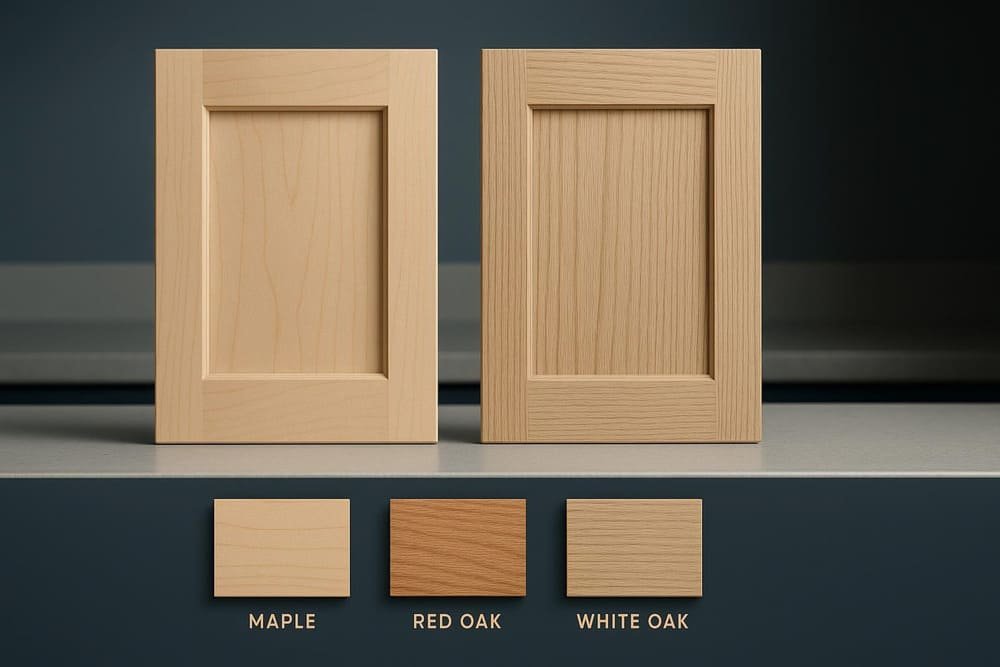
Multi‑family cabinet programs live or die by total cost of ownership (TCO)—not just what you pay for doors and boxes, but the stack of finishing labor, install efficiency, punch‑list risk, color uniformity at scale, and the maintenance curve over 5–10 years.
Maple and oak (red and white) are the workhorses in North American cabinetry. All three species can succeed in apartments; the best choice depends on finish intent, budget tier, and schedule predictability.
Below, we compare maple, red oak, and white oak through a TCO lens tailored to value‑engineered, repeatable multi‑family deployments.
What really drives cabinet TCO in multi‑family
- Species and grade cost: Material deltas (e.g., white oak premium) ripple through thousands of square feet of doors and face frames.
- Finishing stack and labor variance: Paint vs. stain, pore‑filling steps, sealer systems, and color‑matching protocols can add or remove hours per batch.
- Durability and maintenance cadence: Hardness, moisture behavior, and edge denting influence touch‑up cycles and resident‑turn costs.
- Supply and lead‑time volatility: Trend‑driven demand (notably white oak) can stretch timelines and pricing; predictability matters across hundreds of units.
- Packaging/QC and damage rate: Export‑grade packaging, cure windows, and edge protection cut rework and punch‑list delays.
Quick comparison snapshot (maple vs. red oak vs. white oak)
| Attribute (2025) | Maple (Hard Maple) | Red Oak | White Oak |
|---|---|---|---|
| Janka hardness | ≈ 1,450 lbf (slightly harder) | ≈ 1,290 lbf | ≈ 1,360 lbf |
| Stain/paint behavior | Paints very smooth; dark stains can blotch without conditioner/washcoat | Stains readily; open grain shows; for ultra‑smooth paint, pore/grain fill recommended | Stains beautifully, especially rift/quarter; light natural finishes popular; for smooth paint, pore/grain fill recommended |
| Aesthetic | Subtle, uniform grain; modern/clean | Bold grain; classic texture; slight pinkish undertone possible | Neutral/tan; rift/quarter looks premium; straight grain |
| Relative material cost (as of 2025‑10) | Baseline | Often comparable or slightly below maple | Premium vs. both maple and red oak |
| Finishing labor risk | Low for paint; higher for dark stains (testing needed) | Moderate for paint (grain filling) | Low for light/clear finishes; higher if tone‑correcting or painting |
| Moisture behavior | Moderate | Higher permeability (no tyloses) | Better natural moisture resistance (tyloses) |
| Lead‑time/volatility | Generally stable | Generally stable | More volatile; trend‑driven demand |
Hardness figures align with 2025 references: maple ≈1450, red oak ≈1290, white oak ≈1360, consistent with the Janka scale presented by the Osborne Wood Janka chart (2025) and also reflected in Bruce Flooring’s durability overview (2025).
White oak’s superior moisture resistance is tied to tyloses occluding its vessels, a well‑documented anatomy distinction in the NWFA Wood Species reference PDF (2025).
Species deep dives (TCO implications)
Maple (Hard Maple)
Where it excels for TCO:
- Paint‑grade programs: Maple’s tight, uniform grain takes paint very smoothly with fewer prep steps than oak. That reduces finishing labor variance across batches.
- Uniform light stains: Achievable with good shop control. For darker stains, apply pre‑stain conditioner or a washcoat to avoid blotching.
Risks to manage:
- Dark stain blotching: Mitigate with conditioner/washcoat and test panels; see practical methods described in The Wood Whisperer’s blotch control tutorial.
- Edge denting/punch‑list: Maple is hard, but painted edges still benefit from robust edge protection in packaging to avoid chips.
Cost positioning (2025‑10): Typically near or slightly above red oak on material cost; finishing for paint is often simpler than oak (no pore filling), lowering labor spread.
When it pencils out:
- Large, repeatable, paint‑grade multi‑family packages aiming for a smooth finish and predictable schedules. Consider maple frames with MDF center panels for painted Shaker doors to further stabilize paint outcomes and cost.
Red Oak
Where it excels for TCO:
- Value wood‑grain programs: Red oak’s bold, classic grain reads “real wood” at a cost that is often comparable to or slightly below maple on many SKUs. Cabinet Door Factory’s 2025 guidance notes oak frequently prices at or just under maple for similar door models, with white oak as the premium variant, as discussed in their oak vs. maple comparison (2025).
- Stained finishes: Accepts stain readily and evenly; fewer surprises versus dark‑stained maple.
Risks to manage:
- Painted smoothness: For ultra‑smooth, contemporary paint, plan for pore/grain filling and higher‑build primer; this is common shop practice echoed by finishing communities (see 2024–2025 trade discussions, e.g., SawmillCreek’s thread on cabinet enamels and primers referencing BIN and SW enamels: cabinet paint practice (2024)).
- Undertone control: Some SKUs show a pinkish cast; staining systems and toners may be needed for neutral palettes.
Cost positioning (2025‑10): Often the budget‑friendlier path to visible grain compared to maple; paint‑grade may incur extra labor for pore fill if a perfectly flat finish is required.
When it pencils out:
- Mid‑market rentals seeking a classic, visible grain at a competitive price, especially with medium stains that mask undertone variation.
White Oak
Where it excels for TCO:
- Premium natural looks: Rift/quartersawn white oak with light or natural finishes is highly sought and needs minimal stain steps. That finish simplicity plus perceived quality can justify higher rents in premium units.
- Moisture‑adjacent zones: Better natural moisture resistance than red oak (thanks to tyloses), attractive near pantries, utility rooms, or open‑plan kitchens in humid regions, per the anatomy differences summarized in the NWFA Wood Species reference (2025).
Risks to manage:
- Price volatility and lead times: Trend‑driven demand can stretch sourcing windows and raise costs. 2025 industry outlooks still flag white oak premiums, with expectations of some easing after 2024 spikes, according to the Church & Church Lumber 2025 market outlook.
- Tone control: Keeping white oak “neutral” sometimes requires subtle toners to avoid green/gray shift—plan test panels and approvals.
Cost positioning (2025‑10): Premium. Concrete door examples from Cutting Edge Inc. show maple shaker doors around the high‑$20s/sq ft while rift‑cut white oak variants can run more than double per the 2024–2025 posts on their learning center, e.g., wood type affects door cost.
When it pencils out:
- Premium units where a visible upgrade lifts rents or absorption, and schedules can accommodate longer lead times for rift/quarter selections.
Finishing at scale: paint vs. stain and labor deltas
Paint‑grade programs:
- Maple generally needs fewer steps to achieve a flat, smooth surface—no open pores to fill. That can compress cycle time and reduce variability across large batches.
- Oak (red and white) can absolutely be painted, but plan pore/grain filling before primer for an ultra‑smooth look. Field conversations and trade threads (2024) emphasize high‑build primers and enamel systems over filled pores for the flattest results; see the cited cabinet paint practice discussion.
Stain programs:
- Red and white oak accept stains readily and highlight grain; white oak pairs especially well with light/natural finishes favored in 2025.
- Maple can look excellent with light stains but tends to blotch under darker stains unless you use a conditioner or washcoat—methods demonstrated in The Wood Whisperer’s maple blotch control tutorial.
Color standards and sample workflow:
- For multi‑family repeatability, standardize a limited palette and lock samples early with batch QC. If you’re building a finish program, see our internal guide on 2025 kitchen cabinet color trends and designer selections for establishing standard tones and approval workflows.
Supply, lead times, and volatility (2025 outlook)
- White oak remains trend‑forward and premium; some suppliers anticipate moderation after 2024 peaks, but plan buffers for rift/quartersawn programs. This aligns with 2025 trade commentary such as the Church & Church Lumber market outlook.
- Maple and red oak are broadly available with more predictable pricing and lead times in 2025, according to many buyer updates summarized in trade publications; however, final timelines depend on door construction, finishing line capacity, and logistics.
- Practical takeaway: If schedule is king and finishes are painted or light/neutral, maple and red oak offer steadier procurement; specify white oak where unit economics justify the premium and potential schedule variance.
Packaging, QC, and damage prevention in export logistics
Cabinet TCO is sensitive to damage rates and rework. For containerized or LCL shipments, align packaging to recognized distribution testing profiles. Overviews of ISTA 3A and related tests (drop, vibration, compression) explain why double‑wall cartons, reinforced corners, and pallet banding matter; see Safe Load Testing’s 2024 explainer on ISTA 3A fundamentals.
- Painted maple: Prioritize edge/corner protection to prevent chips and rub‑through; ensure films/pads avoid imprinting during cure.
- Painted oak: Allow sufficient cure before packing; pore‑filled and high‑build primer layers can imprint if compressed too soon.
- Process controls for multi‑family:
- Palletize and label by building/stack/unit to speed on‑site kitting and reduce handling damage.
- Include spare doors/fillers by finish/size to resolve punch‑list issues without delaying turnover.
- Document moisture conditioning windows where climate swings are expected.
For an end‑to‑end view of how a single partner can coordinate BOQs, finishing, packaging, and shipment staging across scopes, explore our process‑oriented piece on whole‑house customization for developers.
Scenario‑based recommendations (fit over “winners”)
- Best for painted, uniform finishes with predictable labor and schedule: Maple.
- Best for mid‑market, visible grain at a value price: Red Oak.
- Best for premium natural look and better moisture behavior: White Oak (especially rift/quartersawn, light/clear finishes).
If you must choose a single species for 300+ units with a mix of finish types, a common strategy is: paint‑grade doors in maple (or maple frames with MDF panels) for standard units; white oak upgrades for premium tiers; red oak for a value wood‑grain line.
RFQ checklist (TCO‑friendly)
When you request an itemized, factory‑direct quote for multi‑family cabinets, ask suppliers to specify:
- Material details: species, grade, cut (e.g., rift/quarter for white oak), door construction (solid frame + veneer/MDF panel), and source region.
- Finishing stack: pore/grain filling steps (if oak and painted), conditioners/washcoats (if maple and dark‑stained), primer/topcoat systems, and sheen.
- Unit pricing breakdowns: doors by sq ft, boxes by linear foot, moldings/panels, hardware; finishing as a separate line item with labor steps.
- Packaging spec: carton strength, edge/corner protection, palletization, spare parts policy, labeling schema.
- Lead times: production + finishing + logistics windows; specify any rift/quartersawn white oak buffers.
- QC and samples: color control plan (approved panels, delta‑E thresholds), batch‑to‑batch matching, replacement SLAs, and photographic QC sign‑offs.
- Logistics and delivery: origin, Incoterms, consolidation plan, and on‑site delivery staging.
Primary CTA: Request an itemized, factory‑direct quote that separates materials, finishing steps, packaging, and delivery—and includes lead time, origin, samples, and cost‑optimization suggestions.
Also consider (related sourcing partner)
For teams that prefer a single point of accountability across design, factory‑direct sourcing, QC, packaging, and global delivery, you can work with ChinaBestBuy to coordinate end‑to‑end execution.
Evidence notes and further reading
- Hardness/durability levels summarized here draw on the Osborne Wood Janka chart (2025) and Bruce Flooring’s oak vs. maple durability page (2025).
- White oak’s tyloses and species differences are outlined in the NWFA Wood Species reference PDF (2025).
- Shop‑floor finishing practices for painted oak (pore/grain fill; high‑build primers) and enamel systems are discussed in community and trade contexts like the SawmillCreek cabinet paint thread (2024).
- Door cost differentials by species are exemplified in Cutting Edge Inc.’s 2024–2025 learning center articles such as wood type affects cabinet door cost, showing rift white oak commanding a significant premium over maple.
- Comparative price/selection notes between generic “oak” (often red oak) and maple are discussed in Cabinet Door Factory’s oak vs. maple review (2025).