Mudroom Bench Dimensions: A Practical Sizing Guide for Your Home
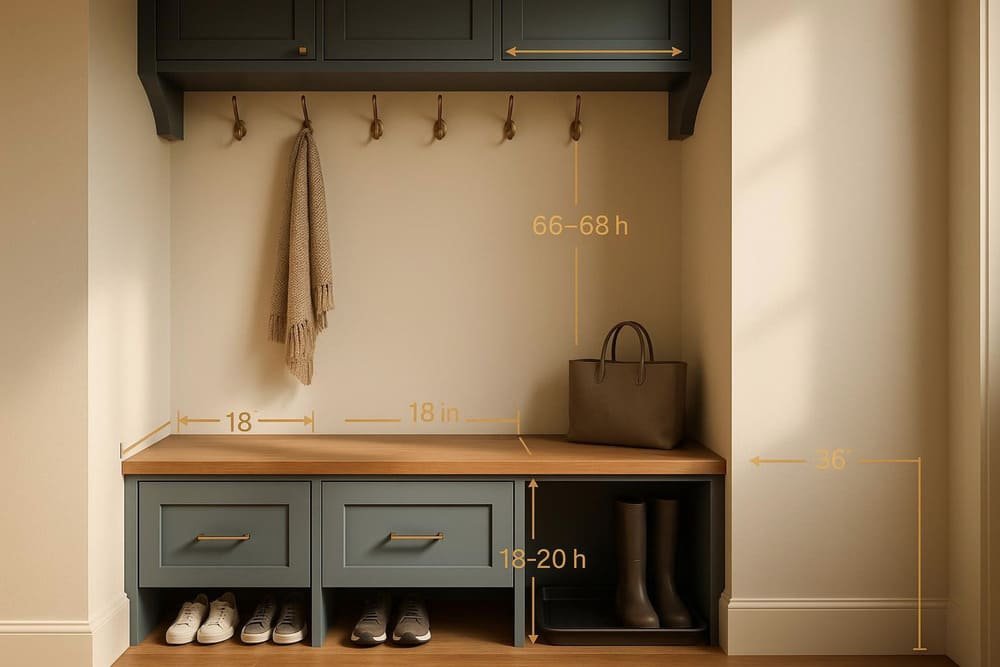
Designing a mudroom bench shouldn’t involve guesswork. This guide distills field-tested dimensions and installation rules I use on real projects so homeowners and custom millwork teams can get comfort, storage, and circulation right on the first pass.
This is Phrany, Founder of ChinaBestBuy—a Guangzhou, China–based one-stop building materials and design solutions supplier. With 15+ years in sourcing, custom production, and project delivery across residential, commercial, and hospitality spaces, we focuse on practical sizing and material standards that prevent costly mistakes.
- One-sentence promise: Use clear sizing rules and real cases to pick the right mudroom/entry bench dimensions the first time—no more guesswork.
- Audience fit: Homeowners planning a renovation or new build; custom millwork/cabinet contractors who need precision; not written for volume developers who typically apply fixed standards.
Myth to Retire: “Deeper Is Better”
Going too deep is the fastest way to make a bench uncomfortable and your aisle cramped. In practice, depths over 22 inches push users’ knees forward and make bending to tie shoes harder. Keep these ranges:
- No back: 18–20 inches
- With back: 17–18 inches
These align with ergonomic clusters observed across benchmarked seating—many indoor benches land in the 16–20 inch depth range and seat heights around 17–19 inches, as seen in the curated catalog at Dimensions.com (updated 2025), for example the Run 3-Seat (seat height 17.75″, depth 16.25″) and Jens Bench (seat height 19″, depth 18″) entries documented by Dimensions Research in 2025: Run 3-Seat Bench and Jens Bench.
For general-purpose benches, an 18-inch seat height is widely cited by manufacturers, echoed in the 2025 planning note from Premier Polysteel’s “standard bench dimensions”.
Part I — Bench Core Dimensions (Field-Tested)
Seat height
- Without cushion: 17–18 inches
- With cushion: 15.5–16.5 inch seat box + ~2 inch cushion → ~18 inches finished
- For universal design ease of sitting/standing, 17 inches is a sweet spot overlapping the ADA public-facility range of 17–19 inches stated by the U.S. Access Board in the 2010 ADA Standards, Section 903.5 (ADA Benches — U.S. Access Board, 2010).
Seat depth
- No back: 18–20 inches
- With back: 17–18 inches
Width per person
- 24–30 inches is a comfortable design target for mudroom seating. Multi-seat products commonly imply ~20 inches per person; see Dimensions.com multi-seat exemplars such as the Florence Knoll Three-Seater (2025 Dimensions record).
Recommended module length
- 36–48 inches per segment for fabrication, handling, and transport efficiency. This mirrors common casework module ranges from cabinetmaking practice and keeps seams manageable.
Front overhang
- 1–1.5 inches. Enough to protect the face frame and improve comfort without creating a shin kick hazard.
Under-bench toe-kick
- 3 inches high × 2–3 inches deep. This slimmer profile works well in mudrooms while still hiding shoe scuffs. (For reference, kitchen/bath toe-kicks are often 4.5 inches high per the NKBA’s 2023 casework chapter: NKBA Chapter 6 — Illustrating Cabinetry/Casework (2023 PDF).)
Why these ranges work: They align with aggregated indoor bench norms from industry references and have proven comfortable in sit–tie–stand workflows in real homes.
Part II — Clearance and Reach Rules (Don’t Skip These)
Aisle clear width
- Target ≥36 inches in front of the bench for circulation and bending room. This matches the publicly documented accessible-route minimum in ADA Chapter 4 and is also recommended for mudroom planning in the 2025 contractor guide by GeorgeFurniture: see their note on “at least 36 inches in front of the bench” in the “ultimate guide to mudroom bench dimensions”. ADA’s accessible routes baseline remains 36 inches per the U.S. Access Board’s Chapter 4 (2010, current): ADA Accessible Routes overview.
Door leaf to bench edge offset
- Keep a 3–4 inch setback from the swing arc to avoid contact and pinches. This is a practitioner rule of thumb derived from door swing clearances in residential layouts; field commentary often cites keeping several inches off corners to maintain a full 90° swing (see a practical discussion among builders on Houzz: “how much space to leave near a door corner”). Treat this as a practical tip, not a code requirement.
Hook heights
- Adults: 66–68 inches
- Kids: 42–48 inches
- Rationale: Keeps hanging space reachable without crowding heads. Maintaining roughly 48 inches of vertical separation between bench seat and the underside of hooks/shelf prevents “face-in-coats” issues; a practical maker note suggests this 48-inch separation in a 2024 trade article by Old World Timber: “choosing the perfect mudroom bench height”.
Upper shelf
- Height: 72–78 inches; Depth: 12–14 inches. This keeps shelf items above head level yet reachable for most adults.
Accessible/multigenerational considerations
- Favor a bench around 17 inches high for easier sitting and standing, and push the clear aisle toward 42 inches if your layout allows. While ADA benchmarks are for public/commercial spaces, the 17–19 inch seat height and 36-inch route width (U.S. Access Board, 2010) are useful universal-design references.
Part III — Integrated Storage Specs (Built Around Real Footwear)
Shoe cubby clear openings (net height)
- Sneakers/flats: 6–7 inches
- Ankle boots: 9–10 inches
- Tall boots: 16–18 inches
- Why these numbers: They map to common consumer organizer modules and adjustable systems. ClosetMaid’s published cubby organizers and entry collections show typical depths/heights that support these ranges; see examples like the 15-cube organizer (12 inch depth cabinet) in Home Depot’s listing for ClosetMaid (2025) and related entry collections at Lowe’s: ClosetMaid 15-cube organizer specs and ClosetMaid Entryway Shoe Storage. Tall boots often need 18–24 inches of vertical clearance per retail guidance like Wayfair’s “shoe storage dimensions” (2024–2025).
Drawer/basket internals
- 12 inches wide × 14 inches deep × 6–8 inches high is a practical baseline for gloves, hats, and kids’ shoes. Many entry benches ship with drawers in this range; for a representative product spec, see a 2025 Target storage bench listing with shallow drawers and removable basket: entryway storage bench specs.
Wet gear management
- Use slatted wood, perforated metal, or removable plastic pans under wet footwear. This Old House’s bench projects consistently emphasize simple ventilation and removable components for drying and cleanup; see “How to build a simple mudroom bench” (TOH, 2019, still applicable).
Boot tray
- ~14 inches deep × 30 inches wide with ~1 inch rim. Size to your bay and confirm you can slide it out without catching on the toe-kick.
Moisture-tolerant materials/finishes
- UV-finished hardwood/plywood tops for abrasion resistance, HPL-faced case panels for moisture resistance, PVC thermofoil fronts (avoid high heat exposure), and stainless pulls/trim to resist corrosion. Cabinetry guides summarize HPL’s moisture durability for kitchen/bath contexts that analogously benefit mudrooms; see a 2024 industry overview on cabinet materials (Zen Living): “best materials for kitchen cabinets”.
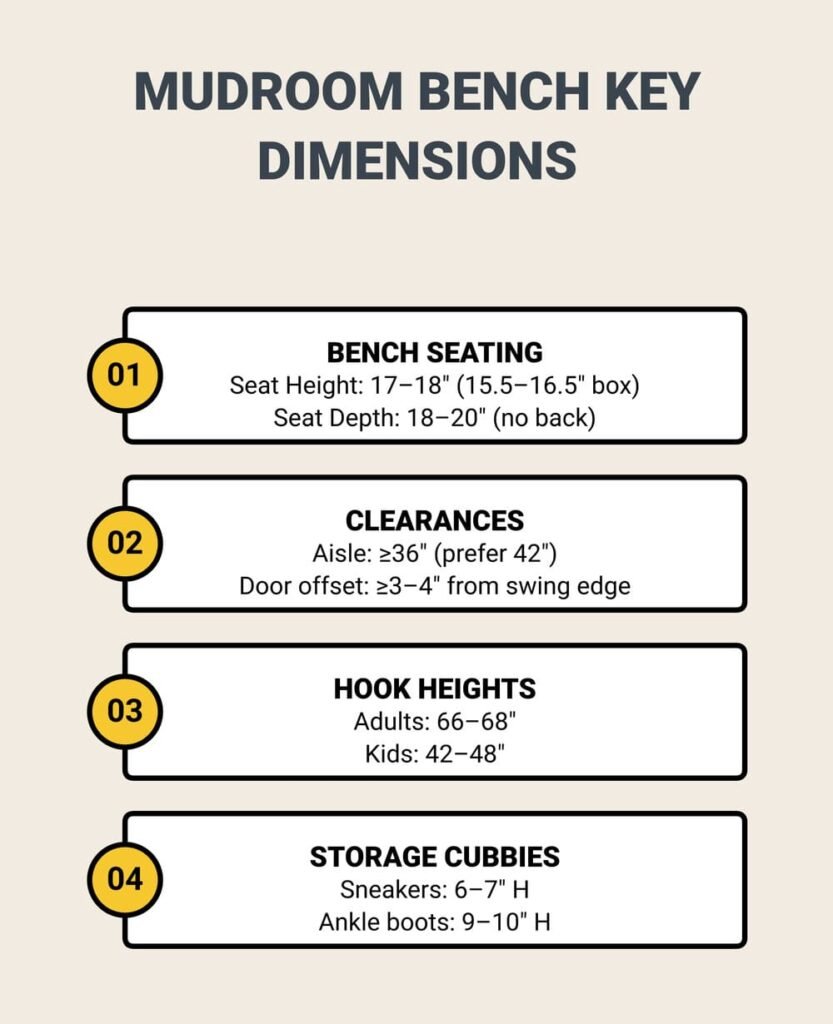
Dimensions At‑a‑Glance (Quick Recall)
- Seat height: 17–18″ (15.5–16.5″ box + ~2″ cushion if padded)
- Seat depth: 18–20″ (no back), 17–18″ (with back)
- Width per person: 24–30″
- Module length: 36–48″ per segment
- Overhang: 1–1.5″
- Toe-kick: 3″ H × 2–3″ D
- Aisle: ≥36″ (prefer 42″ if space allows)
- Door offset: ≥3–4″ from swing edge
- Hook heights: Adults 66–68″; Kids 42–48″
- Upper shelf: 72–78″ high; 12–14″ deep
- Cubbies (clear height): Sneakers 6–7″; Ankle boots 9–10″; Tall boots 16–18″
Scenario Matrix (Numbers First)
Case A — Narrow hallway (5′ wide)
- Bench: 48″ L × 18″ D × 17″ H
- Cubbies: 6 openings @ 7″ net height → ~12 pairs total (two columns)
- Aisle: 36″ clear
- Hooks: adults 66″; kids 44″
- Outcome: Seats two for shoe changes; holds a family of four’s daily shoes; corridor circulation remains smooth.
Case B — Dedicated mudroom (8′ × 10′)
- Bench: 96″ L × 19″ D × 17″ H (three × 32″ segments)
- Storage: 12 shoe cubbies + two tall-boot bays @ 18″ clear
- Hooks: adults 68″; kids 46″; upper shelf at 78″ high
- Outcome: Seats four at once; stores 12+ pairs; maintains 36″ aisle; wet boots isolated on trays; space stays tidy.
Capacity check: With 6.5″ H × 12″ W × 14″ D cubbies, each slot fits one pair; a 6-cubby column stores ~6 pairs. Two such columns under a 48-inch bench comfortably handle ~12 pairs.
Common Pitfalls (and How to Fix Them)
Over-deep seating (>22″)
- Symptoms: Shin pressure, hunched posture to reach laces, congested aisle.
- Fix: Trim to 18–20″ (no back) or 17–18″ (with back); confirm with a full-scale cardboard mockup.
Too-high seat
- Symptoms: Dangling feet for shorter users, awkward leverage to stand.
- Fix: Target 17–18″ finished height. This overlaps ADA’s 17–19″ bench range noted by the U.S. Access Board (2010) and feels right in homes.
Starved aisle (<32″)
- Symptoms: Users turn sideways; clashes when two people pass.
- Fix: Reclaim depth from the bench (to 17–18″) or relocate storage to wall cabinets; aim for ≥36″ clear.
Hooks too low/high
- Symptoms: Coats in faces when sitting; kids can’t reach.
- Fix: Adults 66–68″; Kids 42–48″. Keep ~48″ vertical between seat and underside of hooks/shelf so the seated head isn’t buried in coats (see Old World Timber practical spacing note, 2024).
No plan for wet gear
- Symptoms: Damp odors, finishes degrading.
- Fix: Perforated/s latted bases, removable trays, and cross-ventilation; see drying-friendly methods in This Old House’s bench build (2019).
Toe-kick omitted
- Symptoms: Scuffed faces, hard-to-reach back of lower cubbies.
- Fix: Provide a 3″ H × 2–3″ D recess; reserve full 4.5″ heights for kitchen ergonomics per NKBA norms.
Materials and Finish Playbook (Moisture-Prone, High-Use)
- Carcass/panels: Moisture-resistant plywood or composite with HPL faces for abrasion and water resistance.
- Seat/top: UV-cured hardwood or veneered plywood with a durable topcoat; rounded front edge.
- Fronts: PVC thermofoil or well-sealed paint-grade MDF/plywood; avoid prolonged heat exposure for thermofoils.
- Hardware: Stainless or zinc-alloy with corrosion-resistant finishes.
- Fasteners: Confirm adequate pull-out strength for hooks and load-bearing supports; use blocking in wall.
Corroboration and references include cabinet industry roundups (e.g., Zen Living 2024 on HPL moisture resistance) and practical builds from This Old House focusing on durable construction and maintainable finishes.
Measure, Mock Up, Verify (10-Minute Checklist)
- Mark the bench footprint with painter’s tape; simulate 18–20″ depth.
- Place a temporary seat (box or chair) at 17–18″ height; test tying shoes.
- Walk the aisle; confirm ≥36″ clear with door swing.
- Draw hook line at 66–68″ (and kids at 42–48″). Sit and confirm clearance from your head to coats.
- Stack cardboard to the planned upper shelf (72–78″). Reach test with bins.
- Count shoes; translate to cubby count by type (6–7″ sneakers; 9–10″ ankle boots; 16–18″ tall boots).
- Decide on cushion: add ~2″ to reach ~18″ finished height.
- Add a 3″ × 2–3″ toe-kick to your sketch.
- Specify materials/finishes suitable for moisture (HPL faces, UV finish, stainless hardware).
- Before ordering, cross-check critical numbers with your installer and door swing drawings.
Toolbox — Custom Benches and Materials (Neutral Options)
- ChinaBestBuy: One-stop sourcing partner for custom-sized casework, moisture-tolerant finishes, and coordinated global logistics.
- ClosetMaid: Widely available modular cubbies and entry systems; fast to deploy, limited deep customization vs. fully bespoke.
- IKEA: Budget-friendly modules and accessories; great for prototypes and starter builds, but may require hacks for exact dimensions and heavy-duty use.
Citations & Further Reading (selected)
- ADA/U.S. Access Board (2010, current): Bench height 17–19″; accessible routes 36″ minimum — “ADA Standards, Chapter 9: Benches” and “ADA overview”.
- Dimensions Research (2025): Bench dimension exemplars by model — “Run 3-Seat Bench”, “Jens Bench”, “Florence Knoll Three-Seater”.
- Premier Polysteel (2025): “Standard bench dimensions”.
- GeorgeFurniture (2025): “Mudroom bench dimensions guide”.
- NKBA (2023): “Illustrating Cabinetry/Casework — toe-kick norms”.
- Old World Timber (2024): “Bench and hook separation practical tip”.
- This Old House (2019): “How to build a simple mudroom bench”.
- ClosetMaid/retail references (2024–2025): “15-cube organizer specs”; “Entryway Shoe Storage collection”; Wayfair “shoe storage dimensions”.
Where These Practices Apply (and Where to Adjust)
- Best for: Residential mudrooms/entries; built-ins or freestanding benches; families with mixed footwear.
- Adjust if: You have exceptionally tall users (increase seat height toward 19″); compact corridors (prioritize 17–18″ seat depth and keep aisle at 36″); or heavy work boots (increase cubby heights and add drainable trays).
- Not a silver bullet: Treat ADA figures as universal-design guidance, not code for private homes. Always reconcile dimensions with your specific door swings, user heights, and storage inventory.