18 Open Kitchen Living Room Ideas for Hospitality Suites (Open-Plan Kitchenette + Living Area)
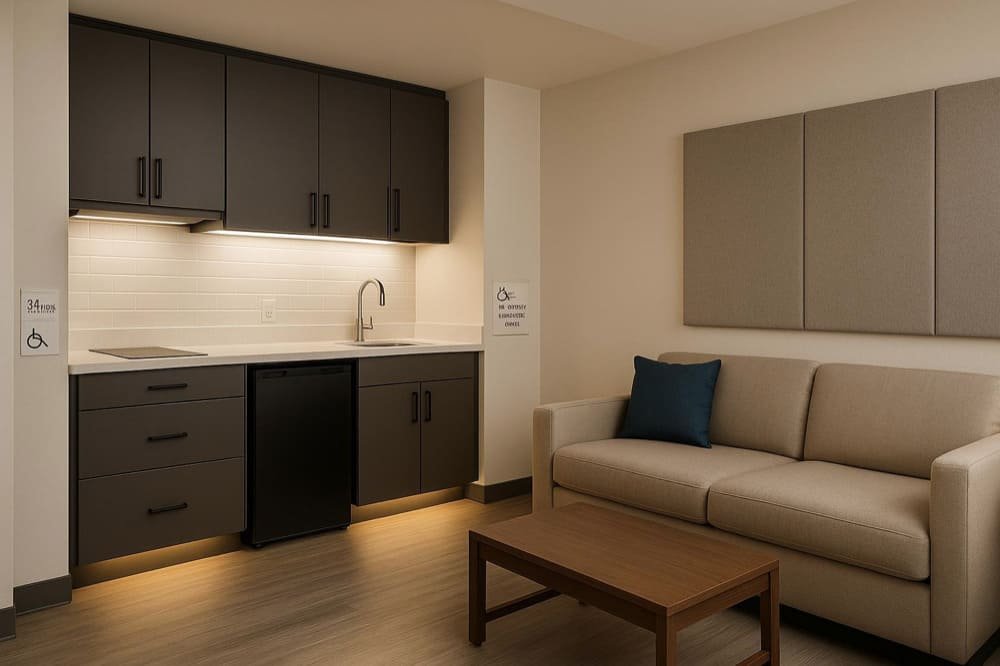
Designing an open-plan kitchenette + living area for hospitality suites is a balancing act: guest comfort and aesthetics on one side, code compliance, durability, and deployment-at-scale on the other.
The ideas below pair layout concepts with materials, MEP notes, and procurement guidance so your team can move from inspiration to specification without getting stuck on lead times or logistics.
Selection criteria: Each idea emphasizes hospitality-grade durability, accessibility, operational feasibility, scalable procurement, and lifecycle maintenance. Where specific dimensions or rules are cited, verify against the adopted edition and your local Authority Having Jurisdiction (AHJ) and hotel brand standards.
1) Linear Kitchenette Along the Quiet Wall
A streamlined run keeps working noise away from sleeping zones and optimizes circulation.
- Materials/specs: Quartz or solid surface countertop; HPL cabinet fronts with ABS edge banding; porcelain tile or resilient LVT for the wet zone.
- Accessibility: Keep a dedicated work surface capped at 34 inches max height with centered clear floor space, per the U.S. Access Board’s guidance in ADA Chapter 8, 804.3 Kitchen Work Surface (2010). Confirm reach ranges for controls and shelving via ADA Chapter 3, Section 308 (2010).
- Electrical: Plan GFCI-protected countertop receptacles and dedicated circuits as needed; align with NEC requirements in licensed design.
- Procurement/lead time: Standardize lengths and appliance cutouts to batch-produce tops and cabinets; pre-drill for hardware to reduce onsite time.
2) L-Shaped Kitchenette with a Peninsula Divider
Use the peninsula to subtly zone dining, prep, and living functions.
- Materials/specs: Peninsula with durable edge profiles (eased/mitered) to resist chipping; undercabinet LEDs for task lighting.
- Accessibility: Peninsula top heights should respect dining/work surface ranges (28–34 inches) per ADA Chapter 9, 902 (2010), plus knee/toe clearances as applicable.
- Operations: Consider induction-only packages to limit odors and heat; provide an outdoor-vented hood or local exhaust where permitted by code.
- Logistics: Ship peninsula cabinets pre-assembled; stone tops cut-to-size with labeled crates; protect corners in export packaging.
3) Pocket/Hidden Kitchen for Premium Suites
Conceal the kitchenette behind bi-fold or pocket doors to maintain a luxury feel.
- Materials/specs: Use quiet, soft-close door hardware; compact appliances behind decorative panels.
- Accessibility: Verify reach ranges for controls and outlets with ADA Chapter 3, Section 308 (2010); ensure clear approach and turning radii in front of the work surface.
- MEP: Ensure door clearance doesn’t block exhaust performance; interlock lighting with door sensors for energy savings.
- Deployment: Prefab the door set with integrated tracks; room-number kitting reduces onsite confusion.
4) Compact Galley with Sliding Door for Odor/Noise Control
A short galley run enclosed by a sliding door provides nighttime quiet and better odor containment.
- Materials/specs: Use high-wipeability finishes; acoustic door seals to limit sound transfer.
- Ventilation: Clarify suite IAQ strategy with the mechanical engineer; hotel guest rooms are typically treated under ASHRAE Standards 62.1/62.2 overview (2025), with local kitchen exhaust requirements derived from adopted codes.
- Fire/life safety: If the program allows only induction/microwave (no grease-laden vapors), you’re usually outside the scope of NFPA 96; confirm with AHJ using NFPA 96 overview (current).
- Logistics: Sliding door kits ship efficiently; pre-assemble cabinet carcasses and label hardware bags by unit.
5) Island-Bar Seating with ADA-Conscious Heights
Create social seating while meeting accessibility.
- Materials/specs: Use robust countertop edges; plan two height zones if brand standards permit—one accessible, one bar-height.
- Accessibility: For the accessible portion, respect ADA Chapter 9, 902 dining/work surface heights (2010) and clear floor space.
- Electrical: Apply NEC countertop receptacle spacing and GFCI via your electrician’s code set; add USB-C outlets for guest convenience.
- Procurement: Standardize stool counts and finishes; order spare tops to cover damage across the batch.
6) Induction-Only, Low-Odor Appliance Package
Minimize odors and grease to keep maintenance light and code coordination straightforward.
- Materials/specs: Single or double-zone induction; microwave-convection oven; compact fridge; optional drawer dishwasher if brand permits.
- IAQ: Coordinate local exhaust with the mechanical engineer referencing ASHRAE 62.1/62.2 overview (2025); continuous or intermittent airflow rates depend on adopted codes.
- Electrical: Confirm circuit loads and GFCI/AFCI requirements in suites from the adopted NEC edition.
- Logistics: Bundle appliances per unit; verify decibel ratings for nighttime quiet in extended-stay programs.
7) Slip-Resistant Flooring Strategy for Wet Zones
Protect guests from slips while keeping cleaning simple.
- Materials/specs: Porcelain tile or resinous systems with manufacturer-declared DCOF suitable for interior wet zones; many specs target wet DCOF ≥ 0.42—confirm with AHJ and data sheets.
- Evidence: Use the Tile Council of North America’s DCOF resource (accessed 2025) to frame testing and product-use classifications.
- Deployment: Minimize grout lines; pick darker or mid-tone grout; ship tiles with corner guards; include 2–3% overage.
8) Quartz or Solid Surface Countertops (Suite-Grade)
Durable, easy-clean tops that survive high guest turnover.
- Materials/specs: High-CRI task lighting reveals messes; eased/mitered edges with 3–4 mm radius recommended by technical manuals; use trivets for hot items.
- Maintenance: Manufacturer guidance for quartz (e.g., Caesarstone’s technical manual) prioritizes mild cleaners and avoiding harsh chemicals; confirm specifics in the chosen brand’s latest datasheet.
- Logistics: Cut-to-size production with standardized sink/faucet cutouts; crate tops vertically with protective films; approve golden samples before mass run.
9) HPL Cabinet Fronts with ABS Edge Banding
A workhorse cabinet spec for high-traffic hospitality.
- Materials/specs: High-pressure laminate fronts bonded to moisture-resistant substrates; ABS edge banding applied with PUR adhesive for superior bond and moisture resistance.
- Evidence: Zero-joint edgebanding reduces seam visibility and improves durability, as noted in industry best-practices like Woodworking Network’s zero-joint overview (2023).
- Procurement: Confirm colorways and textures early; batch hardware (hinges, pulls) by room number; include spare fronts.
10) Large-Format Porcelain Slab or SPC Panel Backsplashes
Fewer seams, faster cleaning, and efficient installs.
- Materials/specs: Porcelain slabs for heat/chemical resistance; SPC panels for quick installs—verify fire ratings and AHJ acceptance in kitchen areas.
- Evidence: Manufacturers highlight the cleaning and seam-minimizing benefits of slabs; see Atlas Plan’s backsplash overview (accessed 2025) for typical properties.
- Logistics: Template once, repeat across units; palletize panels with edge protection; plan lift points and team-of-two handling.
11) Ventilation and IAQ Strategy for Suites
Get the exhaust and make-up air right to protect comfort and finishes.
- Scope cues: Guest rooms/suites are commonly treated as dwelling units; confirm local exhaust needs with your mechanical engineer in line with ASHRAE Standards 62.1/62.2 overview (2025).
- NFPA 96: If commercial cooking producing grease-laden vapors is not present, full hood/duct systems may not be required; verify with AHJ via NFPA 96 overview (current).
- Operations: Choose quiet fans; coordinate night-mode lighting and controls; ensure door undercuts or transfer grilles support airflow paths.
12) Acoustic Comfort: NRC Targets in the Living + Kitchenette Zone
Control reverberation and nighttime noise.
- Materials/specs: Aim for a combined treatment yielding NRC around 0.60 in the open area (non-prescriptive target); use acoustic ceiling clouds and decorative wall panels, plus soft seating and rugs.
- Deployment: Install acoustic elements early to protect finishes; verify STC needs at demising walls separately with an acoustician.
13) Lighting Layers and Controls Without Glare
Help guests cook, dine, and relax safely.
- Materials/specs: Under-cabinet task lighting with high CRI; dimmable ambient fixtures; warm low-level night lights at toe kicks or baseboards.
- Energy/code: Coordinate controls and zoning with your energy code set; for hospitality lighting planning, see the ConTech Hospitality Lighting Guide (accessed 2025).
- Logistics: Pre-wire harnesses where possible; label drivers and dimmers per room.
14) Modular/Prefab Kitchenette Pods for Speed
Off-site fabrication compresses onsite labor and sequencing.
- Spec: Factory-built modules with pre-installed MEP and finishes; dimensions coordinated for transport; plug-and-play onsite hookups.
- Evidence: For industry guidance, see the AIA–NIBS Modular & Off-Site Construction Guide (2025).
- Logistics: Batch production by floor stack; inspect mock-up pods before scale; plan craning routes and protection.
15) Room-Number Kitting, Mock-Ups, and Inspection
QA and packaging practices that cut errors and protect finishes.
- Process: Build a full mock-up for stakeholder sign-off; maintain golden samples; conduct AQL sampling before shipment.
- Packaging: Room-number kitting (cabinets, tops, fixtures, hardware) reduces onsite sorting; use seaworthy pallets and corner guards.
- Evidence: Off-site construction programs routinely emphasize pre-assembly and QA prior to shipment; align with best-practice guidance like the AIA–NIBS Modular & Off-Site Construction Guide (2025).
16) Hospitality Appliance Packages: Size, Noise, Energy
Choose quiet, efficient models that fit compact footprints.
- Spec cues: Compact fridge (often 20–24″ W), microwave-convection, and induction cooktop; consider ENERGY STAR where applicable.
- Noise: Confirm decibel ratings for nighttime comfort; quieter models improve guest satisfaction.
- Logistics: Bundle appliances per unit; order spares; coordinate plug types and voltage.
17) Sourcing & Logistics Toolbox (Neutral)
Use consolidated, factory-direct sourcing to streamline materials and shipping.
- What to expect: Design consultancy, verified factories, QA/inspection, export packaging, and global logistics coordination under one roof to reduce handoffs and risk.
- Link: ChinaBestBuy
- How it helps: Batch production by unit type, room-number kitting, golden sample control, and container-level planning combine to compress timelines while protecting finishes. Prices and lead times are subject to market conditions—lock POs early for critical SKUs.
18) Operations Playbook: Cleaning, Replaceables, Buffer Stock
Plan for day-two realities so the suite stays fresh.
- Cleaning: Specify easy-clean surfaces (quartz/solid surface, large-format tile, HPL) with manufacturer-approved cleaners.
- Replaceables: Keep spare fronts, hardware, light drivers, and countertop offcuts; label per unit.
- Buffer stock: Hold a small percentage of extra materials to address damages and future refreshes.
Compliance callouts to keep projects on track
- ADA dimensions and clearances: See the Access Board’s ADA Chapter 8, 804.3 Kitchen Work Surface (2010), ADA Chapter 3, Reach Ranges 308 (2010), and ADA Chapter 9, 902 Dining/Work Surfaces (2010). Include knee/toe clearances per Chapter 3 where applicable.
- Slip resistance: Align product selection with manufacturer DCOF declarations and AHJ acceptance; consult the TCNA DCOF resource (accessed 2025).
- Ventilation/IAQ and fire/life safety: Coordinate with licensed engineers and your AHJ using ASHRAE Standards 62.1/62.2 overview (2025) and the NFPA 96 overview (current). Final requirements depend on adopted editions and local amendments.
- Electrical: Ensure countertop receptacle placement and protection (GFCI/AFCI) align with your NEC-adopted edition through your electrical engineer/contractor.
Next steps
If you’re planning a multi-unit rollout, we can help you compare material options, batch production windows, and consolidated shipping schedules.
Reach out to inquire about factory-direct pricing and current lead times. Prices and lead times are subject to change.