How to Make Your Living Area Feel Like “Your Room”: Best Practices for Real Estate Developers in 2025
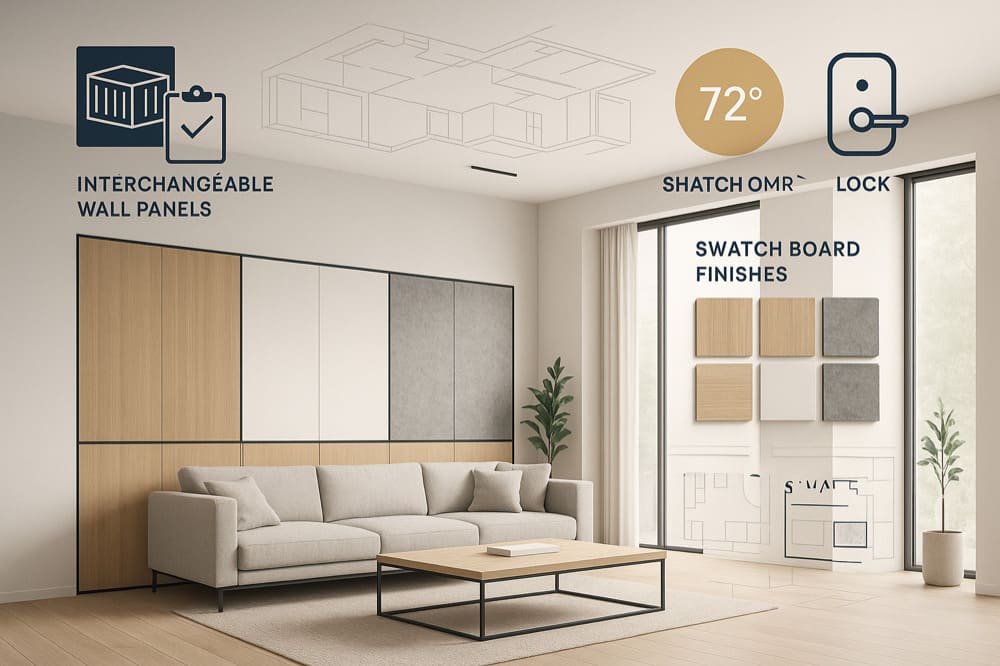
Personalization has moved from “nice-to-have” to competitive necessity in multifamily and mixed-use projects. In 2025, residents expect living areas—both in model units and shared lounges—to feel like their room: comfortable, controllable, and reflective of their lifestyle.
For developers, the challenge is achieving that individualized feel at scale without blowing budgets, schedules, or material consistency.
This guide shares a systematized, field-tested approach that integrates modular design, palette-based mass customization, smart tech, and cross-border sourcing discipline.
It’s written from the perspective of a project delivery consultant who has seen personalization succeed—and fail—based on how early decisions, supply chain rigor, and configuration governance are handled.
Why personalization-at-scale matters now
- Residents favor communities that combine wellness, technology, and flexible amenity experiences. The Urban Land Institute’s annual outlook emphasizes evolving tenant expectations and operational intensity across North America; see the ULI/PwC Emerging Trends in Real Estate 2025 report for context on demand drivers (2025).
- Operators are investing in digital experiences and connected devices to meet customer expectations. NMHC’s 2024 Customer Experience & Tech webinar highlights point to growing tech adoption focus among multifamily companies; reference NMHC CX/Tech survey highlights (Feb 2024 webinar).
- In competitive markets, personalization impacts lease-up velocity, renewal likelihood, and brand differentiation. Even if your team doesn’t quote premiums, you can still track the operational outcomes—fewer service tickets, stronger reviews, higher utilization of amenities—that accrue when residents feel ownership of their spaces.
The Scalable Personalization Framework
Personalization that works at portfolio scale follows a disciplined, six-stage workflow. Each stage translates resident needs into specification-ready decisions and supply chain actions.
Stage 1: Participatory needs mapping
Goal: Convert qualitative resident expectations into measurable requirements.
- Identify primary personas for your project: remote worker, wellness-first, family with young children, pet owner, hospitality-inclined empty nester. Use prior building data, local comps, and leasing team interviews.
- Run short, structured inputs: two-week discovery with 5–7 stakeholder interviews (leasing, ops, facilities), plus a survey of 50–100 prospects or existing residents. Keep it practical: what finishes feel premium vs. durable; which controls matter (lighting, temperature); how they use shared living lounges.
- Translate inputs into requirement statements: “Provide two acoustic zones in lounge,” “Enable resident control of task lighting,” “Offer three finish families that can be locked 60 days before installation.”
Deliverables: Persona brief, requirement matrix, and a decision calendar aligned to procurement lead times.
Stage 2: Modular palettes and systems
Goal: Enable choice without chaos by designing with modularity and DfMA (Design for Manufacture and Assembly) principles.
- Create 3–5 coherent finish families (e.g., Warm Modern, Clean Nordic, Urban Loft) with defined SKUs for flooring, wall panels, casework, hardware, and textiles. Keep cross-compatibility for replacements.
- Standardize dimensions, attachment methods, and tolerances for wall systems and casework to simplify installation and future swaps.
- Use biophilic elements—natural wood tones, plants, daylighting strategies—aligned with wellness guidance. The WELL v2 overview (IWBI) outlines concepts relevant to living areas (Light, Sound, Air, Thermal Comfort, Mind) and verification pathways (current as of 2025).
- Frame modularity in business terms: McKinsey’s analysis of productization and off-site methods shows faster delivery and reduced waste when construction is treated like manufacturing. See McKinsey’s ‘The next normal in construction’ (2020) for the productization and DfMA rationale.
Deliverables: Palettes with spec sheets, mock-ups, and a substitution policy; modular system drawings and tolerance tables.
Stage 3: Configuration management and choice governance
Goal: Offer choice while protecting schedule and cost.
- Option trees: Define a base package plus up to two upsell tiers per area (e.g., living room flooring: base LVP, upgrade engineered wood; acoustic package: base panels, upgrade fabric-wrapped).
- Choice windows: Lock selections 60–90 days before installation based on lead-time realities. Document change-order rules (fees, cut-off dates, approved exceptions).
- Evidence-first sampling: Physical boards and digital configurators with photoreal renderings. At pilot properties, let prospects walk the model unit with a tablet configurator to experience the “your room” concept.
- SKU discipline: Every option is a real SKU with tested logistics and QA; “design-only” placeholders are banned.
Deliverables: Option tree workbook, decision calendar, change-order policy, and configurator content.
Stage 4: Cross-border sourcing QA (materials, finishes, FF&E)
Goal: Source globally while meeting safety, emissions, and durability standards with traceability.
- Compliance anchors for composite wood and finishes: U.S. EPA TSCA Title VI governs formaldehyde emissions for composite wood products; if shipping to California or adopting stricter benchmarks, align with the CARB vs EPA comparison (updated Jan 2024).
- Management systems: Vet factories for ISO-aligned quality and environmental processes. See the ISO certification overview to anchor vendor audits (ISO 9001 for quality; ISO 14001 for environmental).
- Packaging integrity: Require ISTA-tested packaging to reduce damage-in-transit for panels, casework, and fixtures; refer to ISTA standards for test protocols.
- Typical lead times (plan conservatively): 6–12 weeks production plus ocean transit; add buffers for custom millwork, fabric color matching, and holiday periods.
- QA sequence: Pre-production samples, in-process inspection, final pre-shipment inspection, emissions testing where relevant, and packaging validation. Archive traceability documents (e.g., batch numbers, chain-of-custody for wood).
Deliverables: Supplier vetting pack, compliance checklist per category, inspection plan, and logistics timeline with risk buffers.
Practical workflow vignette (illustrative example)
When teams consolidate palettes and logistics into a single orchestration layer, coordination improves dramatically. In one recent portfolio refresh, the developer centralized finish families, emissions compliance, inspection checkpoints, and unified packing lists before tendering.
A one-stop partner managed factory-direct sourcing, pre-shipment inspections, and routing to regional distribution hubs, keeping SKUs consistent across sites and reducing change-order noise.
Example: ChinaBestBuy provided the end-to-end material sourcing, QA inspection, and export packaging for the pilot, aligning supplier audits to ISO practices and validating carton integrity to ISTA methods.
Stage 5: Smart home tech and controllability
Goal: Deliver resident-level control that feels personal and contributes to operations.
- Prioritize high-adoption devices: Smart locks/keyless entry, smart thermostats, and environmental sensors. In a June 2024 decision-maker survey, adoption among multifamily respondents was reported at 61% for smart locks/keyless entry, 60% for window/door sensors, and 54% for smart thermostats—see Cox Multifamily Survey (June 2024).
- Connectivity planning: Managed Wi-Fi or fiber-to-unit with QoS that supports streaming, work-from-home, and device onboarding at move-in.
- Resident experience: Simple scenes (reading, hosting, winding down) mapped to lighting and temperature presets. Provide printed quick-start guides and QR-code tutorials; keep support SOPs in your ops portal.
- Data governance: Define what data is collected (e.g., thermostat setpoints), who can access it, and how it informs maintenance without invading privacy.
Deliverables: Device stack spec, network plan, onboarding SOPs, and support documentation.
Stage 6: Post-handover feedback and iteration
Goal: Close the loop between design intent and lived experience.
- Track KPIs: Lease-up velocity, upgrade package uptake, renewal rates, work order rates, energy usage, and lounge utilization.
- Structured feedback cadence: 30/90/180-day resident check-ins, ops team huddles, and a quarterly improvement backlog.
- Tie to industry frameworks: Wellness and IEQ cues from WELL v2; digital touchpoints informed by customer experience highlights like the NMHC CX/Tech program referenced earlier.
Deliverables: KPI dashboard, feedback instruments, iteration roadmap, and next-year palette updates.
Risk register: pitfalls and mitigations
- Late design lock: If palette lock occurs inside procurement lead times, expect premium freight, schedule slippage, or downgraded alternates. Mitigation: enforce 60–90 day lock windows; tie deposits to selection deadlines.
- SKU mismatch: Design teams change finishes without updating the master SKU list. Mitigation: weekly configuration control review; one source of truth; change forms routed through procurement.
- Emission compliance gaps: Composite wood shipped without TSCA/CARB documentation. Mitigation: contractually require compliance certificates, retain sample reports, and spot test upon receipt.
- Damage-in-transit: Casework arrives with corner crush due to insufficient packaging. Mitigation: ISTA test protocols, reinforced corner protectors, humidity control in containers.
- Smart tech fragmentation: Devices from multiple vendors don’t integrate, raising support costs. Mitigation: standardize device stack and onboarding SOP; validate integrations before bulk purchase.
- Common area personalization overreach: Overly bespoke lounges become maintenance-heavy and hard to clean. Mitigation: design for durability and cleanability; select fabrics and finishes that meet commercial abrasion and stain standards.
Measuring ROI without magic numbers
You don’t need speculative premiums to prove value. Build an ROI story with project-verified KPIs:
- Lease-up: Compare time-to-stabilization for buildings with palette-based personalization versus prior baselines.
- Renewal: Track renewal rates for residents who selected an upgrade package versus those who didn’t. Combine with qualitative feedback.
- Work orders: Monitor post-handover service tickets related to living areas; an effective modular design reduces rattles, peeling, and fit issues.
- Energy and comfort: Measure temperature setbacks, thermostat runtime, and occupant comfort feedback after scene presets are introduced.
- Amenity utilization: For shared living lounges, track reservation rates and dwell time; iterate layouts and acoustic treatments quarterly.
Pilot method: Run a 20–40 unit pilot or one building stack, instrument it with the KPIs above, then scale the palette and SOPs across the portfolio.
Implementation checklist (action-oriented)
- Stakeholder inputs (2 weeks)
- Interview leasing, ops, facilities; gather resident/prospect survey.
- Define personas and requirement statements; draft decision calendar.
- Palette and modular system design (3–4 weeks)
- Create 3–5 finish families; specify SKUs; mock-ups and substitution policy.
- Standardize dimensions and attachment methods; align to WELL v2 cues (light, sound, thermal) without over-claiming.
- Configuration governance (2 weeks)
- Build option trees; set lock windows and change-order rules.
- Prepare physical sample boards and digital configurators.
- Supplier vetting and QA plan (parallel; 3–5 weeks)
- Audit factories for ISO-aligned processes; confirm TSCA/CARB compliance.
- Define inspection steps and ISTA packaging requirements; book logistics.
- Smart tech enablement (2–3 weeks)
- Choose device stack and network plan; write onboarding SOPs.
- Train ops and maintenance on support flows.
- Pilot, handover, and feedback (ongoing)
- Instrument KPIs; conduct 30/90/180-day feedback cycles.
- Update palettes and SOPs; plan scale-up.
Next steps
Personalization at scale is a delivery discipline—less about décor and more about decisions, SKUs, and governance.
If you want a partner to operationalize palette-based customization, compliance, and logistics in one orchestration layer, consider engaging ChinaBestBuy for a free design consultation.
We’ll help translate resident expectations into specification-ready palettes, align QA to TSCA/CARB and ISO anchors, and design a pilot that proves results before you scale.