Navigating the Right Materials for Outdoor Stairs in Coastal, Humid Climates
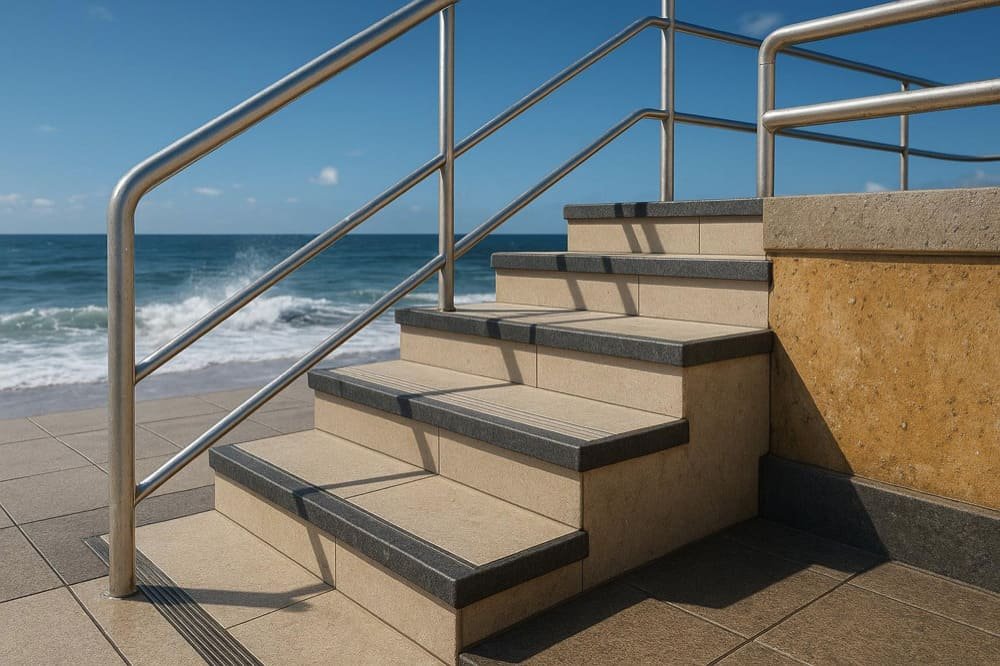
Public and semi-public stairs in coastal, humid subtropical climates ask a lot from materials: constant moisture, high UV, chloride-laden spray, and medium–high foot traffic. If you specify or procure for hotels, resorts, and residential communities, the smartest move is to optimize for long-term durability first—freeze–thaw resilience, UV stability, and corrosion resistance.
Then validate slip resistance and safety, all while keeping lifecycle cost in view. Updated for current 2025 standards, this guide distills the strongest options and where each shines.
What really governs performance (and safety) on coastal stairs
Salt and humidity accelerate deterioration. Chlorides attack metals and reinforced concrete; porous materials wick and hold water; UV degrades coatings and some polymers. Add periodic cold snaps or chilled nights and you create freeze–thaw stresses in saturated materials. In this context, three pillars decide outcomes:
- Durability under moisture, UV, and chlorides: choose low-absorption or non-porous bodies, chloride-tolerant metals or protective systems, and UV-stable finishes or resins.
- Slip resistance under wet use: specify per current methods—ANSI A326.3 for DCOF-based tile testing and DIN ramp classes for shod, inclined conditions. See the Tile Council of North America’s concise summary in the TCNA overview of ANSI A326.3 DCOF (current as of 2025) for how DCOF values relate to application categories and design context: TCNA overview of ANSI A326.3 DCOF.
- Stair geometry and drainage: tread depth, nosing radius, visual contrast on nosings, and a subtle slope-to-drain reduce pooling and slips. These design details often move the needle more than a single lab number.
A note on slip testing: ASTM C1028 has been withdrawn; for tile and pavers, rely on ANSI A326.3 DCOF declarations paired with project context, and consider DIN EN 16165/DIN 51130 R12–R13 textures for regularly wet, inclined exterior stairs.
Quick comparison snapshot
Below is a high-level view tailored to coastal, humid projects. Use it to shortlist; then dive into the material capsules for how to specify and what to watch.
| Material | Durability in coastal/humid exposure | Slip and safety notes | Maintenance & LCC | Core standards to cite |
|---|---|---|---|---|
| Porcelain pavers (20 mm) | Impervious body (≤0.5% absorption). Frost-resistant. UV-stable. | Use textured/structured surfaces; verify ANSI A326.3 DCOF and DIN class for exterior stairs. | Low routine care; inspect joints and nosings annually. | ISO 10545-3/-12; ANSI A326.3 |
| Granite/Basalt (natural stone) | Low absorption; strong and salt-tolerant with correct finish. | Flame/bush-hammer/sandblast; validate with stone slip/roughness tests. | Periodic sealing in salt spray zones; durable when detailed well. | ASTM C97/C170; EN 12371; BS EN 14231; NSI guidance |
| Sandstone (natural stone) | Higher absorption; vulnerable without sealing. | Requires aggressive texture; more frequent slip/finish maintenance. | Higher upkeep in coastal conditions; seal on a cadence. | ASTM C97/C170; EN 12371/14231 |
| Precast concrete treads | Durable with engineered mix (low w/cm, SCMs, air). Chloride risk if untreated. | Exposed aggregate or grooves help; manage drainage. | Reseal cycles; inspect for scaling/cracking. | ASTM C666/C672; RCPT targets (C1202) |
| Metals: galvanized, 304/316 SS, aluminum | 316 SS best in chlorides; galvanizing life finite under splash; aluminum ok with isolation. | Design against crevices/water traps; maintain finish. | Clean deposits; recoat galvanized; inspect fixings. | EN ISO 9227 for comparative salt spray |
| FRP/composites | Corrosion-immune; UV-stable resins required; verify fire behavior. | Gritted surfaces; contrasting nosings common. | Minimal upkeep; monitor UV wear and regrit if needed. | ASTM E84; D638/D790/D2344 |
| Treated wood (UC4A/B) | Treated for decay, but moisture cycling and UV take a toll. | Add anti-slip coatings; use 316 SS hardware. | Highest maintenance; shorter service life in coastal settings. | AWPA U1 UC4A/UC4B; AWPA M4 |
Material-by-material guidance
1. Porcelain pavers (full-body/BIa, typically 20 mm)
Why it fits: A vitrified body with water absorption ≤0.5% per ISO 10545-3 resists saturation, and products rated to ISO 10545-12 withstand freeze–thaw cycling without damage. That low porosity also means UV-stable faces and minimal staining compared with porous alternatives.
For exterior stairs, select textured surfaces with manufacturer-declared usage for wet, inclined conditions and verify slip performance via ANSI A326.3 and applicable DIN class for the intended use. For the frost piece of the puzzle, see the ISO 10545-12 frost resistance method: ISO 10545-12 overview.
How to specify
- Thickness: 20 mm (2 cm) pavers for stair treads and landings, or thicker where structural spans demand.
- Finish: R11–R13 textures for wet exteriors; confirm A326.3 DCOF and edge/nosing compatibility.
- Details: Use prefabricated or metal nosings with visual contrast; slope treads slightly to drain; account for thermal movement joints.
Constraints
- Needs a rigid, well-drained substrate and high-quality edge fabrication. Avoid polished or lightly textured finishes on exterior stairs.
Lifecycle and maintenance
- Routine cleaning, confirm grout/expansion joint integrity annually, and inspect nosings. Sealing is generally not required.
2. Natural stone (granite, basalt, sandstone)
Why it fits (and when it doesn’t): Granite and basalt offer low absorption, high compressive strength, and good wear; sandstone is more variable and often higher in absorption, which increases maintenance in salt and humidity. Specify by test numbers rather than stone names.
The Natural Stone Institute’s Dimension Stone Design Manual details absorption, strength, abrasion, and flexural test methods used for stair treads: Natural Stone Institute – Dimension Stone Design Manual.
How to specify
- Properties: Require ASTM C97 absorption results and compressive strength per ASTM C170; for freeze–thaw, use EN 12371 or equivalent; validate slip/skid via BS EN 14231 or a pendulum/roughness method appropriate to stone.
- Finish: Flame, bush-hammer, or coarse sandblast for traction; specify a minimum surface roughness or a slip test value suitable for wet stairs.
- Details: Edge profiles with visual contrast; slope to drain; salt-resistant sealers in splash zones.
Constraints
- Quarry-to-quarry variability; ensure lot-specific test reports. Sandstone may need frequent sealing and may still darken or spall in severe exposure.
Lifecycle and maintenance
- Expect sealing cadence in salt spray zones (often 12–24 months, product- and exposure-dependent). Inspect for polish from wear; retexture if needed.
3. Precast concrete stair treads
Why it fits: Concrete can be engineered for durability if you control permeability and air-void structure. Aim for low water–cementitious ratio, supplementary cementitious materials (e.g., slag, fly ash, silica fume), air entrainment for freeze–thaw, and curing practices that deliver low chloride penetrability.
Use RCPT (ASTM C1202) targets for severe exposures; many agencies set thresholds below 1000 coulombs. For background on RCPT targets and mix design strategies, see GCP Applied Technologies’ technical bulletin: RCPT guidance and targets (GCP Applied Technologies).
How to specify
- Durability tests: Freeze–thaw resistance per ASTM C666; deicer scaling resistance per ASTM C672 where applicable; RCPT limits (e.g., <1000 coulombs).
- Finish: Exposed aggregate, broom, or ribbed/grooved surfaces for traction; factory-cast nosings if desired.
- Details: Sealers appropriate to coastal chloride exposure; ensure drip edges and drainage to prevent ponding.
Constraints
- Without a stringent mix and sealer regimen, chloride ingress leads to reinforcement corrosion and cracking. Edges are vulnerable to impact without proper nosings.
Lifecycle and maintenance
- Reseal on a 2–5 year cadence depending on exposure. Inspect annually for scaling, cracking, and joint integrity.
4. Metals: galvanized steel, stainless 304/316, aluminum
Why it fits: Stainless 316’s molybdenum content improves corrosion resistance in chlorides, making it the go-to for handrails, fixings, and even stringers in splash zones. Galvanized steel offers economical protection where abrasion is low and splash is limited; aluminum is lightweight and resists general corrosion but needs galvanic isolation from dissimilar metals.
Salt spray tests under EN ISO 9227 provide comparative data for coatings and finishes—useful for QA, even if not predictive of life. For a current overview of the test’s role, see the ANSI brief on ISO 9227:2022: ISO 9227:2022 salt spray tests (ANSI overview).
How to specify
- Selection: 316 for splash/spray or where crevices are unavoidable; 304 only in protected zones; hot-dip galvanizing for carbon steel components with realistic inspection/recoat plan; marine-grade coatings as warranted.
- Details: Avoid water traps and crevices; isolate dissimilar metals; specify surface finishes that are cleanable and resist tea-staining.
Constraints
- Even 316 can suffer in stagnant, chloride-rich crevices. Galvanizing’s life shortens under abrasion or constant wetting. Aluminum is softer and may dent; galvanic corrosion is a risk without isolation.
Lifecycle and maintenance
- Rinse and clean deposits periodically; inspect joints and fasteners annually. Recoat galvanized components as cycles dictate.
5. FRP/composites
Why it fits: Fiberglass-reinforced polymer (FRP) stair treads, platforms, and gratings are inherently corrosion-resistant, making them strong candidates in salt spray environments. Gritted surfaces provide wet traction; UV-stabilized vinyl ester resins and surface veils mitigate sun exposure. Confirm fire performance for public use—many products target Class A per ASTM E84.
How to specify
- Performance: Require mechanical property data (tensile/flexural/interlaminar) and fire test classification (ASTM E84). Specify gritted, high-contrast nosings.
- Details: Verify deflection under expected loads; choose resin systems with UV inhibitors and document warranty terms for coastal exposure.
Constraints
- Not as stiff as steel; check vibration and impact tolerance. Some resins chalk under intense UV without proper stabilization; plan for regritting high-wear areas.
Lifecycle and maintenance
- Minimal corrosion maintenance; periodic washing; reapply grit topcoats where worn.
6. Treated wood (AWPA UC4A/UC4B)
Why it fits (with caveats): Pressure-treated lumber is familiar and cost-effective. For exterior stairs with ground contact or severe wetting, specify AWPA U1 Use Categories UC4A (general ground/freshwater contact) or UC4B (heavy-duty). Field cuts must be treated per AWPA M4 to keep protection continuous. The AWPA publishes use-category guidance suitable for specs: AWPA U1 Use Categories (excerpt).
How to specify
- Treatment: Match UC4A/UC4B to exposure; verify retention levels and treatment type; require field treatment of cuts/bores per AWPA M4.
- Hardware: Mandate 316 stainless fasteners and connectors in coastal settings to avoid galvanic damage and staining.
- Surface: Add non-slip coatings or bonded grit on treads; plan for drainage at stringer landings.
Constraints
- Highest maintenance burden in humid, salty air; UV degrades coatings; moisture cycling can lead to checks and decay at connections if details trap water.
Lifecycle and maintenance
- Annual inspections; frequent recoating of anti-slip finishes; prompt retreatment of field cuts. Expect shorter service lives vs inorganic materials in coastal exposure.
Scenario-based recommendations
Best for beachfront resorts and direct salt-spray zones
- Treads/landings: 20 mm porcelain pavers with R12–R13 textures or low-absorption basalt/granite with aggressive finishes and documented test data.
- Structure/hardware: 316 stainless for handrails and fasteners; avoid 304 or plan for rapid maintenance. Where steel is necessary, combine galvanizing with a robust coating and detail out crevices.
- Detailing: Continuous nosings with visual contrast; slope-to-drain; easy-to-clean surfaces.
Best for humid subtropical residential communities (semi-public, cost-controlled)
- Treads/landings: 20 mm textured porcelain for lowest lifecycle cost; or precast concrete treads with exposed aggregate, meeting freeze–thaw and RCPT targets, plus a practical sealer schedule.
- Hardware: 316 stainless fasteners even when using wood or concrete; aluminum handrails acceptable away from splash with proper isolation.
- Detailing: Prefabricated nosings; sealed joints; rain-shedding stair design.
Best for mixed indoor–outdoor transitions
- Continuity: Maintain compatible slip resistance across thresholds; verify ANSI A326.3 DCOF for interior wet areas and appropriate DIN class for exterior stair runs.
- Materials: Textured porcelain for consistency; or stone finished to a defined roughness, ensuring interior maintenance won’t polish surfaces smooth.
Procurement and lifecycle cost lens (factory-direct feasibility)
What you specify drives both risk and cost over time. Here’s a concise checklist to keep projects on schedule and within total cost expectations while sourcing from China at factory-direct pricing.
- QA/QC and documentation: Request test reports that match the standards cited in your spec (e.g., ISO 10545-3/-12 for porcelain; ASTM C97/C170 and EN 12371 for stone; ASTM C666/C672 and RCPT for concrete; ASTM E84 for FRP; EN ISO 9227 for metal finishes). Add first-article inspections to verify finish, dimensions, and nosings before mass production.
- Packaging and export readiness: Use ISPM 15-compliant pallets/crates; edge guards; desiccants and moisture barriers; clear handling markings; reinforced crates for porcelain and precast to prevent corner damage.
- Consolidated shipping: Combine materials by zone and unload sequence; segregate heavy/brittle from metal hardware; confirm container loading diagrams and tie-downs; ensure complete documentation (commercial invoice, packing list, certificates of origin, insurance) before sailing.
- Lead times and contingencies: Typical production/inspection/packaging can add 3–6 weeks before ocean transit. Plan a buffer for rework on first articles and retain spare treads/nosings for rapid replacement.
- Lifecycle cost controls: Favor low-absorption, corrosion-resistant materials to reduce sealing/recoating cycles. For concrete, hitting permeability targets at the mix stage is cheaper than years of patching. For metals, 316 up front saves multiple recoats or replacements. Think of it this way: an extra few dollars per linear tread that eliminates one reseal cycle pays back quickly in labor and disruption avoided.
Also consider
If you prefer a single partner to source porcelain, stone, precast concrete, metals, FRP, and treated wood with coordinated QA/QC, factory-direct pricing, export packaging, and consolidated shipping, you can learn more at ChinaBestBuy’s site: ChinaBestBuy – One‑stop Building Solutions.
Wrap-up
There’s no single “best” stair material for coastal, humid climates—there’s a best fit for each exposure, traffic pattern, and maintenance reality. As a rule of thumb, start with low-absorption surfaces (porcelain or dense stone), specify chloride-tolerant metals (316 stainless in spray), and set concrete and FRP performance with explicit test targets.
Validate slip resistance with current methods, design stairs to shed water, and lock down QA/QC and packaging early. Do that, and you’ll deliver stairs that stay safe, look good, and cost less to own over time.