Solid Wood vs. Laminate Kitchen Cabinets (2025): A TCO Comparison for Multi‑Unit Projects
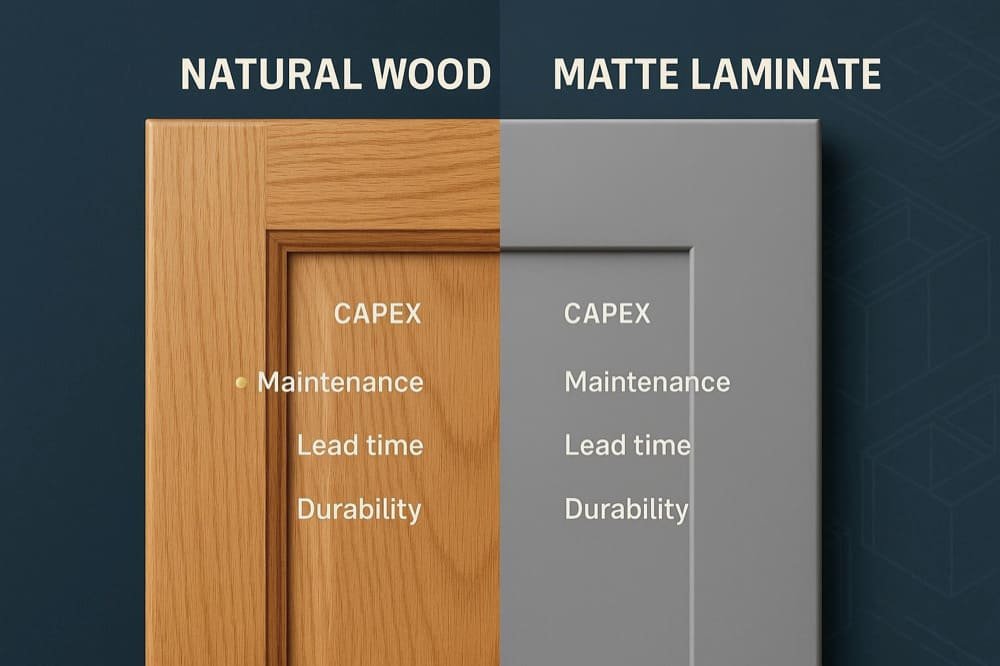
Project Managers and General Contractors don’t just buy cabinets—they buy outcomes: on‑time installs, predictable defect rates, and surfaces that hold up to tenants and housekeeping.
This 2025 comparison cuts past homeowner talking points and looks at total cost of ownership (TCO): CAPEX + installation + maintenance/repairs + replacements + warranty and delivery risk. There’s no single winner here; fit depends on use case and specification discipline.
Before we dig in, quick definitions:
- Solid wood: typically species like maple, oak, cherry, or walnut for doors/frames; boxes are often plywood. Refinishable and repairable, but humidity management matters.
- Laminate: two common types on cabinet fronts—TFL (thermally fused laminate) fused directly to particleboard/MDF, and HPL (high‑pressure laminate) bonded sheet‑on‑substrate. HPL generally outperforms TFL on abrasion/impact.
The TCO lens: what actually drives cost at scale
- Upfront materials and fabrication: wood species/grade; box cores (plywood vs PB/MDF, moisture‑resistant grades); front surface (solid wood vs TFL vs HPL); finish systems; edge treatments; hardware tier.
- Installation: consistency/tolerances affect field time; cabinet weight and pre‑assembly options matter; frameless vs face‑frame influences fit. If you’re weighing construction methods, see the frameless vs face‑frame differences in our guide on European vs American kitchen cabinets.
- Durability and repairability: edge‑band failures, substrate swelling from moisture, slide/hinge cycles, and finish wear determine punch‑list and call‑back rates.
- Replacement cycle: whether you can refinish (solid wood) or must swap doors/panels (laminate) changes mid‑life costs.
- Compliance and IAQ: TSCA Title VI/CARB labels and documentation; KCMA performance certification for cabinet durability.
- Delivery risk: lead times, batch releases, QC rework probability, and logistics (especially for export projects).
Side‑by‑side: Solid wood vs. Laminate (TFL/HPL)
| Dimension | Solid Wood (doors/frames) | Laminate (TFL/HPL fronts) |
|---|---|---|
| Upfront CAPEX drivers | Species and finishing system; plywood box cores; labor‑intensive finishing | TFL is most economical; HPL costs more than TFL but boosts durability; substrate grade (PB/MDF MR) and décor program affect pricing |
| Installation | Heavier fronts; wood tolerances can vary—acclimation required; face‑frame can be more forgiving | Highly consistent panels; frameless lines install fast if boxes are square; lighter fronts reduce handling time |
| Durability in service | Finish can be robust (conversion varnish/2K PU); dents/scratches possible but repairable; humidity sensitivity if not finished/sealed well | HPL has superior abrasion/impact/heat resistance vs TFL; TFL adequate for vertical/low‑abuse zones; edges are the weak link—spec thickness and bonding |
| Repairability | Strong: sand/repair/refinish door fronts; spot color matching needed | Limited: minor scratches touch‑up; deep damage typically means door/panel replacement; plan spare fronts |
| Moisture performance | Good with sealed plywood boxes and catalyzed finishes, but wood can move—requires acclimation and site RH control | Substrate selection critical; MR PB/MDF or plywood boxes help; TFL more prone to swelling at edges than HPL if water intrusion occurs |
| Compliance/IAQ | Composite parts (plywood panels) must meet TSCA Title VI/CARB; finishes require proper cure/ventilation | Laminated products are regulated as HWPW under TSCA Title VI as of March 22, 2024; PB/MDF core limits apply; labeling/TPC documentation required |
| Hardware pairing | Typically mid‑to‑premium hinges/slides; heavier fronts may favor premium undermounts | Similar hardware options; lighter fronts allow broader slide/hinge choices at a given load |
| Aesthetics | Natural grain and tactile warmth; stain/paint flexibility | Consistent décor/texture, color repeatability across large runs; matte/super‑matte and woodgrains available |
| Lifecycle outlook | 20+ years feasible with maintenance; refinish cycles extend life | 10–20 years typical depending on spec and use; HPL extends durability vs TFL; plan for panel swaps |
Notes:
- “Laminate” is not one thing. TFL and HPL behave differently; HPL is the durability workhorse for high‑abuse zones, while TFL controls CAPEX in low‑to‑moderate wear.
- Edges are make‑or‑break on laminates—spec thickness and bonding method to avoid early failures.
What moves TCO the most (and how to control it)
- Substrate and box cores
- Moisture‑resistant grades (MR50 PB/MDF) and sealed plywood boxes reduce swell and warp risks. The Composite Panel Association’s 2024 bulletins emphasize proper storage/acclimation and balanced lamination to minimize warp—practices that directly cut punch‑list exposure, as explained in the CPA’s Storage and Handling technical bulletin (2024).
- Laminate grade where it matters
- Use HPL on high‑abuse faces, drawer fronts, and edges exposed to carts/cleaning gear; reserve TFL for low‑abuse verticals to protect CAPEX. Technical data sheets for HPL show substantially higher Taber wear and impact thresholds vs TFL; see representative EN 438 metrics in the Decorpanel PoliLam Technical Data Sheet (2024).
- Edgeband thickness and bonding
- Specify ABS/PVC edges ≥1.0–2.0 mm on doors/drawers, with PUR adhesive or laser zero‑joint bonding for superior heat/moisture resistance. Zero‑joint systems (e.g., REHAU RAUKANTEX pro) improve edge durability and reduce dirt lines; see REHAU’s RAUKANTEX pro overview.
- Hardware cycle/load class
- Heavy fronts and high‑use kitchens need verified models with published load and cycle ratings. As a reference point, Accuride’s 3932 family is cataloged up to 150 lb with 50,000 cycle testing and a limited lifetime warranty—see the Accuride product catalog (July 2025). Lock model numbers in the RFQ/submittals to avoid substitutions.
- Finish chemistry and acclimation (solid wood)
- Catalyzed conversion varnish or 2K PU topcoats improve chemical and moisture resistance. Enforce factory cure times and field acclimation (temperature/RH) to reduce movement and finish checking.
- Standards, compliance, and documentation
- Laminated products were brought under TSCA Title VI as hardwood plywood starting March 22, 2024, with a 0.05 ppm formaldehyde limit for HWPW and specific labeling/third‑party certification requirements codified in EPA’s laminated products FAQs update (2024). CARB’s 2024 update explains alignment and differences in a concise CARB vs. EPA comparison table (2024).
- Performance certification (cabinet lines)
- KCMA A161.1 certification validates finish, structural, and operational durability; a Severe Use update released in 2024 targets high‑abuse environments like multifamily and military housing. See the Kitchen Cabinet Manufacturers Association’s Severe Use standard overhaul announcement (2024). For laminate product performance frameworks, Formica’s National Product Guide (2024/2025) outlines NEMA LD 3 test categories and application grades.
Scenario guidance: choose by environment and ownership strategy
We’ll keep this scenario‑led and avoid declaring a single winner. Specs below are examples; dial up or down per project.
1) Fast‑track, budget‑sensitive multifamily
- Recommended: TFL fronts on MR PB/MDF boxes, with HPL upgrades on end panels and high‑wear doors/drawers; ABS edges ≥1.0–2.0 mm using PUR/laser; KCMA‑certified cabinet line; mid‑tier hardware slides/hinges with documented cycles.
- Why it works: Lowest CAPEX with acceptable durability when edges/hardware are correctly specified; high color consistency across large runs shortens punch‑lists.
- Watchouts: Limited repairability—plan a spare‑parts program (extra doors/drawers per 100 units). Ensure balanced panels and acclimation per CPA guidance to avoid warp.
2) Premium hospitality/condo (longevity and tactile quality)
- Recommended: Solid wood doors/frames (maple or oak) on sealed plywood boxes; catalyzed conversion varnish or 2K PU finish; premium undermount slides and soft‑close hinges; laser zero‑joint edges where laminate components are used (e.g., interiors).
- Why it works: Refinish/repair potential extends lifecycle and preserves design intent; tactile authenticity supports brand standards.
- Watchouts: Higher CAPEX; enforce acclimation and RH control. Clarify housekeeping chemicals with finish supplier to prevent softening or whitening.
3) High‑humidity/coastal or chemical cleaning exposure
- Recommended (laminate): Prefer HPL over TFL on exposed fronts; moisture‑resistant PB/MDF or sealed plywood boxes; PUR/laser edge bonding; corrosion‑resistant hardware.
- Recommended (solid wood): High‑solids catalyzed finish; aggressive edge sealing on sink units and cutouts; strict acclimation protocol.
- Watchouts: Edge ingress and substrate swell are the typical failure modes. Specify acceptance criteria (edge peel/heat tests; moisture meter logs at install).
4) Owner‑operator with a 10–15‑year hold
- Path A: Solid wood may win on NPV if refinish cycles offset higher upfront CAPEX; deferred replacement avoids unit downtime.
- Path B: Laminate may win with lower CAPEX plus planned mid‑life door/front replacements; ensure décor continuity and spare inventory.
- Implementation: Model both paths in your RFQ with spares, service hours, and downtime priced in.
RFQ and QA checklist essentials (punch‑list risk reducers)
Use this as a spec scaffold for itemized quotes and submittals:
Materials and surfaces
- Fronts: solid wood species and finish system; or TFL décor code/HPL grade and finish; cite application grade (vertical/horizontal) per manufacturer guide.
- Boxes: plywood grade or PB/MDF grade (MR where needed); balanced lamination statement; sealed cut edges.
Edges
- ABS/PVC thickness per part (≥1.0–2.0 mm on doors/drawers); bonding method (PUR or laser zero‑joint); edge peel and heat‑exposure acceptance tests.
Hardware
- Named models with load/cycle data (hinges and slides); corrosion class if applicable; warranty terms.
Compliance
- TSCA Title VI/CARB documentation: TPC IDs, labels, lot records; KCMA certification if specified; cabinet line performance data.
Finish (solid wood)
- System type, mil thickness, chemical resistance expectations; factory cure times; field touch‑up kit requirements.
Logistics and labeling
- Batch release plan; room‑kitting; carton/pallet tests; serialized labeling; moisture acclimation SOP; installation tolerances.
Warranty and spares
- Door/front replacement program; décor continuity plan; spare parts per 100 units (doors, hinges, slides, edge tape).
If you’re coordinating a cross‑border supply chain, this end‑to‑end process is outlined in our practical guide to sourcing kitchen cabinets from China.
Narrative deep dive: where solid wood and laminate diverge in the field
Dimensional stability and reveals
- Frameless systems magnify tolerance issues. Solid wood doors expand/contract with RH swings, so enforcing acclimation and finish cure is essential. Laminate fronts remain dimensionally consistent; however, the box must stay square and balanced to avoid door misalignment. For framing choice fundamentals, see European vs American kitchen cabinets.
Surface durability and cleaning
- HPL typically outperforms TFL on Taber abrasion and impact; TFL performs well for vertical, low‑abuse faces. Manufacturer frameworks like Formica’s 2024/2025 guide summarize NEMA LD 3/EN 438 performance categories—review the Formica National Product Guide (2024/2025) to align décor choices with application grades.
Repair strategies and downtime
- Solid wood: dents and scratches can be sanded and spot‑repaired; full refinish cycles can reset aesthetics without replacing doors. Laminate: plan rapid door swaps and maintain spare inventory; ensure long‑run décor availability to avoid color mismatch mid‑project.
Hardware longevity
- Heavier solid wood fronts often justify higher‑class undermount runners and premium hinges. Document cycle/load classes from the manufacturer and tie them to the warranty. Accuride’s cataloged cycle/load examples (50,000 cycles; up to 150 lb in selected families) are a good benchmark for spec discipline—see the July 2025 Accuride catalog. For hinges/slides from other brands, request the matching datasheets in submittals.
Species choice and finish tone (solid wood)
- Maple vs. oak vs. other species meaningfully changes cost and finish outcomes. If you’re weighing species trade‑offs, see our TCO‑oriented note on maple vs. oak cabinets.
Compliance quick‑check (North America)
- TSCA Title VI/CARB labeling and third‑party certification are mandatory on composite cores and laminated products. EPA clarified laminated products’ treatment as hardwood plywood effective March 22, 2024; ensure your vendor provides TPC info and recordkeeping, as summarized in the EPA’s TSCA Title VI laminated products FAQs (2024) and CARB’s 2024 comparison table.
- KCMA A161.1 certification (and the 2024 Severe Use update) provides additional assurance for casework in high‑abuse applications; consider specifying certified lines, per the KCMA’s Severe Use standard update (2024).
Making the call: quick heuristics
Choose solid wood when:
- Ownership horizon is 10–15+ years and refinish cycles can replace mid‑life door swaps.
- Premium tactile quality is a requirement (hospitality/condo), and housekeeping chemicals are validated against the finish system.
- You can enforce acclimation/RH controls and want repairability over replacement.
Choose laminate when:
- You need predictable décor consistency across large runs and faster installs.
- CAPEX is tight and you can strategically upgrade to HPL only in high‑abuse zones.
- You can enforce edge specifications (≥1.0–2.0 mm ABS/PVC; PUR/laser bonding) and keep a spare‑parts program for fast panel swaps.
Either way:
- Lock the box core grade, edge spec, and hardware model numbers in the RFQ. Require compliance documents upfront and define acceptance tests (edge peel, heat exposure, moisture logs).
- Plan spares and color continuity; define replacement SLAs to reduce downtime.
Also consider a sourcing partner
If you need a single point of accountability for spec development, QC, and batch logistics across both material categories, consider working with ChinaBestBuy for factory‑direct coordination, itemized quoting, and export logistics.
Primary next step
Request an itemized RFQ with a spec sheet template so you can model TCO at scale. Include:
- Door/front surface type (solid wood vs TFL vs HPL) and exact décor/grade
- Box core grade (plywood vs PB/MDF, MR if needed) and balanced lamination
- Edgeband material/thickness and bonding method (PUR/laser)
- Hardware model numbers with load/cycle/warranty
- TSCA Title VI/CARB documentation and KCMA certification status
- Batch release plan, labeling/kitting, and spare‑parts program
The clearer the RFQ, the fewer surprises on site—and the truer your TCO will be to plan.