Top 7 Bathroom Ideas for Modern Bathrooms in 2025 (Developer Edition)
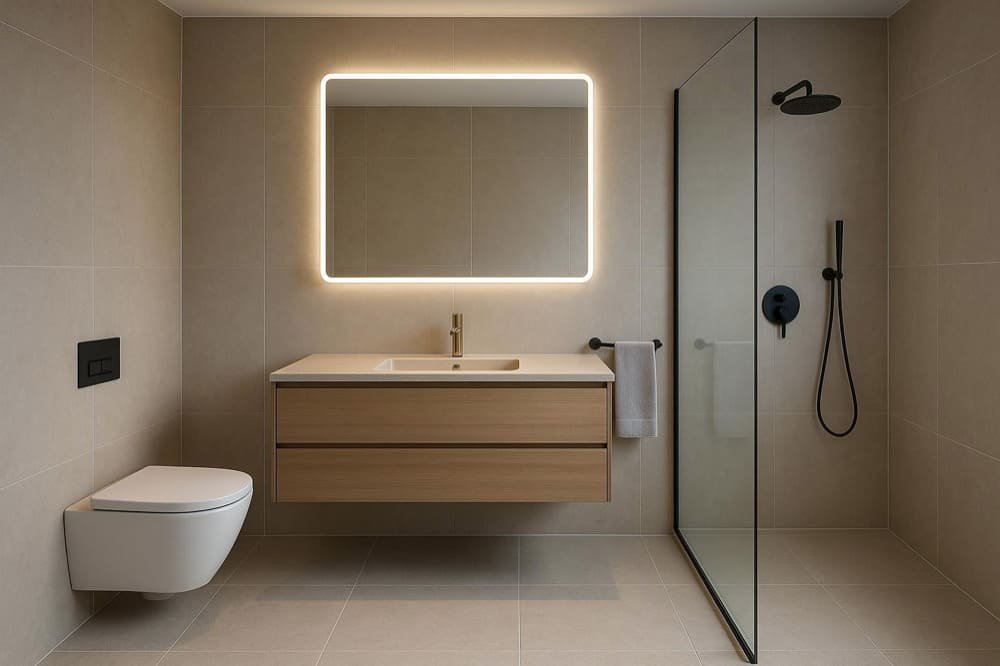
If you’re delivering hundreds of keys on a tight schedule, “nice inspiration” isn’t enough—you need ideas that scale, survive daily use, meet code, and can be procured and installed without drama. The seven ideas below are selected for their leverage in multi-unit projects: durability and lifecycle cost, installation speed, compliance potential, maintenance burden, and aesthetic versatility across unit types.
— How we weighed choices: durability/lifecycle (30%), scalability/schedule (25%), compliance & sustainability potential (20%), maintenance & hygiene (15%), aesthetic versatility (10%).
1) Large-Format Porcelain and Sintered Stone Surfaces
A monolithic, low-grout look that is tougher than natural stone and engineered for easy maintenance.
- Spec-ready notes
- Typical slab sizes: ~1200×2400–3000 mm porcelain; ~3200×1600 mm sintered stone; thickness options 6–12 mm for walls/vanities and 9–12+ mm for floors (verify per collection).
- Slip resistance: For interior wet-walked floors, the U.S. guideline commonly referenced is a wet DCOF of ≥0.42 under ANSI A326.3—see the Tile Council of North America’s explanation in the TCNA dynamic coefficient of friction overview (2024).
- Joints & grout: Rectified large-format tiles generally target ~3 mm joints; epoxy grout improves stain and moisture resistance in wet zones (see Mapei’s 2024 epoxy vs. cement grout tech talk).
- Why developers like it
- Fewer grout lines means faster cleaning and fewer hygiene complaints.
- Factory-finished surfaces resist stains/etching; no resealing cycles typical of some natural stones.
- Watch-outs
- Substrate flatness is critical; plan for full-coverage mortars and movement joints.
- Crane/hoist paths and on-floor handling plans are needed for XL slabs.
- Best for: Hotels and build-to-rent where housekeeping efficiency and long-term finish stability are priorities.
- Not for: Highly irregular substrates without remediation budgets.
2) Water- and Energy-Efficient Fixtures (Without Sacrificing Experience)
Lower operating costs and easier certification pathways with right-sized flow rates.
- Spec-ready notes
- Typical high-efficiency baselines: toilets ≤1.28 gpf; faucets ≤1.5 gpm; showerheads ≤2.0 gpm—confirm local code and brand warranties. The EPA WaterSense bathroom faucets page (2024–2025) explains labeled thresholds and certification.
- Public/commercial lavs may require ≤0.5 gpm aerators—verify jurisdiction.
- Why developers like it
- Utility savings at scale and potential alignment with LEED/WELL documentation.
- Consistent performance specs across tiers simplify BOQs.
- Watch-outs
- Pressure-balancing and thermostatic mixing must be tuned to lower flows to maintain comfort.
- Include a spare-parts plan (aerators, cartridges) in O&M manuals.
- Best for: Hospitality and multifamily chasing LEED/WELL credit potential.
- Not for: Ultra-luxe “rainfall” concepts without pressure management.
3) Prefabricated Bathroom Pods (When Speed and Consistency Rule)
Off-site built bathrooms shorten schedules, standardize quality, and reduce site waste—particularly powerful for repetitive unit stacks.
- Spec-ready notes
- Process: Early BIM coordination and design “freeze,” factory mock-up and QA (including leak tests), route/crane planning, quick-connect MEP tie-ins, commissioning.
- Transport constraints set max module dimensions—plan routes, staging, and rigging early.
- For a technical overview, see the NIBS Modular and Off-Site Construction Guide (2025).
- Execution partner example
- For integrated sourcing, QC, and export logistics of materials and kit-of-parts for pods, consider ChinaBestBuy as an end-to-end coordinator that matches factories, conducts in-house inspections, and manages global delivery.
- Why developers like it
- Parallel factory production compresses overall timeline; QA is controlled; site labor and rework drop.
- Watch-outs
- Early design lock-in is essential; late changes are costly.
- Crane access and structural openings must be solved at schematics.
- Best for: Hotels, student housing, rental apartments with repetitive layouts.
- Not for: Boutique one-offs or tight urban sites without crane access.
4) Accessibility and Universal Design (Designed-In, Not Bolted-On)
Make accessibility a design asset and reduce retrofit risk by baking in clearances and fixture choices from day one.
- Spec-ready notes
- Showers: ADA Section 608 sets minimum 36×36 in for transfer-type and clearances like 30×60 in for roll-in configurations—see the ADA §608 shower compartments reference (2010 standard; current on ADA.gov).
- Grab bars: Typical heights 33–36 in AFF; ensure backing in walls during framing; coordinate with tile layout.
- Doors: Provide a 32 in clear opening and turning radius where required; verify applicable local standards (e.g., ICC A117.1, FHA Type A/B units).
- Why developers like it
- Reduces change orders and ensures more units meet inclusive design expectations for hospitality and rental audiences.
- Watch-outs
- Ensure slope to drain does not create trip hazards; specify slip-resistant floors per project standards.
- Best for: Hospitality and mixed-use where guest demographics vary.
- Not for: None—accessibility planning benefits nearly all programs.
5) Touchless and Smart Operations (Hygiene with a Maintenance Plan)
Hands-free fixtures reduce touchpoints and can curb water waste; pick power strategies your staff can actually maintain.
- Spec-ready notes
- Power options: battery, hardwire, or self-powered. For example, Kohler offers hydroelectric, self-powered faucets that generate energy from flow—see the Kohler HES-powered commercial faucet spec page (current product).
- Plan service cycles for sensors/valves and stock consumables (filters, batteries) or specify hardwire to reduce replacements.
- Why developers like it
- Improved hygiene perception and consistent flow control.
- Potential integration with leak detection and building systems.
- Watch-outs
- Battery change logistics in multi-unit scenarios can strain ops if not planned.
- Best for: High-turnover hospitality and amenity restrooms.
- Not for: Sites without reliable access to power for hardwired options, unless choosing self-powered.
6) Maintenance-Friendly Finishes and Hardware (Design for Housekeeping)
Pick components that clean fast, resist damage, and meet safety codes without constant attention.
- Spec-ready notes
- Shower glass: Use tempered safety glazing labeled per ANSI Z97.1/CPSC 16 CFR 1201; typical frameless thickness ~3/8 in. The Safety Glazing Certification Council explains requirements in its SGCC safety glazing overview (2023).
- Hardware: Prefer 304 stainless; upgrade to 316 in coastal/corrosive environments.
- Coatings & sealants: Hydrophobic glass coatings and epoxy grout cut cleaning time.
- Why developers like it
- Fewer callbacks and lower housekeeping minutes per room.
- Watch-outs
- Deeply textured surfaces look great but trap grime—use as accents, not primary surfaces.
- Best for: Any program with tight cleaning SLAs.
- Not for: Ultra-textured, high-relief schemes in high-use showers.
7) 2025 Palettes and Textures—with SKU Standardization
Deliver a modern, calming look that’s easy to replicate across hundreds of bathrooms by standardizing finish packages.
- Spec-ready notes
- 2025 palettes continue warm neutrals, tactile stones, and minimal grout lines; large-format surfaces and metallic accents remain strong—see the Porcelanosa 2025 bathroom trendbook.
- Create A/B/C finish packages (e.g., Mid-Market, Premium, Flagship) that share core SKUs to simplify procurement and spares.
- Why developers like it
- Design consistency across phases and buildings, easier reordering, and predictable install sequences.
- Watch-outs
- Limit exotic or import-sensitive SKUs that could destabilize lead times; always define alternates for critical path items.
- Best for: Portfolio owners and brands enforcing a standard look with minor regional tweaks.
- Not for: One-off custom homes with unique artisan materials.
Practical procurement checklist (use this to speed up your BOQ request)
- Unit count by typology (e.g., king, double, studio, 1BR) and any accessible unit ratios.
- Target finish tier(s) and any brand standards you must meet.
- Preferred flow rates (toilets/faucets/showers) and certification goals (LEED/WELL if any).
- Schedule constraints: design freeze date, first-install date, delivery phasing.
- Site constraints: crane access (for pods), hoist limits, storage conditions.
Ready to turn ideas into a coordinated package? Request a Full Bathroom Package Quote and we’ll assemble consolidated BOQs (materials + fixtures + accessories + export packaging + international shipping) with value-engineering alternatives and lead-time planning.
Notes and caveats
- Performance ratings and codes evolve; always verify local requirements before final specification.
- Manufacturer-specific data (DCOF, warranties, power specs) should be confirmed at model selection stage.