Top 7 Kitchen Ideas for Modern Kitchens in 2025
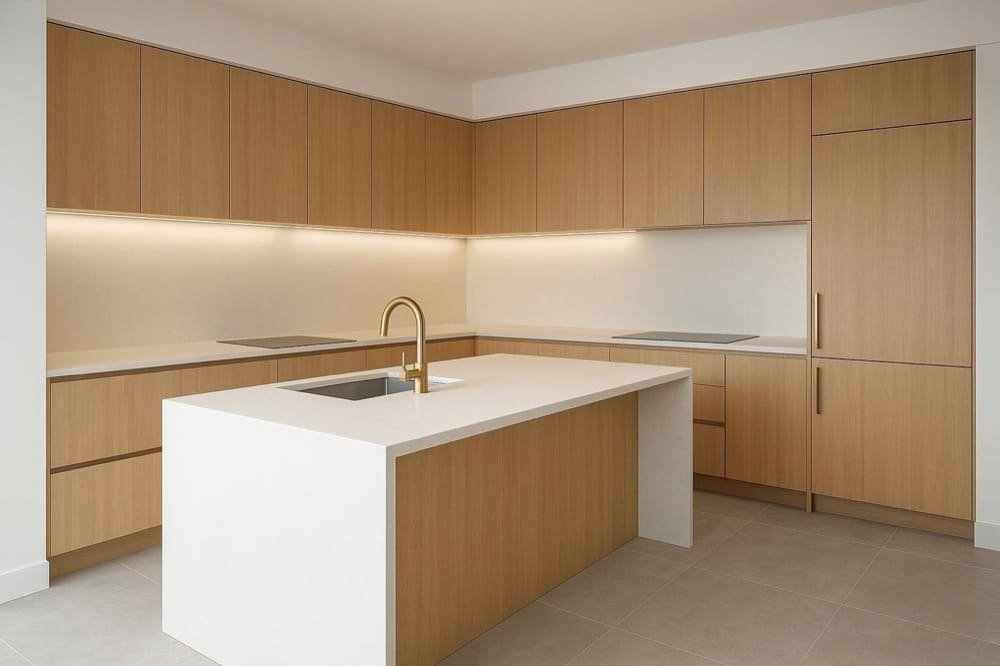
Developers and architects don’t just need “pretty.” You need design directions that scale across dozens—or hundreds—of units, stay on budget, meet codes, and minimize punch lists.
Here are seven 2025-forward kitchen ideas that pair modern aesthetics with practical specifications, compliance notes, and procurement tips you can actually build around.
For trend context, these directions align with mainstream 2025 coverage (for example, concealed function, islands, and warm, natural finishes noted by House Beautiful’s 2025 kitchen trend roundup published in 2025), but are translated here for multi-unit feasibility.
How we chose
- Scalable across multi-unit deployments
- Durable, low-maintenance materials and finishes
- Compliance-ready (emissions, energy/water, safety) with documentable standards
- Design longevity and tenant appeal
- Installation and logistics feasibility for global projects
1) Handle-free modular cabinetry (with a modern Shaker option)
Positioning: Clean-lined, handle-free fronts or slim-rail pulls keep elevations calm and contemporary; a narrow-profile modern Shaker adds subtle detailing without drifting traditional. For multi-unit projects, modularity and preplanning drive your install velocity.
Specification and materials
- Cores and finishes: Specify composite wood that meets formaldehyde emission limits under TSCA Title VI/CARB Phase 2 in the U.S. and E1 under EN 717-1 in the EU. See the U.S. EPA’s TSCA Title VI FAQs (updated 2024–2025) and Sweden’s chemicals agency (KEMI) summary of E1 emission class for context.
- Module grid: Standardize widths (e.g., 12/15/18/24 inches or 300/450/600 mm) and hinge/pull drilling to simplify ordering and replacements.
- Hardware: Soft-close hinges/slides and quick-connect fittings reduce noise and speed installation.
Procurement notes
- Choose a short list of door styles and finishes across the development to lock in volume pricing and ensure color consistency over phases.
- Decide early between RTA (flat-pack) or pre-assembled depending on site labor costs and elevator constraints.
Best for
- Multifamily units where you need fast, repeatable install and a modern aesthetic that doesn’t date quickly.
Watchouts
- True push-to-open systems require precise alignment; consider slim pulls for heavy-use rental stock to reduce maintenance calls.
2) Waterfall islands and durable countertops (quartz vs. sintered stone/porcelain)
Positioning: A monolithic island with a waterfall edge anchors open-plan kitchens and adds generous prep and entertaining space. Two materials dominate project specs: quartz and sintered stone/porcelain.
Material comparison
- Quartz (engineered stone): Non-porous and stain-resistant with common thicknesses of 20 or 30 mm. Because of resin binders, treat heat carefully—plan trivets for hot cookware. For a representative data point on product and care, see Caesarstone’s 1141 Pure White page.
- Sintered stone/porcelain: Exceptional heat and scratch resistance, large-format slabs, and thin yet strong profiles (6/12/20 mm are typical). See Cosentino’s Dekton technical guide (2025) for thicknesses and performance characteristics.
Detailing and logistics
- Waterfall edges: Use mitered corners and color-matched adhesives; plan factory pre-miters for consistency across phases.
- Overhangs and supports: Follow manufacturer guidance for substrate and bracket spacing—especially at seating overhangs.
- Seams: Sequence slabs and lighting to minimize visible seams; coordinate with cabinet shop drawings.
Best for
- Premium model units, amenity kitchens, or any unit tier where longevity and easy cleaning matter.
Watchouts
- Verify availability of matching vertical slab for the waterfall leg to avoid batch/lot color variation.
3) Integrated task/smart lighting and concealed appliances
Positioning: Continuous lines stay modern when work lighting is tucked under cabinets and appliances disappear behind panels. The result: quieter elevations and a premium feel, without sacrificing function.
Specification and compliance
- Task lighting: Target neutral-white LEDs with high CRI for accurate color rendering. Pre-plan wire routing and driver access to avoid field improvisation.
- Panel-ready appliances: Refrigerators and dishwashers can still be energy-efficient—use models that meet current criteria. ENERGY STAR’s Most Efficient 2025 listings outline top performance tiers you can specify toward.
- Electrical planning: The 2023 NEC revised island/peninsula receptacle rules; placement and provision differ from prior cycles. Eaton’s overview of NEC 2023 kitchen receptacle updates is a helpful briefing—always verify local adoption.
Procurement notes
- Lock in panel thickness and hardware early with appliance vendors; share panel weights with the cabinet factory for hinge selection.
Best for
- Open-plan kitchens in multifamily and hospitality where sightlines matter.
Watchouts
- Ensure adequate ventilation clearances for panel-ready units, especially in compact layouts.
4) Low-maintenance flooring that installs fast (SPC/LVT or porcelain tile)
Positioning: Flooring is a lifecycle-cost lever. Stone polymer composite (SPC) or luxury vinyl tile (LVT) can speed installation and improve acoustics, while porcelain delivers unmatched scratch and heat resistance.
Specification and safety
- Slip resistance: For interior wet areas, aim for tiles tested to ANSI A326.3 with a dynamic coefficient of friction (DCOF) ≥ 0.42, per the Tile Council of North America’s DCOF guidance.
- SPC/LVT: Click systems accelerate install and limit downtime; underlayment can improve sound ratings. Select wear layers appropriate to turnover.
- Porcelain: Highest durability; factor in grout maintenance and longer install times but a longer service life.
Procurement notes
- Standardize 2–3 SKUs across the project. Pre-approve transition profiles and reducers to minimize on-site decisions.
Where a factory-direct partner helps
- Coordinating cabinets, countertops, and flooring through one factory-direct program reduces color-lot variability and simplifies delivery sequencing—especially for phased towers or garden-style communities. If you need a single point of contact for cabinet modules, worktops, tiles, sinks, faucets, and hardware, consider partnering with ChinaBestBuy for specification-to-shipment consolidation.
Best for
- Multifamily value-engineered tiers (SPC/LVT) and premium amenity/model units (porcelain) where long-term durability is the priority.
Watchouts
- Confirm slip ratings and acoustic assemblies with the GC for local code and lease requirements.
5) PVD-finished faucets and coordinated hardware
Positioning: Coordinated metal finishes across faucets, pulls, and accessories create cohesion. Physical Vapor Deposition (PVD) coatings offer improved scratch and corrosion resistance versus traditional electroplating—helpful in high-turnover units.
Specification and compliance
- Water use: For bathrooms in the same project, EPA WaterSense labeling is a simple efficiency signal; see the EPA’s page for Bathroom Faucets (program overview, accessed 2025). Kitchen faucet specifications are under consideration by EPA; confirm local requirements and any owner standards.
- Accessibility: Favor lever handles and D-pulls that are easy to operate; coordinate heights and clearances with your accessibility consultant when applicable.
Procurement notes
- Standardize one finish family (e.g., brushed PVD) across units to reduce spare-part complexity and simplify maintenance.
Best for
- All unit tiers seeking durable finishes with fewer warranty claims.
Watchouts
- Confirm cartridge type and serviceability; stock a small buffer of aerators and cartridges for quick turnarounds.
6) Sustainability-forward specs you can document
Positioning: Sustainability isn’t only about materials—it’s also about documentation and replaceability. Choose specifications that you can substantiate and maintain.
Specification and documentation
- Emissions: Use cabinetry cores verified to meet TSCA Title VI/CARB Phase 2 or EU E1. Keep mill certificates and supplier attestations on file (see EPA and KEMI references in Idea 1).
- Long-life surfaces: Sintered stone/porcelain counters and porcelain tile floors extend service life, reducing replacements.
- Modular replaceability: Standardized cabinet modules and door/drawer fronts make partial refreshes feasible without scrapping whole runs.
Procurement notes
- Request EPDs where available and capture all certificates (emissions, slip-resistance, appliance efficiency) in your handover package.
Best for
- Developers seeking to balance ESG reporting needs with practical, low-maintenance operations.
Watchouts
- Avoid over-customization that complicates future replacement cycles and spare inventories.
7) Multi-functional islands with real-world ergonomics and power
Positioning: Islands do triple duty—prep, dining, and storage. In 2025, they’re also smart: integrated power/charging and trash-recycle organization keep counters clear.
Planning and compliance
- Clearances: Typical planning targets are 42 inches for work aisles (single cook) and up to 48 inches for multi-cook scenarios to improve flow; align with your local guidelines and accessibility requirements.
- Power and code: The 2023 NEC adjusted island/peninsula receptacle rules; if you include outlets, confirm placement and protection (GFCI/AFCI) according to your jurisdiction’s adoption. Eaton’s primer on NEC 2023 kitchen receptacles is a good starting point—coordinate final layouts with your electrical engineer.
Procurement notes
- Pre-plan drawer organizers, recycling pull-outs, and pop-up/edge power in the millwork drawings so the factory can pre-cut and reinforce panels before finishing.
Best for
- Open-plan units and amenity kitchens where the island is the social hub.
Watchouts
- Overhangs beyond manufacturer limits need concealed brackets; specify early to avoid field fixes.
Next steps (for developers, architects, and procurement leads)
- Standardize your specification set (cabinet modules, finishes, worktop edges, flooring SKUs, fixture finishes) across unit types.
- Capture documentation up front (emissions certificates, slip-resistance tests, ENERGY STAR/WaterSense listings, warranties).
- Sequence logistics by building/stack and pre-assign install kits per unit to compress schedules.
If you’d like a single, factory-direct partner to quote cabinets, worktops, flooring, sinks, faucets, and hardware to your exact sizes and finishes—and package everything for global shipping—request a consolidated materials quote from ChinaBestBuy. You’ll get coordinated samples, shop drawings, and a line-item BOM aligned to US/EU/AU standards.