What Is a Spiral Staircase? Types and How to Choose
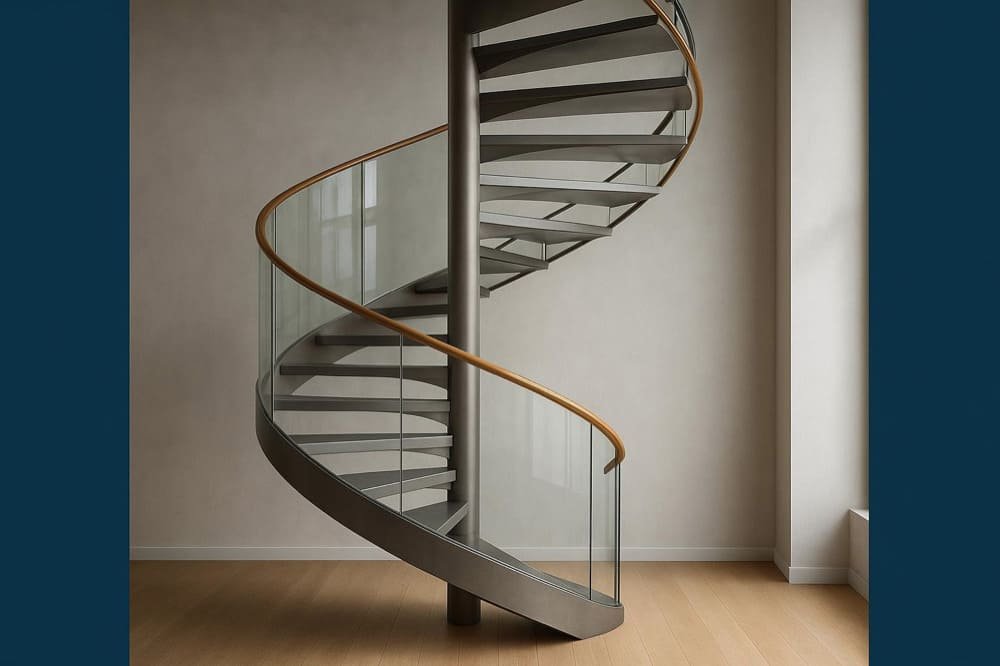
A spiral staircase wraps treads around a central support—usually a steel column—creating a compact vertical route that saves floor area and adds visual interest. It’s different from a helical stair or circular stair: those curve gracefully without a central pole and typically require more space and structural continuity. For procurement managers and architects, the distinction matters because it drives geometry, comfort, and code classification.
If your project aims to optimize tight interiors or deliver a bespoke centerpiece with premium materials, a spiral stair can be the right call. The key is to balance space, user comfort, and compliance from the first sketch through fabrication, QA, and delivery.
Geometry and components that matter
Before comparing types, align on the essentials that determine how the stair feels, passes inspection, and fits the structure:
- Central support and treads: Spiral stairs typically use a central column with tapered treads radiating outward. Consistency of tread angle and attachment tolerances drives smooth walking and clean sightlines.
- Clear width: The usable width measured at and below the handrails; it governs both comfort and code compliance.
- Walkline and going: Codes define where you measure tread depth—often at a fixed distance from the inner edge (e.g., 12 inches/305 mm under the U.S. IBC). That measured depth is the going. Think of the walkline like the ideal path your foot follows around the curve.
- Rise and headroom: Uniform riser heights reduce trip risk; headroom (commonly around 80 inches/2032 mm in U.S. practice) avoids “jarring” encounters with the ceiling.
- Handrails and guards: Height, continuity, and loading limits must meet local standards; detailing matters at joints, terminations, and landings.
- Landings and interfaces: How the stair connects to slabs or steel frames (baseplates, anchors, stiffeners) is as critical as the stair itself.
According to the 2024 International Building Code, spiral stairways must provide a minimum clear tread depth of 6¾ inches (171 mm) measured at a point 12 inches (305 mm) from the narrow edge, and a clear width not less than 26 inches (660 mm) at and below the handrails, with uniform treads. See the official text in IBC 2024 Section 1011.10 Spiral stairways. General riser limits of 7 inches (178 mm) maximum and 4 inches (102 mm) minimum appear in IBC 2024 Section 1011.5.2 Riser height.
Multi‑region compliance snapshot (verify locally)
Designers working across regions should anchor decisions to recognized standards, then confirm local amendments with the Authority Having Jurisdiction (AHJ):
- United States (IBC/ICC): Geometry and egress provisions are in Chapter 10, with structural loads for stairs, guards, and handrails in Chapter 16. Typical guard/handrail design loads include 50 plf and a 200‑lb concentrated load at the top, per IBC 2024 Chapter 16 structural design (Section 1607.8.1).
- UK/Europe (BS 5395‑2, AD K, Eurocode loads): UK Approved Document K directs designers to BS 5395‑2 for spiral/helical stairs. Publicly accessible industry guidance reproduces this pointer (e.g., AD K paragraph 1.28). Use the official government publications for current wording and pair with barrier load guidance (e.g., BS 6180 and national annexes to EN 1991‑1‑1). A practical overview referencing AD K/BS 5395‑2 is offered by industry summaries such as Spiral UK’s guidance on spiral staircase building regulations (UK); consult the latest gov.uk document for definitive text.
- Australia/New Zealand (NCC 2022; AS 1657): The NCC 2022 Volume One sets dimensional controls for stairways with housing specifics in Housing Provisions Part 11.3 Barriers and handrails. Industrial access often follows AS 1657:2018; confirm scope before applying workplace stair rules to residential/commercial settings.
- GCC notes (UAE examples): Many jurisdictions discourage spiral stairs for primary escape routes or accessible main access; approvals are AHJ‑dependent. For planning context, see the Ras Al Khaimah Architectural Requirements (English, 2021) and coordinate with Civil Defence for the project’s emirate/country. Treat egress use of spiral stairs as a case‑by‑case review.
A simple rule of thumb: confirm where spiral stairs are permitted (private vs public, primary vs secondary access), then size geometry and guard/handrail loads to the most demanding occupancy you expect.
Types by material and system
Material choice shapes performance, durability, and aesthetics—especially in space‑saving interiors and high‑end showpieces.
Steel (carbon and stainless)
- Carbon steel suits interior stairs and can be protected for exterior use via galvanizing or high‑performance coatings. For exterior durability, specify hot‑dip galvanizing to ISO 1461:2022 and architectural powder coating performance to AAMA 2604/2605 or European equivalents.
- Stainless steel (304/316/duplex) offers corrosion resistance and a crisp finish. In coastal or chlorinated environments, 316 or duplex grades outperform 304.
Cast iron
- Traditional, ornamental aesthetics with robust feel. Casting quality, dimensional control, and coating systems require disciplined QA; consider metallizing or multi‑coat paint systems for exterior.
Aluminum
- Light weight aids installation and reduces corrosion risk; design around stiffness and connection detailing to avoid vibration.
Glass systems
- Laminated safety glass is a must for treads and balustrades (e.g., per ASTM C1172/EN 14449; toughened glass per EN 12150). Interlayer selection (PVB vs ionoplast) affects stiffness and post‑breakage behavior. For performance context, review TCNA resources on slip resistance and DCOF, such as ANSI A326.3 overviews.
Stone or engineered stone
- Striking, tactile surfaces with custom nosings and anti‑slip treatments. Reinforcement and thickness must be engineered to loads.
Wood
- Warm, quiet underfoot with species choices for wear resistance. Control moisture content and creep; consider nosing profiles with inserts for traction.
Hybrid systems
- Mix metals with glass or stone for bespoke results. Hybrids raise the bar on connection detailing, tolerances, and testing—plan for mock‑ups.
Selection anchored to two common scenarios
A. Space‑saving interiors (residential/multifamily)
When every square meter counts, spirals compress footprints compared with straight flights and landings. The trade‑off: tighter curves reduce comfort on large furniture moves and can challenge accessibility.
- Footprint and diameter: Smaller diameters save space but narrow the walkline and clear width. In many U.S. residential contexts, designers keep clear width at or above 26 inches to align with IBC; verify local codes.
- Comfort tuning: Aim for uniform risers and consistent going at the code’s measured radius. A continuous handrail improves confidence for children and older adults.
- Noise and privacy: Metal treads can transmit sound; consider wood overlays, rubber inserts, or tread pads. Balustrade opacity (metal infill vs glass) changes sightlines in compact layouts.
- Finish resilience: In high‑touch interiors, choose coatings that resist wear and fingerprints; stainless with a brushed finish hides smudges better than mirror polish.
B. Custom luxury (glass, stone, premium metals, bespoke finishes)
For hospitality and high‑end homes, spirals can become sculptural. Luxury materials demand elevated engineering and QA:
- Glass treads and balustrades: Use laminated assemblies with documented interlayers and engineering sign‑off. Slip‑resistant treatments—acid‑etched patterns or frits—should be tested for DCOF/PTV per regional practice.
- Metals and patinas: Consider duplex stainless, bronze accents, or blackened steel. Specify finish samples and acceptance criteria (gloss, color variance, scratch resistance).
- Stone craft: Coordinate reinforcement, nosing profile, and anti‑slip. Protect edges in shipping with rigid crating and foam wraps.
- Lighting integration: LED handrails or tread edge lighting enhance the “feature” effect; confirm cable routes and service access in shop drawings.
Procurement and supplier evaluation checklist
For international sourcing, a disciplined package reduces risk and speeds approvals:
- Compliance path and specs: State the code route (e.g., IBC/IRC; AD K + BS 5395‑2; NCC/AS; GCC AHJ), geometry targets (diameter, clear width, going/rise, headroom), guard/handrail loads, materials/grades, coatings, slip resistance, anchors, and tolerances; request stamped calculations where required.
- Factory capability and QA: Verify EN 1090‑1 certification for EU/UK projects, ISO 9001, welding credentials (ISO 3834 or AWS D1.1). Ask for FPC certificates, WPS/PQR, welder quals, and sample inspection reports.
- Samples and mock‑ups: Call for finish chips, laminated glass specimens with interlayer IDs, anti‑slip nosing samples, and optional partial junction mock‑ups.
- Packaging and logistics: Require ISPM 15‑compliant timber, labeled components, corrosion protection (VCI wraps/desiccants), crate drawings with weights/COG, containerization plans, Incoterms, insurance, and schedule buffers.
- Installation readiness: Provide baseplate/anchor details, tolerance maps for fit‑up, lifting/sequence plans, and local inspection requirements.
Installation readiness and coordination
Even a perfect stair will disappoint if the receiving structure isn’t prepared. Share and review baseplate locations, anchor types, grout beds, and shimming strategies early. Confirm headroom at the tightest points, especially under soffits or secondary landings.
Decide which connections are site-bolted versus shop-welded, and plan safe lifting paths. On inspection day, have QA records and coating certificates available, along with handrail continuity checks and guard opening measurements (e.g., UK’s 100-mm sphere rule in practice).
Practical example workflow (international sourcing)
Here’s how a buyer might request a code‑checked spiral stair package through ChinaBestBuy, keeping design and compliance aligned:
- Brief and geometry: You share floor‑to‑floor height, target diameter, clear width, preferred materials/finishes, and the applicable code path (e.g., IBC 2024 with local amendments).
- Technical proposal: We return a concept set with geometry at the defined walkline, riser/going tables, handrail/guard details, and a compliance note referencing the relevant clauses; for EU/UK projects, we include EN 1090‑1 scope and execution class proposals.
- QA and samples: Finish chips, laminated glass specimens with interlayer documentation, and optional partial mock‑ups are produced; welding/WPS documentation and material test certificates are shared.
- Packaging and shipping plan: Crate drawings, ISPM 15 compliance, labels, corrosion protection steps, and Incoterms (DAP/DDP) are confirmed alongside provisional transit windows.
- Final shop drawings and production: Approved drawings move to fabrication with in‑process inspections; a pre‑shipment dimensional report and coating certificates are issued.
This workflow ensures designers and procurement teams can validate compliance while keeping schedules realistic.
Cost, lead time, and shipping notes
Spiral stair costs vary with material systems, finishes, geometry complexity, and testing/documentation requirements. International lead times reflect fabrication plus transit.
- Incoterms: DAP or DDP often suits bulky architectural assemblies; responsibilities are clearer across multimodal legs than sea‑only terms. Align with contract language and insurance.
- Transit ranges (context only): Typical ocean port‑to‑port windows are China → US West Coast ~13–25 days, US East Coast ~25–35, Northern Europe ~30–45, UAE ~25–35, Australia ~10–18, New Zealand ~15–22. Check current carrier schedules—events like Red Sea disruptions can shift timings.
- Crate engineering: Protect finished surfaces with foam films, edge guards, and rigid bracing; separate flights, landings, and rails; include hardware kits and clear labels.
Common mistakes and smart trade‑offs
- Undersized diameter: Saving space is tempting, but squeezing the walkline can make the stair feel precarious. Size for users and furniture movement.
- Vague compliance specs: “Follow local code” isn’t enough. Cite the applicable clauses and measured geometry; include guard/handrail load targets.
- Finish selection without samples: Luxury projects deserve finish chips and acceptance criteria; otherwise, color/gloss surprises are likely.
- Ignoring slip resistance: Wet or high‑traffic areas need verified DCOF/PTV or local equivalents.
- Overlooking installation tolerances: Baseplate plumbness, anchor edge distances, and handrail continuity checks should be planned, not improvised.
Final thoughts and next steps
Spiral stairs excel when you match geometry and materials to the space and confirm the compliance path early. Whether you’re designing for a compact duplex or curating a showpiece with glass and premium metals, start with a clear spec, verify factory credentials, and lock down packaging and logistics alongside drawings.
If you’d like a single partner to coordinate design, factory‑direct production, QA, and global delivery, our team at ChinaBestBuy can help you scope and quote a spiral staircase package aligned to your target market’s standards.
For code specifics, always confirm with your AHJ and refer to primary sources: IBC 2024 Section 1011.10 for spiral geometry, IBC Chapter 16 loads, UK AD K pointers to BS 5395‑2, NCC 2022 Volume One and Housing Provisions Part 11.3, plus GCC AHJ guidance such as RAK Architectural Requirements. Then let the materials and detailing bring the staircase to life.