What Is “Taj Mahal Marble”? (And Why Most Projects Mean Quartzite)
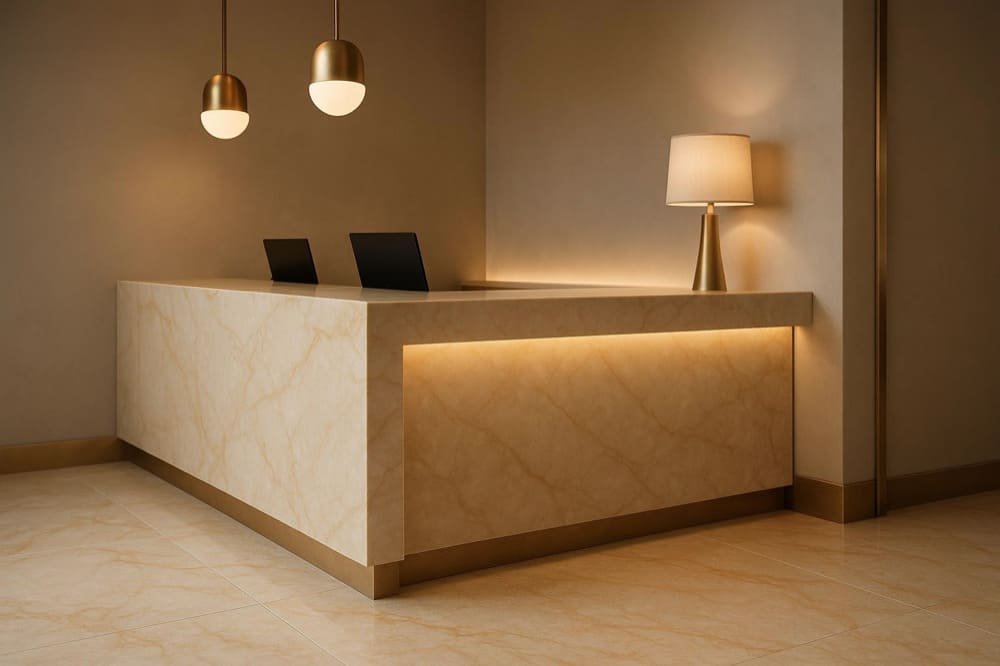
“Taj Mahal Marble” is a common trade name for a warm, creamy-beige stone with soft gold or gray veining used for countertops, floors, and wall cladding.
In modern interiors, however, most slabs sold under this name are not marble at all—they’re Taj Mahal Quartzite, a hard, quartz-rich natural stone prized for durability and subtle elegance.
The term persists because the look resembles marble and because the famous Taj Mahal monument is clad in white marble, but geologically and commercially these are different materials.
Key takeaways
- In today’s market, “Taj Mahal Marble” typically refers to Taj Mahal Quartzite, not true marble.
- True quartzite is harder and more resistant to kitchen acids than marble, though sealing is still recommended for stain management.
- If you need a consistent “Taj Mahal” look with low maintenance, porcelain slabs/tiles and engineered options are strong alternatives.
Myth-buster: It’s usually quartzite, not marble
- Quartzite is a metamorphic rock composed mostly of quartz and is typically around Mohs 7 in hardness, which makes it highly scratch resistant and generally resistant to etching from common household acids; the Natural Stone Institute explains these properties in its overview of the properties of quartzite (2019), and the U.S. Geological Survey describes quartzite as a quartz-rich metamorphic rock.
- Marble, by contrast, is predominantly calcite/dolomite (Mohs ~3), which is why it scratches more easily and readily etches with acids; see the Natural Stone Institute’s marble care guidance on etching and maintenance.
- The historic Taj Mahal mausoleum is famously clad in white marble (Makrana). This is well documented by UNESCO’s description of the Taj Mahal as a white marble mausoleum and Britannica’s overview of the monument’s marble construction. That historic marble is not the modern “Taj Mahal Quartzite” used in kitchens and lobbies.
How Taj Mahal Quartzite looks (and why it’s popular)
Taj Mahal Quartzite typically ranges from creamy-beige to warm off-white with soft gold and occasional gray veining. Movement can be linear or gently flowing, and finishes commonly include polished (gloss), honed (matte), and brushed/leathered (soft texture). A representative commercial listing also notes this stone is quarried in Brazil; see an example where the Taj Mahal Quartzite origin is listed as Brazil.
Natural variation is part of the appeal—no two slabs are perfectly alike. If your project requires tight visual consistency, consider porcelain or engineered lookalikes; the Natural Stone Institute discusses how natural quartzite varies and how to identify it accurately in its definitive guide to quartzite.
Quartzite vs Marble vs Porcelain “Taj Mahal look”: What’s the difference?
Taj Mahal Quartzite (natural stone)
- Performance: High hardness, excellent scratch resistance, and generally resists etching from common kitchen acids; periodic sealing helps reduce staining. See Natural Stone Institute: properties of quartzite.
- Best for: Kitchen countertops and high-use worktops, feature walls, busy floors (finish-dependent), and other high-traffic zones.
Marble (natural stone)
- Performance: Softer (Mohs ~3), prone to scratching and especially etching with mild acids; requires more maintenance and acceptance of patina. See NSI marble care and etching guidance.
- Best for: Low-traffic areas, feature walls, or spaces where a lived-in patina is desired and maintenance is understood.
Porcelain “Taj Mahal look” slabs/tiles (manufactured)
- Performance: Very low water absorption (porcelain classification requires ≤0.5% by mass per ISO 13006:2018); excellent chemical and stain resistance tested via the ISO 10545 series. Slip performance for interior floors is assessed by DCOF testing per ANSI A326.3 (TCNA publications), alongside a project-specific risk assessment.
- Best for: Bathrooms and wet areas, public corridors, exterior cladding (when designed and installed per standards such as ISO/TS 17870-3:2023 for large porcelain panels), and applications needing consistent visuals and thin, large formats.
Engineered quartz with a Taj Mahal-like design (manufactured)
- Performance: Consistent patterning and low day-to-day maintenance; note resin binders can impose heat limitations vs natural quartzite. The Natural Stone Institute compares these categories in “Natural Quartzite and Engineered Quartz—What’s the Difference?”.
- Best for: Projects prioritizing uniformity and predictable supply with simple care routines.
Application and specification guidance
Countertops and worktops
- Quartzite offers a strong blend of hardness and acid resistance; seal with a quality penetrating sealer and use trivets and cutting boards as best practice. See NSI care for quartzite countertops.
- Marble can be specified if you accept etching/patina and commit to appropriate maintenance; see NSI marble care guidance.
- Porcelain slabs provide a Taj Mahal aesthetic with thin, large-format options and robust stain/chemical resistance per ISO 10545 methods; follow manufacturer and TCNA-compliant methods for substrate, adhesive, and edge detailing.
Flooring
- Commercial/public corridors often favor porcelain for slip management and durability. Verify DCOF per ANSI A326.3 (TCNA) and perform a project-specific risk assessment. Honed or textured finishes typically offer better traction than polished.
- Quartzite floors can perform well; finish selection (honed/leathered) helps with traction. Seal to mitigate staining.
- Marble floors are best suited to controlled environments or where patina is expected; plan for periodic honing/polishing; see NSI’s guidance for marble floors.
Walls, showers, and wet areas
- Porcelain excels due to ≤0.5% absorption per ISO 13006 definition and chemical/stain resistance under ISO 10545-13 and -14.
- Quartzite and marble are viable with sound waterproofing, proper sealers, and pH-neutral cleaners (avoid acidic cleaners on marble).
Exterior cladding
- Large-format porcelain panels are widely used when engineered and installed to the guidance in ISO/TS 17870-3:2023.
- Some quartzites perform outdoors; confirm frost resistance, anchoring, and finish per project engineering. Marble exteriors require careful evaluation for weathering.
Finishes and thickness
- Polished: visual depth, but typically less slip-resistant—better for walls, vanity tops, and controlled environments.
- Honed/leathered: reduced glare and improved traction; popular for busy kitchens and floors.
- Thickness norms vary by product type and region; many stone slabs are offered in 2 cm and 3 cm, but always confirm current lot details with your supplier.
Sealing and cleaning (natural stone)
- Penetrating sealers are commonly recommended for quartzite and marble to reduce absorption; frequency depends on porosity, use, and sealer chemistry. NSI emphasizes testing and appropriate sealer selection in its quartzite care guidance.
- Use pH-neutral cleaners; avoid acidic products on marble to prevent etching.
Sourcing, origin, and logistics
- Origin: Major distributors list Taj Mahal Quartzite as quarried in Brazil; see a representative listing where the origin is identified as Brazil. Availability can vary and typically involves global partners and import logistics.
- Lots and variation: Expect color/vein variation in natural stone; request current slab photos or inspect in person. Manufactured alternatives provide tighter visual and dimensional consistency.
- Sampling and approvals: For natural stone, approve a control sample and reserve matching slabs from the same lot. For porcelain/engineered products, review dye-lots, surface textures, and slip ratings.
- Packaging and shipping: International shipments should use robust crating with edge/corner guards and moisture protection, and align crate sizes with containerization plans. Pre-shipment inspection and detailed packing lists reduce on-site surprises.
Practical example: Coordinating a boutique hotel program
Disclosure: ChinaBestBuy is our product.
For a boutique hotel with back-of-house kitchen worktops, a lobby reception desk, guest bath vanities, and public corridor flooring, here’s how a coordinated “Taj Mahal” palette can be specified across functions while balancing performance, maintenance, and cost.
Kitchen back-of-house worktops
- Material: Taj Mahal Quartzite (natural)
- Rationale: High hardness and resistance to common kitchen acids make true quartzite a strong performer; seal to reduce absorption and follow best practices for heat and cutting. See NSI quartzite properties overview.
- Notes: Specify honed or leathered finish for reduced glare and better grip when surfaces are damp.
Lobby reception desk (front and top)
- Material: Taj Mahal Quartzite or a Taj Mahal-look porcelain slab depending on budget and service exposure
- Rationale: For heavy luggage contact and cleaning frequency, quartzite resists abrasion and cleans well; porcelain offers consistent patterning with robust chemical resistance under ISO 10545, and thin panels can ease fabrication for vertical faces.
Guest bath vanities and shower walls
- Material: Taj Mahal-look porcelain slabs/tiles
- Rationale: ≤0.5% absorption per ISO 13006 porcelain definition plus stain/chemical resistance (ISO 10545) and easy cleaning. For slip-sensitive floors, select surfaces validated via ANSI A326.3 DCOF testing with a risk assessment.
Public corridor flooring
- Material: Taj Mahal-look porcelain tiles with appropriate surface texture
- Rationale: Durable, slip-tested surfaces are suited to rolling loads and frequent cleaning; performance confirmed at specification by DCOF per ANSI A326.3.
Workflow and procurement
- Aesthetic coordination: Start by defining the target tone/vein movement using a quartzite control sample and matching porcelain “Taj Mahal” SKUs for floors/wet areas.
- Sampling: Order hand samples and, for natural stone, review current-lot slab photos or an in-person inspection.
- Technical checks: Confirm porcelain DCOF for corridors and bathrooms (ANSI A326.3), wall panel suitability (manufacturer guidance; for facades, check ISO/TS 17870-3).
- Logistics: Align production and shipping schedules for stone and porcelain to land within the same installation window; specify crating and labeling that maps to zone drawings.
About us: For one-stop coordination—from material consultation and factory-direct porcelain production to global shipping and QC—you can engage ChinaBestBuy.
We support authentic natural-stone sourcing via global partners (subject to availability and import logistics) and supply China-made porcelain/engineered alternatives with consistent sizing and finishes.
Common questions
Is Taj Mahal actually marble?
In modern interiors, most “Taj Mahal Marble” slabs are true quartzite, not marble. The marble association stems from its look and the famous monument’s material. The Taj Mahal in Agra is historically clad in white marble, as noted by UNESCO and Britannica.
Will Taj Mahal Quartzite etch or stain?
True quartzite generally resists etching from common kitchen acids, but it can absorb liquids; periodic sealing and prompt cleanup are recommended. See NSI quartzite care guidance.
What about exterior use?
Porcelain panels are commonly used in facades when engineered and installed per ISO/TS 17870-3. Some quartzites perform outdoors depending on climate and engineering. Marble exteriors warrant careful evaluation.
Key reminders for specifiers
- Define the material precisely in your spec: “Taj Mahal Quartzite” (natural), “Taj Mahal-look porcelain tile/slab,” or “engineered quartz—Taj Mahal design.”
- Match finish to function: polished for walls/vanities; honed/leathered for busy counters and floors.
- For natural stone, plan for sealing and maintenance; for porcelain, confirm DCOF and installation method per ANSI/TCNA.
- Expect natural variation in quartzite; rely on lot-specific approvals. Choose porcelain/engineered for visual uniformity.
Next steps
If you’d like expert help aligning aesthetics, performance, budget, and logistics for a “Taj Mahal” look across different spaces, request a material consultation, ask for samples, or review current sizes and finishes through ChinaBestBuy.
We coordinate design-to-logistics with factory-direct porcelain and global-partner natural stone sourcing, backed by quality inspection and international shipping.