What Size of Beds Do Hotels Use?
If you manage FF&E procurement for hotels, you live and die by details.
Bed sizes look simple until a Twin turns out to be a Twin XL, your headboards don’t align, and housekeeping flags linen misfits.
Here’s the straight answer, followed by the depth you need to lock specs, avoid rework, and keep containers moving.
The short answer (by common room types)
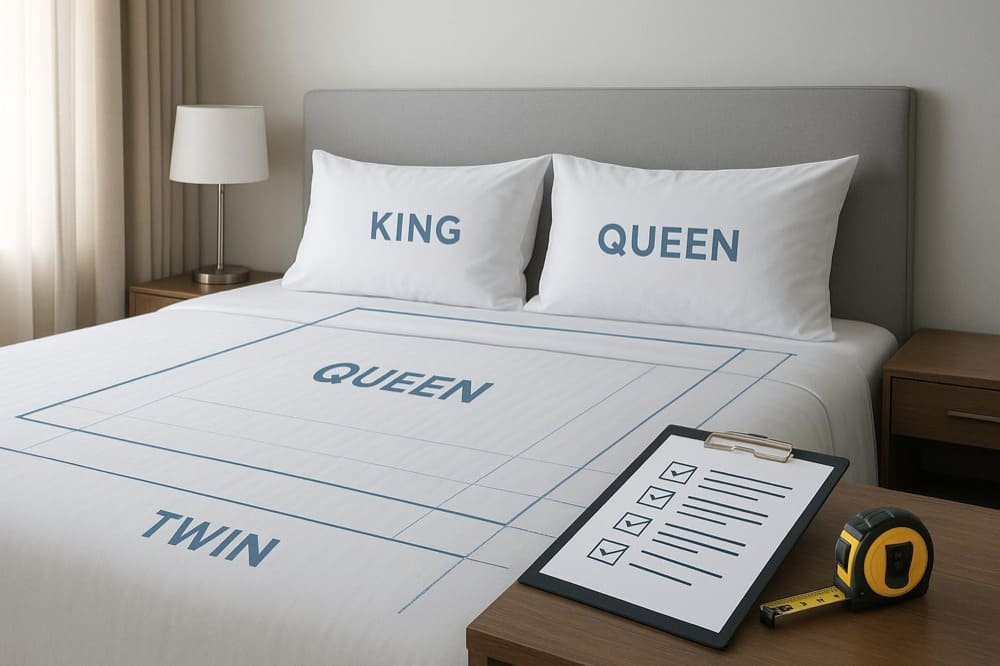
For North American king rooms, the common target is 76 × 80 inches. Standard queen rooms typically use 60 × 80 inches. Two-bed rooms frequently run two Twin XLs at 38 × 80 inches; some legacy or space-constrained rooms still specify two Doubles/Fulls at 54 × 75 inches.
In the UK, a “King” is commonly 150 × 200 cm and “Super King” 180 × 200 cm, while in continental Europe you’ll often see 160 × 200 cm (king) and 180 × 200 cm (super king). Twin rooms across the UK/EU commonly use two 90 × 200 cm singles. Flex rooms increasingly rely on zip-and-link: two 90 × 200 cm units joined to become 180 × 200 cm.
“Commonly” is doing a lot of work here. Sizes vary by region, program, and vendor tolerances. That’s why your BOQ should specify both target dimensions and acceptable tolerances—and require verification at inspection.
The hotel bed size chart (by region)
Below is a consolidated reference you can use at schematic design or RFQ. Treat these as industry-standard targets and always state tolerances in your spec.
| Region | Common size name | Target width × length | Notes |
|---|---|---|---|
| North America | Twin | 38 × 75 in | Some charts list 39 in width; specify exact target + tolerance. |
| North America | Twin XL | 38 × 80 in | Frequently used in two-bed rooms for adult length. |
| North America | Full/Double | 54 × 75 in | Older properties; many brands now prefer two Queens. |
| North America | Queen | 60 × 80 in | Ubiquitous for standard rooms. |
| North America | King | 76 × 80 in | Primary for king rooms. |
| North America | California King | 72 × 84 in | Rare in hotels; check casegoods clearances. |
| United Kingdom | Single | 90 × 190 cm | NBF tolerances commonly ±20 mm; state your tolerance. |
| United Kingdom | Small Double | 120 × 190 cm | Also called “Three-Quarter.” |
| United Kingdom | Double | 135 × 190 cm | Common in compact rooms. |
| United Kingdom | King | 150 × 200 cm | Typical UK “King.” |
| United Kingdom | Super King | 180 × 200 cm | Often supplied as zip-and-link (2 × 90 × 200 cm). |
| Continental Europe | Single | 90 × 200 cm | 80 × 200 cm exists in some markets; 90 cm is common in hotels. |
| Continental Europe | Double | 140 × 200 cm | Less used in new builds; check brand tier. |
| Continental Europe | King | 160 × 200 cm | Often labeled “Queen/King (EU).” |
| Continental Europe | Super King | 180 × 200 cm | Common for premium rooms; zip-and-link capable. |
Evidence basis: Representative North American sizes align across major references such as the Sleep Foundation and manufacturer guides, while UK/EU sizes align with major UK retailers and contract suppliers; UK tolerance practice is noted by the National Bed Federation. See the compliance and sources section for links.
Twin vs. Twin XL
Twin XL (38 × 80 in) protects adult guest comfort and linen interoperability with Queen/King lengths. It’s the safer default for two-bed rooms in North America where the footprint allows.
Zip-and-link flexibility (UK/EU)
Zip-and-link lets you convert between two singles and one super king. It’s a workhorse in boutique and resort operations. When you specify it, include the joining system, perimeter zip protection, and gap-fill topper.
What the big chains publish publicly (and what they don’t)

Proprietary brand standard manuals aren’t public. But several chains sell their mattresses to consumers, which gives you a window into common size offerings:
Marriott’s shop lists The Marriott Bed in Twin, Full, Queen, King, and California King with explicit inch dimensions on the product page; see the Innerspring Mattress by Marriott Hotels listing on the official retail site. For reference: dimensions are shown on the page for each size. Link: the official product page for the Innerspring Mattress by Marriott Hotels.
Westin, also part of Marriott, publishes the Heavenly Bed sizes on its official shop; see the Westin Heavenly Bed mattress page.
Hilton’s consumer channel describes the Serenity Bed, but the EU site’s product page doesn’t enumerate sizes; contextually, Hilton room listings show King, Queen, and rooms with two Double/Queen beds. See Hilton to Home (EU) Serenity Bed.
Use these as public context only. Do not treat them as definitive procurement standards. Always align with your chain’s project brand team for final approvals.
The specs that prevent rework (and callbacks)
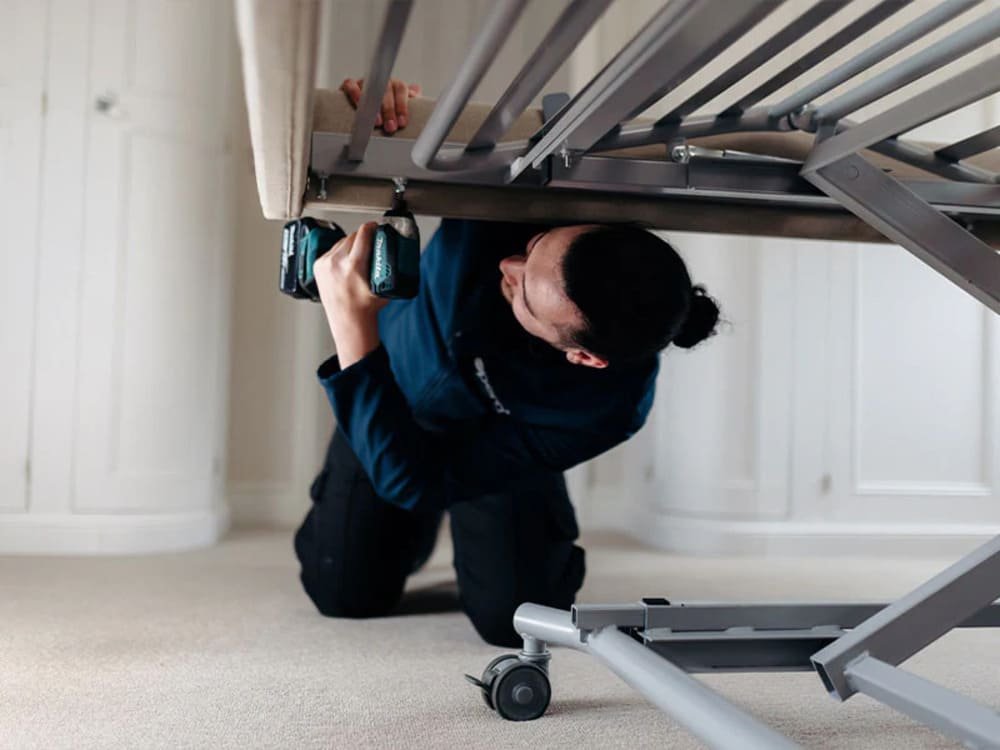
You can avoid most post-install issues by locking four items up front:
1) Exact target dimensions and acceptance tolerances
(±1–2 cm is a practical hospitality range)
2) The total bed height plan
Choose base profile first, then mattress thickness to hit a 24–28 in ergonomic target and match linen pocket depths
3) Base type vs casegoods fit
Platform, box/foundation — low-profile ~5–6 in or standard ~9 in — or divan, with headboard and nightstand elevations set to the final height
4) Linen compatibility
Specify fitted sheet pocket depth and flat sheet drop based on final mattress thickness to avoid operating cost creep
Compliance you must lock (by region)
Fire safety is not optional. Procurement must name the standard, require test reports, and verify labels.
- United States: Mattresses and mattress pads must comply with 16 CFR Part 1632 (smoldering cigarettes) and mattress sets must comply with 16 CFR Part 1633 (open flame). The Consumer Product Safety Commission provides overviews and the full text in the eCFR. See the CPSC’s overview page for mattresses and the eCFR entries for 16 CFR 1632 and 16 CFR 1633, also summarized in CPSC educational materials.
- United Kingdom: BS 7177 specifies ignition resistance for mattresses and divans with hazard categories; hotels typically require Medium Hazard (often described with “Crib 5”). SATRA and other UKAS-accredited bodies summarize the scope for contract buyers. See SATRA/FIRA summaries such as FIRA’s bed and mattress testing overview and VisitBritain’s guidance for accommodation providers on fire safety for furniture and furnishings.
- European Union: EN 597-1/-2 define smoldering cigarette and small open flame tests widely referenced in EU procurement; Europur’s technical resource explains their role in mattress testing. See Europur’s overview of mattress testing procedures in Europe.
- Upholstered bases/headboards in the U.S.: TB 117-2013 applies to upholstered furniture components nationally (labeling, smolder standard). Mattresses remain under 16 CFR 1632/1633. Consult CPSC’s upholstered furniture FAQ.
- Special jurisdictions: Some AHJs or purchasers require TB 129 or Boston IX-11 full-scale testing for mattresses in certain occupancies. Confirm early and include reports in the compliance dossier.
None of this is legal advice; coordinate with your brand’s safety team and local authorities having jurisdiction.
Construction and durability choices (what lasts in hotels)

- Support cores: Pocketed coils dominate upper-tier hospitality for motion isolation and lifespan. Continuous coil or Bonnell can still be value-engineered choices in select segments.
- Comfort layers: Contract-grade polyurethane or viscoelastic foams are common. Specify density ranges and thicknesses in the RFQ; don’t accept vague “premium foam” language.
- Edge support: Foam encasement or reinforced edge coils help preserve surface area and reduce roll-off. For high-occupancy rooms, edge integrity is worth the line-item.
- Cover textiles: Woven, high-denier quilting with anti-snag properties reduces cosmetic wear. If you need waterproofing, specify breathable barriers to manage heat and noise.
- Warranty expectations: Commercial warranties around 10 years are common; ensure the warranty explicitly covers hospitality use and outlines body impression thresholds.
Think of the mattress like a workhorse. Spring geometry, foam density, and edge construction decide how it feels after year three—not day one.
A practical, checklist-driven procurement workflow (with a neutral example)
- Freeze sizes by room type and region. Map Twin/Twin XL/Queen/King to each room type on your schedule, including final bed height targets.
- Issue the specification checklist with your RFQ. Include target dimensions, tolerances, construction preferences (e.g., pocketed coil + foam), flammability standards and test report requirements, labeling, warranty terms, and packing/CBM preferences.
- Prototype, test, and approve. Build one room mock-up. Obtain 16 CFR/BS 7177/EN 597 reports as applicable. Confirm linen fit with the actual mattress thickness.
- Plan cartonization and container loads. Decide roll-pack vs flat-pack by construction and property access constraints. Consolidate SKUs to reduce misloads.
- Inspect and ship. Pre-shipment QA measures sizes at multiple points under ambient conditions; verify labels and documentation before loading.
Neutral example for context: On multi-property rollouts, a partner like ChinaBestBuy supports checklist-first RFQs, coordinates third-party flammability testing, and engineers CBM-efficient load plans so Twin XL and King cartons stack cleanly without exceeding weight limits. Procurement teams retain control of specifications while reducing avoidable errors.
Logistics, CBM, and lead time planning

Roll-pack vs flat-pack: All-foam and some hybrid mattresses can be vacuum-compressed (roll-pack), cutting volume roughly 50–80% depending on model. Pocketed-coil hospitality builds are often shipped flat to protect spring geometry.
Container math (illustrative): A 180 × 200 × 20 cm mattress occupies 0.72 CBM when flat. At 0.72 CBM, a 40HQ (67 CBM usable) fits roughly 90–95 units depending on cartonization and dunnage. With roll-pack to ~0.29–0.36 CBM, you could target about 185–230 units, subject to stack limits and weight.
Labeling and palletization: Use side-panel labels with model, size, and room-type codes; add barcode/QR links to installation sheets. Palletize by property and room type to reduce on-site sorting.
Lead times (typical ranges): Prototyping and mock-up 2–6 weeks; compliance testing can run in parallel when risk-managed; mass production 6–12 weeks after spec freeze depending on capacity and order size; ocean freight and final mile 4–8 weeks to US/EU with customs clearance. Back-planning 16–26 weeks from install is realistic; complex multi-region projects can push longer. Start earlier than you think.
Frequently asked, procurement-grade
- Do hotels in North America ever use two Queens in a room instead of two Doubles? Yes, increasingly. Two Queens (60 × 80 in) offer adult-friendly dimensions and simplify linen programs.
- What overall bed height should we target? Many programs operate well at 24–28 inches from floor to top of mattress. Confirm with brand operations and housekeeping for ergonomics.
- Are California Kings common in hotels? Not typically. They’re longer but narrower; verify casegoods and room width before specifying.
Sources and standards (selected)
- United States mattress flammability standards: see the eCFR pages for 16 CFR 1632 (smoldering) and 16 CFR 1633 (open flame), summarized by CPSC guidance.
- UK/EU compliance context: FIRA’s bed and mattress testing summary and VisitBritain’s fire safety for furniture and furnishings guidance; EU testing background via Europur’s mattress testing procedures overview.
- Public chain retail context: Innerspring Mattress by Marriott Hotels; Westin Heavenly Bed mattress page; Hilton to Home Serenity Bed.
Next steps for procurement teams
Need a clean, procurement-ready template to align your RFQs and acceptance criteria?
Download our hotel bed and mattress specification checklist to capture dimensions, tolerances, flammability standards, construction, labeling, warranty, and packing/CBM preferences — so vendors can quote apples-to-apples and your projects can land on time.
Start here: ChinaBestBuy — One-stop Building Solutions