What Kind of Carpet Is Good for Hotel Rooms? A 4‑Star Buyer’s Guide to Compliance, Durability, and Comfort
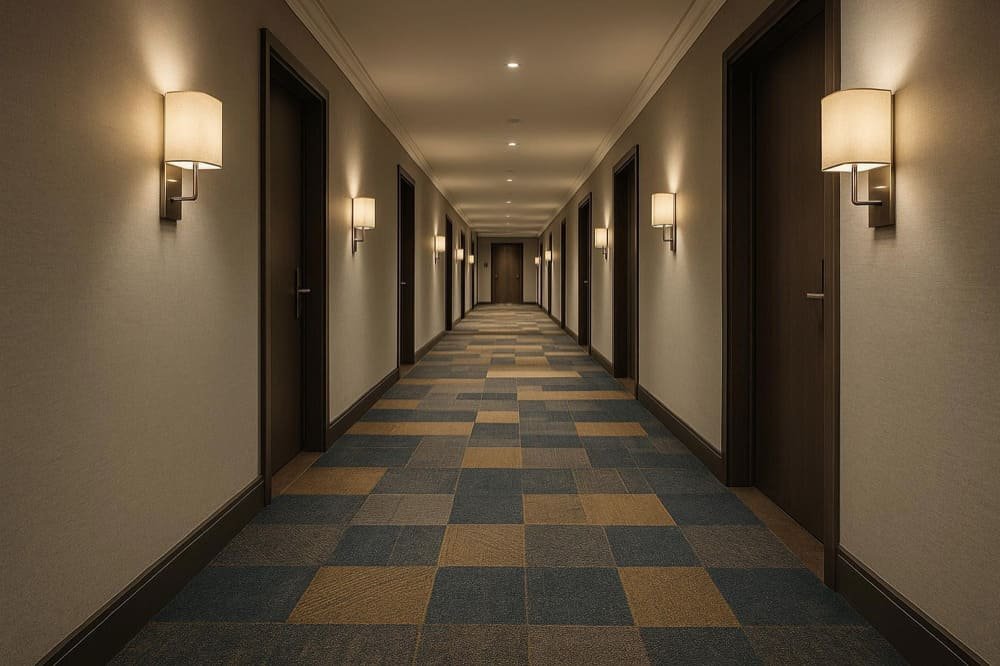
If a carpet fails fire inspection or mats down in six months, design doesn’t matter—operations do.
For 4-star hotels, the “right” carpet blends verified compliance, long-wearing construction, acoustic comfort, and a maintenance plan you can actually execute.
This guide gives you clear targets and a practical workflow so procurement, design, and facility teams can specify with confidence.
The non-negotiables for 4-star properties
Fire performance you can document
In the United States, interior floor finishes are classified using the flooring radiant panel. Corridors and exit ways typically require Class I (critical radiant flux ≥ 0.45 W/cm²); guestrooms may allow Class II (≥ 0.22 W/cm²) depending on the Authority Having Jurisdiction.
See the model code basis in the International Building Code Chapter 8 and the test standard in the National Fire Protection Association’s flooring radiant panel, referenced as ASTM E648/NFPA 253.
For context, review the code framework in the ICC’s IBC Chapter 8 on interior finishes and the standard overview on NFPA 253 (flooring radiant panel).
In Europe/UK, use Euroclass per EN 13501-1, based on EN ISO 9239-1 and EN ISO 11925-2. Corridors/public spaces commonly target Bfl-s1; guestrooms often accept Cfl-s1, subject to local rules.
For a technical summary of Euroclass testing for floors, see Interface’s EU fire testing white paper (EN 13501-1, EN ISO 9239-1/11925-2).
Wear and appearance retention appropriate for traffic
Specify heavy commercial performance. In Europe, EN 1307 Class 33 is a reliable target for corridors and public spaces; Class 32–33 for guestrooms depending on brand standards and lifespan goals.
See the classification context from BSI’s EN 1307 overview.
Indoor air quality (IAQ)
Favor carpets and adhesives with low VOC emissions. Familiar certifications include:
- CRI Green Label Plus for carpet and adhesives — North America
- Eurofins Indoor Air Comfort Gold — Europe
These keep rooms fresh post-install and support brand sustainability claims.
Acoustic comfort
In guestrooms and corridors, carpet with cushion or acoustic backings can reduce impact sound transmission by roughly 20–30 dB ΔLw; specialized backings add several dB more.
For practical benchmarks and assembly considerations, see Interface’s acoustics guidance.
For quantified gains from acoustic backings, Tarkett reports SoundMaster backings can add approximately +5 to +8 dB ΔLw over standard constructions in its DESSO SoundMaster documentation.
Tip: Always confirm local acceptance with the AHJ and the hotel brand’s design manual — fire classes and documentation vary by jurisdiction and flag.
Zone-by-zone benchmark targets
Below are starting targets for a typical 4-star. Adjust to brand and local code.
| Zone | Use Class (EN 1307) | Typical Fire Target | Acoustic Aim | Construction Notes |
|---|---|---|---|---|
| Guestrooms | Class 32–33 | US: Class II CRF ≥0.22 W/cm²; EU/UK: Cfl-s1 (some brands Bfl-s1) | ΔLw ≥17–20 dB | SDN tufted broadloom or tiles with cushion; tight gauge and density; strong tuft bind |
| Corridors | Class 33 | US: Class I CRF ≥0.45 W/cm²; EU/UK: Bfl-s1 | ΔLw 20–25+ dB | SDN tufted or modular tiles; consider cushion-back tiles for trolley noise |
| Lobbies/Lounges | Class 33 | As corridors | ΔLw ≥20 dB | Woven Axminster (80/20) or high-density SDN tufted; patterning to mask soil |
| Ballrooms/Meetings | Class 33 | As corridors | Coordinate with RT goals | Woven Axminster or robust SDN cut/loop; chair-caster resistance |
Material systems that work in 4-star hotels
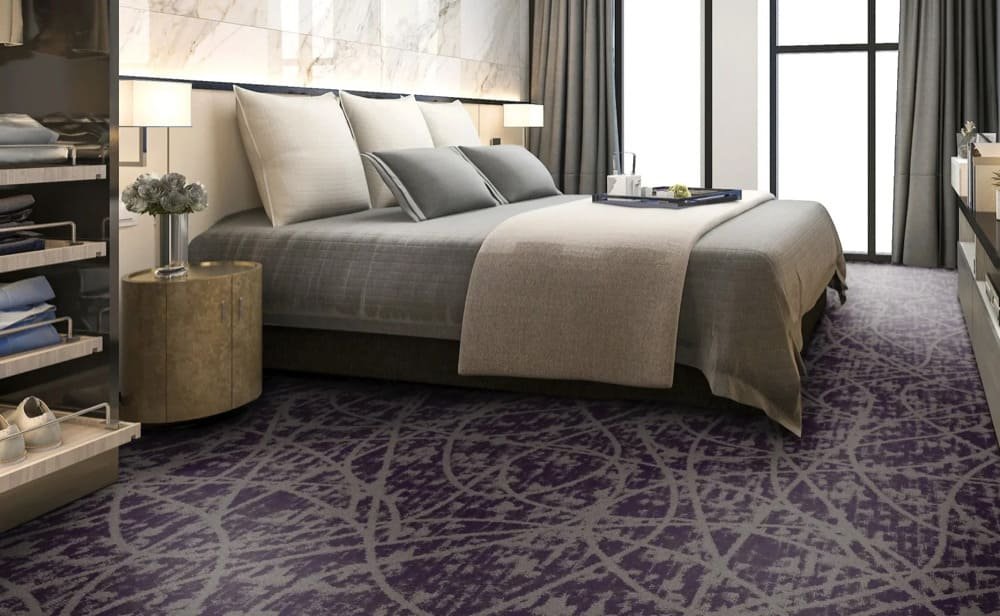
Solution-dyed nylon (SDN) tufted broadloom
- Why it works: Pigment is in the polymer, so colorfastness and stain resistance are strong. With the right gauge, stitch rate, and density, SDN holds appearance in high traffic. Maintenance is straightforward.
- Where to use: Guestrooms and corridors; often the default for durability and cost control.
Printed nylon broadloom
- Why it works: Design flexibility at a sharp price point. Good for guestrooms when budgets are tight and you want branded patterns without woven costs.
- Watchouts: Surface-level color can be less robust under aggressive cleaning or UV than SDN; confirm colorfastness.
Woven Axminster (typically 80/20 wool/nylon)
- Why it works: Dimensional stability, refined hand, crisp pattern definition, and strong pile recovery. Excellent for signature public spaces.
- Watchouts: Higher first cost and stricter maintenance; beverage/oil stain resistance is lower than SDN.
Carpet tile (modular)
- Why it works: Modular replacement reduces downtime and lifecycle cost. Cushion-back tiles raise acoustic performance and comfort underfoot.
- Where to use: Corridors, many guestrooms in contemporary concepts, select back-of-house zones.
Acoustic comfort without guesswork
Here’s the deal: your carpet can’t fix a noisy slab by itself, but it’s the easiest lever to pull.
Standard commercial carpet systems deliver around 20–30 dB ΔLw on concrete; acoustic backings can add 5–8 dB.
Coordinate early with your acoustic consultant to set IIC/STC targets for the full assembly (slab, underlayment, ceiling).
In corridors, cushion-back tiles or broadloom on underlay help tame trolley and luggage rumble.
In guestrooms, aim for a soft, dense face with attached cushion or an acoustic underlay to keep footfall quiet and reverberation low.
RFQ/BOQ checklist for fast, accurate pricing
Use this to brief suppliers and speed up apples-to-apples quotes.
- Areas and zones: Net and gross areas by room type; waste assumptions; installation method.
- Compliance: Fire class by jurisdiction (US Class I/II or EU Bfl/Cfl), target EN 1307/ISO 10874 class, IAQ certifications (CRI GLP, Eurofins IAC Gold as applicable).
- Construction targets: Fiber system (SDN vs wool/nylon), pile type (cut, loop, cut-loop), face weight range, gauge (1/10″–1/8″ typical), density/stitch rate targets, tuft bind requirement.
- Backing and cushion: Tile vs broadloom backings, cushion/underlay specs, acoustic goals (ΔLw/IIC guidance).
- Aesthetics and samples: Colorways, pattern scale, large samples/match lines, seam mock-ups.
- Testing & documentation: Recent third-party fire tests, appearance retention (ISO 10361 or comparable), colorfastness (AATCC/ISO), dimensional stability, warranties.
- Logistics & timeline: Delivery window, packaging specs, roll/tile labeling, spare stock strategy.
Procurement and QA workflow (international sourcing)
1. Vet suppliers and audit the factory
Shortlist mills with hospitality references and a proven compliance record. Verify ISO 9001/14001, dyeing/tufting controls, shade batching, roll tracking, and packaging procedures. Ask for hotel project case references.
2. Sample, test, and approve
Approve hand and large samples for color/pattern; build seam mock-ups. Commission third-party fire testing to your jurisdiction (ASTM E648/NFPA 253 or EN ISO 9239-1/11925-2) and performance testing like ISO 10361 and tuft bind. Confirm IAQ certificates such as CRI Green Label Plus.
3. Production QC and pre-shipment inspection
Run in-process checks to catch shade or pattern drift early. Before shipping, verify roll IDs, batch codes, packaging integrity, and documentation completeness.
4. Logistics and handover
Align Incoterms and packaging (core size, roll diameter, palletization). On site, verify substrate flatness, moisture, and adhesive compatibility. Handover should include warranties, a cleaning schedule aligned to CRI 204 practices, and a spare stock plan (especially for tiles).
Practical example (how we support)
As a one-stop sourcing partner, ChinaBestBuy vets mills, coordinates third-party testing, manages batch/roll pairing and packaging, and prepares the compliance pack (test reports, certificates, labeled rolls) ahead of shipment. That reduces rework at installation and keeps inspections smooth.
Common mistakes to avoid
- Don’t mix fire classes by zone without AHJ sign-off — inconsistent ratings will delay approvals and can trigger costly redesigns.
- Don’t chase face weight while ignoring density, gauge, and tuft bind — specs that look good on paper can still fail performance and wear tests.
- Don’t skip acoustic backing in trolley-heavy corridors — impact noise will travel through floor assemblies and lead to guest complaints.
- Don’t approve only small hand swatches — expect seam visibility, pattern mismatch, or incorrect scale once installed on large surfaces.
- Don’t forget IAQ certificates — missing VOC/IAQ documentation increases the risk of odor complaints and post-opening remediation.
- Don’t neglect spare tiles and roll matching — replacements will stand out visually, especially across dye lots or pattern runs.
Ready to move from concept to compliance?
Submit your BOQ/drawings for a factory-direct quote and material recommendations.
You’ll get compliant options with documented fire class, wear rating, acoustic performance, and IAQ credentials — plus packaging and installation guidance tailored to your site.