Carpets Buying Guide in 2025 – Free Sample Delivery and Personalization
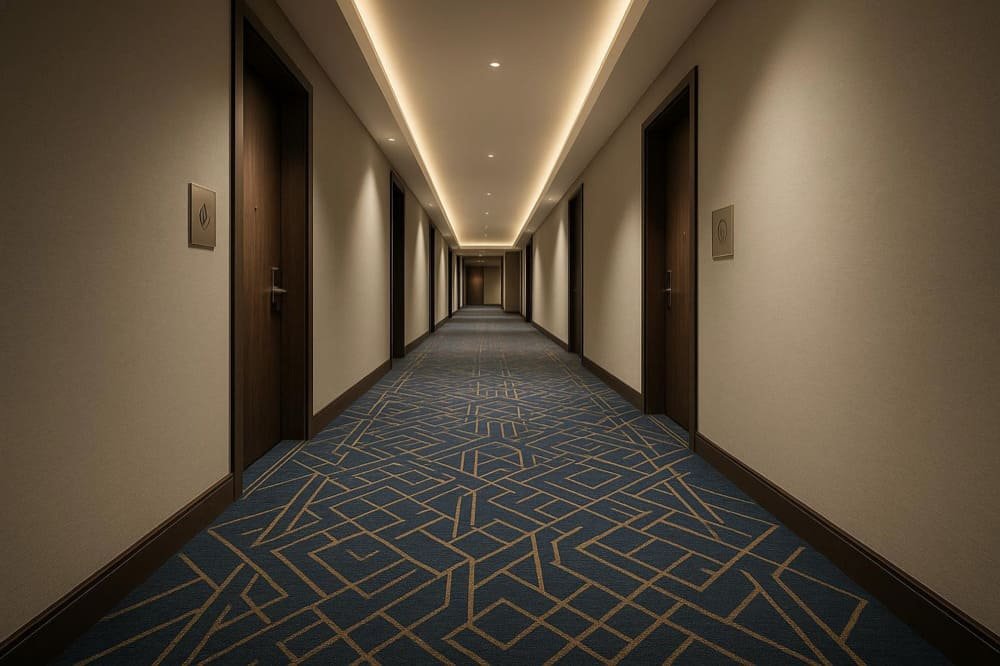
When a carpet package decides the look, safety, and acoustics of an entire property, you can’t leave it to guesswork.
In 2025, procurement teams are expected to deliver brand-right designs, documented compliance, and predictable lead times—often across multiple zones with different performance needs.
This guide distills the decisions that truly move outcomes on hospitality and commercial projects and shows how to translate floor plans into a verified specification and factory-direct quote.
Match construction to the space (and the business case)
Design intent and traffic define construction. Think of it like choosing the right drivetrain for your fleet: woven platforms for precision and longevity; tufted for speed and value; tiles where replaceability is paramount.
| Construction | Where it excels | Why it fits | Typical yarn systems |
|---|---|---|---|
| Axminster (woven) | Lobbies, ballrooms, corridors needing statement patterns | Individually inserted tufts enable intricate, multi-color designs with excellent wear | 80/20 wool/nylon, premium nylon; solution-dyed nylon where stain/bleach resistance matters — see the manufacturing overview by Brintons |
| Wilton (woven) | Luxury guestrooms and corridors | Continuous yarns, cut/loop options, dimensional stability, refined textures | Wool blends and nylon; construction explainer from Wilton Carpets |
| Tufted broadloom | Guestrooms, corridors, value-driven public spaces | Broad cost range, fast production, strong versatility; print and pattern options available | Predominantly solution-dyed nylon for colorfastness and maintenance performance |
| Carpet tile (modular) | Meeting rooms, back-of-house, offices | Easy replacement, phased install, lower waste in irregular layouts | Various backings (PVC/non-PVC); check dimensional stability and rolling-load data in TDS |
The spec levers that drive lifecycle cost
A few variables make most of the difference in durability, comfort, and maintenance.
- Pile height and density/face weight: For heavy-traffic corridors/ballrooms, target dense constructions with controlled pile heights (often around 6–8 mm). Guestrooms typically allow slightly higher piles (8–10 mm) for comfort, balanced with density. Treat these as directional ranges; verify against manufacturer data and the project’s maintenance plan.
- Backing: Secondary latex (SBR) and polyurethane cushions can improve tuft bind and acoustics; woven backings elevate dimensional stability. Modular (tile) backings prioritize dimensional stability and rolling-load performance; confirm numbers in the product’s TDS.
- Yarn and dye method: Solution-dyed nylon offers strong colorfastness and cleanability; wool/nylon blends provide natural hand and resilience in woven constructions. Pattern complexity and dye method (solution-dyed vs piece/space dye) affect both cost and lead time.
- Performance tests: Many owner specs reference methods such as tuft bind (ASTM D1335), delamination (ASTM D3936), electrostatic propensity (AATCC 134), and dimensional stability (ASTM methods). Numeric thresholds are typically set per owner standard; for government work, consult the DoD spec UFGS 09 68 00 Carpeting (2024–2025 edition) for methods and submittals.
Compliance and IAQ: what 2025 reviewers expect to see
Most jurisdictions and brand standards require a clear fire and IAQ dossier. Get this right early to avoid rework.
- EN 13501-1 (EU): Floor coverings are classified A1fl–Ffl with smoke s1/s2/s3. Textile floorings rely on EN ISO 9239-1 (radiant panel) and EN ISO 11925-2 (small flame). Technical explainers indicate that Bfl corresponds to higher critical radiant flux than Cfl, and s1 limits smoke production; see the 2024/2025 overview by Measurlabs on EN 13501-1 performance classes. Always confirm local code requirements.
- U.S. fire standards: Building codes typically reference ASTM E648 (NFPA 253 equivalent) for Critical Radiant Flux. Class I ≥ 0.45 W/cm²; Class II ≥ 0.22 W/cm² per the 2024 IBC references summarized in ICC’s Chapter 8, Interior Finishes. Owners may also require smoke density (ASTM E662) caps.
- IAQ and LEED: Many hospitality/commercial specs accept CRI Green Label Plus (GLP) for low-emitting materials documentation recognized under LEED v4.1 pathways. See a 2025-dated GLP certificate noting USGBC recognition in CRI’s Green Label Plus documentation.
Tip: Create a single PDF “Compliance Dossier” containing fire certificates (EN/ASTM/NFPA), emissions certificates (GLP/CDPH), and any brand-specific sign-offs. It shortens approvals and reduces RFIs.
The sample-to-spec workflow you can trust

Here’s the practical path from drawings to approved production. It’s the 20% of process that controls 80% of risk.
- Floor-plan upload and takeoff: Provide CAD/PDF plans marked by use zones (guestrooms, corridors, ballrooms). Define pattern repeats, seam diagrams, roll widths or tile modules, and waste factors. We translate these into a BOQ with itemized areas and transitions.
- Design and construction confirmation: Lock construction (Axminster/Wilton/tufted/tile), yarn system, pile height/density, backing, and dye method. Request lab dips/strike-offs or machine-made samples for hand-feel, color, and construction verification.
- Compliance dossier assembly: Collect EN 13501-1/EN ISO test reports, ASTM E648/NFPA 253 certificates, and IAQ documentation (e.g., GLP). Cross-check with brand and code expectations.
- Pilot approval and production slot: Approve the sample and freeze the spec. Reserve loom or tufting capacity and confirm dye lots and pattern repeats.
- In-line QA and pre-shipment inspection: Inspect color tolerance, pattern alignment, dimensions, tuft bind spot checks, backing adhesion, labeling, and packing list. Reference UFGS methods where applicable.
- Export packaging and documents: Protect rolls with poly wrap plus core/end-cap protection and desiccants; tiles in cartons on pallets with corner boards and stretch wrap. Prepare commercial invoice, packing list, HS code, and Incoterms.
- Delivery and installation guidance: Coordinate ocean/air mode by schedule; on site, follow industry installation practices (acclimation, adhesive compatibility, subfloor prep) documented in the project spec.
According to ChinaBestBuy — procurement teams typically upload corridor and guestroom plans, receive an itemized BOQ and two targeted samples (e.g., Axminster for ballrooms; solution-dyed tufted for guestrooms), then get a combined fire/IAQ dossier before slotting production.
The same sequence applies whether you buy factory-direct through us or via another vetted vendor.
2025 costs, lead times, and MOQs (directional)
Numbers below are indicative ranges seen in 2024–2025 sources; confirm with current quotes, scope, and shipping mode.
| Item | Indicative range (installed) | Typical lead time from design approval | Common MOQ (custom) | Notes/Source |
|---|---|---|---|---|
| Tufted broadloom | $2.50–$5.00 per sq ft | ~8–12 weeks | ~100–300 m² | Directional 2025 pricing from the Royal American commercial carpet cost guide |
| Axminster (woven) | $6.00–$12.00+ per sq ft | ~12–16 weeks | ~100–300 m² | Pattern complexity influences both cost and capacity |
| Wilton (woven) | $8.00–$15.00+ per sq ft | ~12–16 weeks | ~100–300 m² | Luxury grades can exceed the upper range |
| Carpet tile (modular) | Wide range; project-specific | ~6–10 weeks | Varies by manufacturer | Check backing system and TDS for performance claims |
Variables that swing price/timeline: yarn system (wool vs solution-dyed nylon), pattern repeats, dye method, backing type (cushion vs hard back), order size and waste, and shipping mode (ocean vs air).
Quality control, export packaging, and logistics risk management

Your QC plan should mirror how the product is made and shipped. Practical checkpoints include:
- Factory-stage checks tied to spec: construction, density/face weight, color tolerances, backing adhesion, pattern alignment.
- Pre-shipment inspection: dimensions, labeling (PO, dye lot, batch), roll straightness/ovalization checks, carton integrity for tiles.
- Packaging SOPs: poly wrap and moisture control for broadloom; desiccants; core/end-cap protection; woven outer sleeves; palletized tiles with corner boards and stretch wrap; barcode and lot labels.
- Shipping documents and Incoterms: commercial invoice, packing list, HS code, and agreed Incoterms (FOB/CIF/DDP as contracted). For tariff classification, consult current HTS references via the USITC 2025 HTS index and your customs broker.
For a sense of process rigor and after-sales support, review recent builds on our Projects page. It demonstrates how inspections, documentation, and logistics come together on real shipments.
Quick procurement checklist
- Finalize construction by zone (Axminster/Wilton/tufted/tile) with pile height/density, backing, and yarn system.
- Assemble a single compliance dossier (EN 13501-1/ASTM E648/NFPA 253 + IAQ/GLP) and align with brand/code.
- Approve representative samples (color/hand/structure) and freeze design repeats and dye lots.
- Lock production capacity, QC inspection criteria, and packaging SOPs before issuing the PO.
- Confirm shipping mode, Incoterms, and arrival sequencing aligned to install phases.
Next steps
Have active drawings and a delivery window? Upload your floor plans to get a personalized specification and factory-direct quote, including BOQ, samples, and a compliance dossier aligned to 2025 standards.
Start here: ChinaBestBuy Service — One-stop Building Solutions.