Top 10 Small CEO Office Design Ideas for 2026
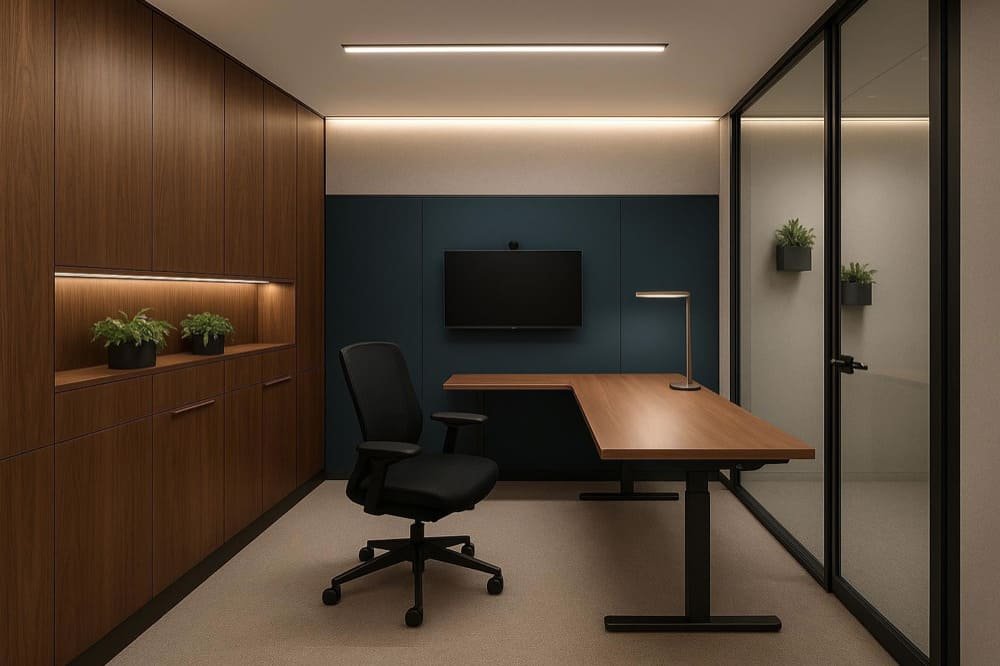
A small CEO office still needs presence, privacy, and performance.
In 2026, the most effective compact executive suites pair space-maximizing modular millwork with integrated tech, healthy lighting, and smart acoustics—so every millimeter works harder without looking cramped.
This guide is written for interior designers and architects who specify premium, small-footprint offices, with SME owners as a secondary audience.
Before we dive in, here’s how we ranked these ideas:
- Feasibility for design, fabrication, and global delivery
- Impact on function in tight footprints
- Integration with power/data and conferencing
- Acoustic/privacy potential
- Materials/IAQ credentials
- Ergonomics
- Evidence quality
1) Modular, space-maximizing millwork systems
If you have 12–18 m² and a premium brief, modular casework and wall systems are your highest-leverage move. Think sequence-matched veneer panels, concealed doors, adjustable shelving, pull-out printer/file towers, and integrated cable channels that keep surfaces clean.
- Spec cues: Consider Premium Grade casework with crisp reveals and consistent grain. The Architectural Woodwork Institute (AWI) defines grades, materials, and tolerances in its standards; Premium Grade is commonly selected for high-end executive spaces. See the AWI Standards overview (2025) for current sections and verification guidance.
- Finish trade-offs: AA/A veneer faces deliver warmth and status but increase cost and care. High-pressure laminate (HPL) is tough, cost-controlled, and consistent—good for heavy-use surfaces. Mixed palettes (veneer surrounds, HPL interiors) are a practical balance.
- Hardware & details: Soft-close concealed hinges, 0.5 mm+ edgebanding, adjustable shelves with evenly spaced holes, and integrated cable raceways. Keep reveals tight and consistent for a refined look.
- Price/lead-time signals: Custom modular millwork typically runs on 4–10+ week lead times depending on finish and complexity; pricing varies widely by grade and hardware. Subject to change.
Best for: Ultra-compact offices needing storage density without visual clutter.
Not for: Spaces requiring heavy day-two reconfiguration; demountable systems might be better.
2) Integrated power/data and cable management
A compact suite can’t afford cable spaghetti. In-surface power modules, under-desk trays, and discreet grommets preserve aesthetics while supporting modern loads.
- Power spec: USB-C Power Delivery 3.1 supports up to 240 W via Extended Power Range—future-proof for high-wattage laptops and hubs. See USB-C PD 3.1 technical overview (Advantech, 2024).
- Module choices: Flush in-desk modules look seamless; clamp-on is flexible. Under-desk trays should vent heat and mount toward the rear to keep knees clear.
- Routing: Use vertical cable risers behind panels and grommets aligned with desktop cutouts; keep service loops accessible but hidden.
- Price/lead-time: Off-the-shelf modules are quick; custom integration adds cost and time. Subject to change.
Best for: Clean, tech-forward desks in tight footprints.
Not for: Heavy reconfiguration without planning; consider modular raceways.
3) Acoustic privacy strategy in small suites
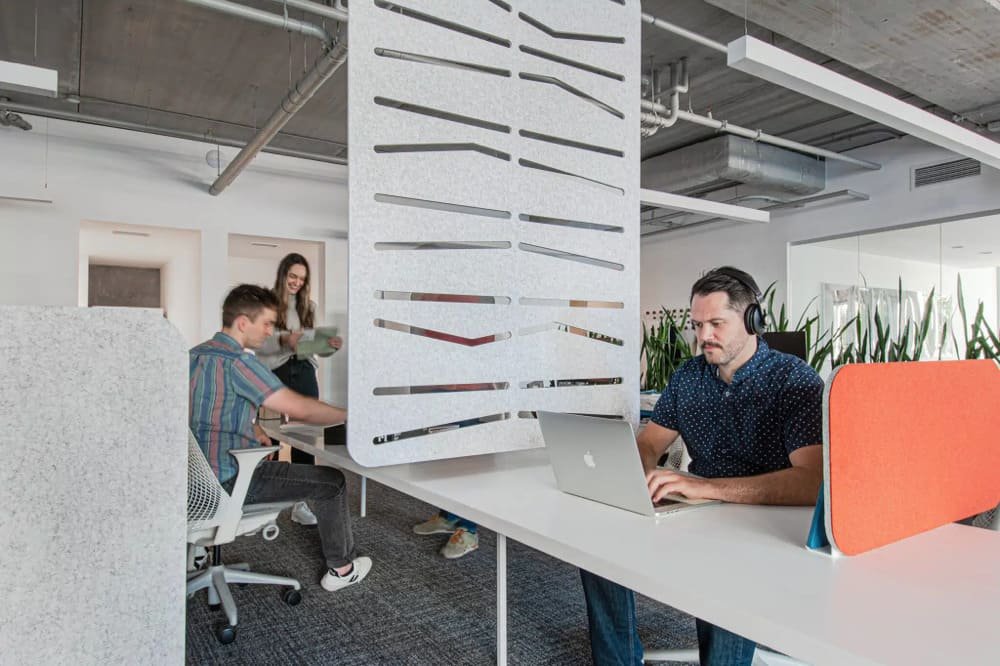
Confidential calls in compact rooms demand smart assemblies. Aim for partitions and doors with higher sound isolation and keep reverberation controlled.
- Targets: Many private offices pursue STC in the mid-40s to 50+ range and RT60 around 0.4–0.6 s, depending on volume and finishes. Measurement standards include ASTM E90 for airborne sound transmission (ASTM) and ISO acoustics standards overview (ISO).
- Assemblies: Laminated acoustic glazing with PVB interlayers; doors with perimeter and drop seals; demountable partitions rated for privacy; ceiling systems with high NRC.
- Flanking control: Treat penetrations, junctions, and plenum paths; small rooms are unforgiving of leaks.
- Price/lead-time: Acoustic doors and rated glazing add cost and lead time; check local certification paths. Subject to change.
Best for: C-suite confidentiality in dense floorplans.
Not for: Ultra-budget retrofits; use films, seals, and soft finishes for incremental gains.
4) Circadian-supportive, glare-controlled lighting
Healthy, comfortable lighting elevates compact executive spaces. Layer indirect ambient light with task lighting and daylight-responsive controls.
- Approach: IES has discussed dynamic lighting that brings qualities of natural light indoors with tuned spectrum and intensity across the day. See IES on double-dynamic lighting (2023).
- Glare control: Aim for luminaires and shielding that keep perceived glare low; office guidance often references low-glare systems and careful positioning. Coordinate shades and reflectances.
- Controls: Occupancy and daylight-responsive dimming are aligned with modern energy codes (e.g., ASHRAE/IES 90.1). Commissioning matters.
- Price/lead-time: Tunable systems and integrated controls raise cost and require coordination. Subject to change.
Best for: Executive suites that prioritize wellbeing and visual comfort.
Not for: Projects without commissioning capacity; select high-CRI static systems with good optics.
5) Executive ergonomics in compact footprints

Comfort drives performance—even in small rooms. Pair height-adjustable desks, compact executive chairs, and monitor arms to optimize posture and reach.
- Standards context: Seating performance and ergonomic guidance are covered by BIFMA; see BIFMA Standards overview for scope. Treat manufacturer ranges (e.g., sit-stand ~22–49 inches, chair seat ~16–21 inches) as typical, not prescriptive.
- Clearances: Maintain maneuvering space behind the chair—often around 48 inches—so entering/exiting feels effortless.
- Accessories: Footrests, keyboard trays, and cable-managed monitor arms reduce strain and visual clutter.
- Price/lead-time: Commodity frames are quick; premium seating adds both. Subject to change.
Best for: Leaders who alternate between focused solo work and brief seated meetings.
Not for: Fixed-height desks with limited reach and poor cable routing.
Indicative targets and dimensions for compact CEO offices
Below are common practice ranges designers often use as starting points. Always verify against official standards, local codes, and manufacturer data.
| Aspect | Indicative Range / Cue | Notes |
|---|---|---|
| Chair clearance behind desk | ~48 in (122 cm) | Aids entry/exit; adjust to layout |
| Sit-stand desk height range | ~22–49 in (56–125 cm) | Manufacturer typical ranges |
| Private office RT60 | ~0.4–0.6 s | Coordinate with soft finishes |
| Partition/door STC | Mid-40s to 50+ | Assembly-dependent |
| Perceived glare | Low-glare luminaires; shielding | Coordinate with shades/placement |
| Power delivery | USB-C PD up to 240 W (EPR) | Requires compliant cables/modules |
6) Compact VC/meeting tech integration
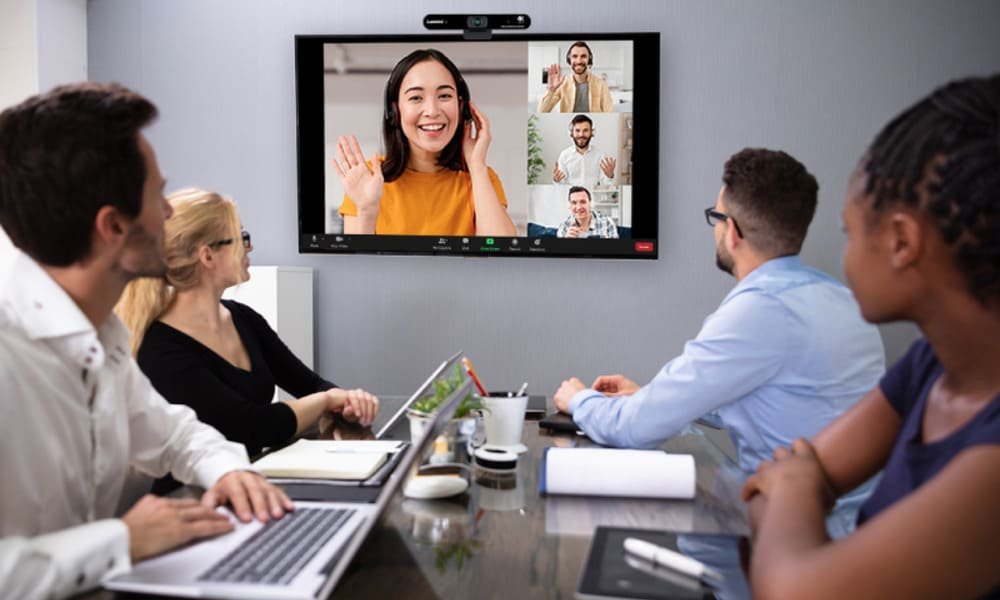
Small offices can host excellent video calls with careful placement and acoustics.
- Placement: Keep cameras at or slightly above eye level; centralize microphones for balanced pickup; position speakers near displays and away from mics. Documentation and coordination are emphasized by AVIXA; see AVIXA’s documentation requirements for AV systems.
- Acoustics & finishes: Reduce flutter with soft wall/ceiling elements; treat the back wall to avoid echo.
- Gear choices: All-in-one soundbar/camera units simplify; discrete components offer upgrade paths.
- Price/lead-time: Commodity kits are fast; custom integration takes longer. Subject to change.
Best for: Executive offices that double as 1–3 person meeting rooms.
Not for: Highly variable seating layouts without adjustable camera/mic mounts.
7) Materials & finishes: premium look with low VOC
Aim for a palette that signals leadership and supports IAQ.
- IAQ credentials: UL’s GREENGUARD program certifies low-emitting products; review the UL GREENGUARD Gold overview when specifying adhesives, sealants, and panels.
- Certifications: LEED v4.1 offers credits for materials and IAQ pathways; see the USGBC LEED overview for current guidance.
- Palette: Sequence-matched veneers for feature walls, HPL for durability, powder-coated metal accents, acoustic fabrics in deep, muted hues.
- Price/lead-time: Certified materials may carry premiums and documentation steps. Subject to change.
Best for: Premium look without compromising IAQ.
Not for: Quick installs without documentation workflows.
8) Biophilic and tactile elements without consuming footprint
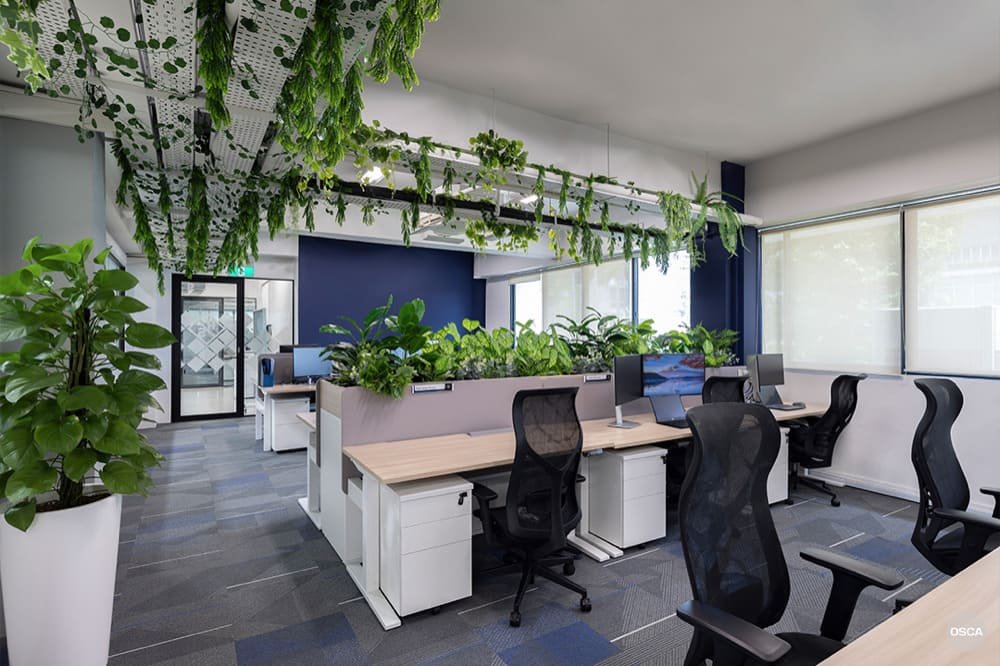
Vertical greenery, warm tactile surfaces, and daylight cues elevate mood in small rooms.
- Strategies: Wall-mounted planters, slim living wall panels, textured veneers/leathers, and acoustic textiles.
- Evidence context: Workplace leaders have highlighted wellbeing urgency and the “flight to quality” in office experience; see Steelcase on workplace wellbeing (2024) and Gensler’s flight to quality perspective (2024) for framing.
- Maintenance: Preserved greenery reduces upkeep while retaining biophilic impact.
- Price/lead-time: Living systems require planning; preserved options are faster. Subject to change.
Best for: Perceived spaciousness and executive presence.
Not for: High-humidity or low-light rooms without maintenance capacity.
9) Smart privacy & access
On-demand privacy and secure access integrate neatly with compact suites.
- Options: Electrochromic glass for instant opacity, privacy films for value-engineering, smart locks tied to occupancy sensors, and controls that coordinate lighting/HVAC.
- Considerations: Coordinate with acoustic and lighting strategies to avoid glare spikes and maintain speech privacy. Confirm local code compliance.
- Price/lead-time: Electrochromic and integrated access systems add complexity and commissioning time. Subject to change.
Best for: Executive offices needing rapid privacy transitions.
Not for: Tight budgets or projects without systems integration support.
10) Design-for-logistics & QA
Factory-direct customization only pays off if shipping and installation are smooth.
- Crating & modules: Size millwork modules to crate dimensions and handling equipment; protect edges with corner guards; add desiccants for sea freight.
- QA & documentation: Conduct pre-shipment inspections with clear acceptance criteria; align installation with woodwork guidance to preserve tolerances.
- Reference: For installation considerations, see AWI finish carpentry/installation requirements.
- Price/lead-time: International logistics vary by mode, season, and route; include buffers. Subject to change.
Best for: Global deliveries that need predictable outcomes.
Not for: Last-minute customizations without packaging redesign.
Also great: One-stop, factory-direct customization for compact executive suites
When you need a turnkey materials package—modular millwork, acoustic glazing, lighting controls, hardware, and export logistics—in one verified flow, a single responsible partner can help designers move from spec to procurement faster.
- What it solves: Consolidates vendors, aligns finishes/specs, manages QA and packaging, and coordinates global shipping.
- Best for: Designers and architects seeking repeatable small-footprint executive suites across multiple locations.
Disclosure: ChinaBestBuy is our product.
Next steps for designers
- Refine intent: What’s the privacy target, program mix, and palette hierarchy in 12–18 m²?
- Lock integration points: Decide on power/data modules, VC placement, and cable routing before millwork shop drawings.
- Verify standards: Align acoustic assemblies, lighting controls, and IAQ documentation with project requirements.
- Coordinate logistics early: Module sizing, crates, moisture control, and acceptance criteria prevent surprises.
Ready to move from concept to procurement? Request a curated materials package/BOQ for a small CEO office. Share your plan and dimensions, and define grade/finish preferences and timeline—then we’ll translate that into a spec-ready BOQ with factory-direct options.
Mini-FAQ
- How small can a CEO office be and still feel premium? Many designers work comfortably in the 12–18 m² range by relying on modular millwork, layered lighting, and acoustic privacy. The key is integrated storage and clean cable management.
- Do I need tunable lighting? Not always. High-quality static systems with low-glare optics and good controls can perform well. Tunable white adds flexibility when aligning schedules and ambience, provided you can commission and maintain it.