How Much Does a Living Room Renovation Cost? | 2026 Guide
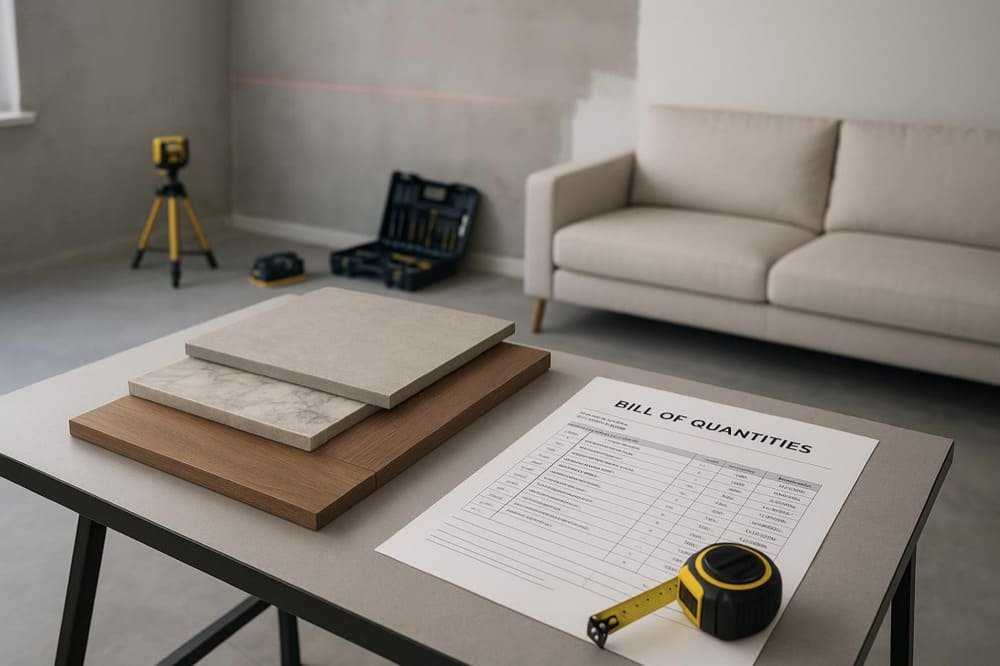
If you manage multiple projects or standardize lounge spaces across properties, you don’t just need “a price.”
You need a repeatable, spec-driven way to plan costs, lock in quality, and keep schedules predictable.
This 2026 guide distills installed cost ranges, shows how material choices move your budget, and turns those decisions into a Bill of Quantities (BoQ) you can deploy across units, buildings, or brands.
Here’s the deal:
We use a tiered budget (Basic / Mid-Range / Luxury) to align materials, installation complexity, and QC/logistics safeguards.
All ranges below reference current 2024–2025 evidence and are framed for 2026 planning assumptions.
What Drives Living Room Cost (Installed-Price Logic)
Installed cost is materials plus professional labor, shaped by five recurring variables: material category, installation method, subfloor preparation, layout complexity, and your market’s labor rates. Typical installed ranges for common flooring systems in living rooms:
- LVT/LVP: about $4–$16 per sq ft installed. See corroborated ranges in the 2025 HomeGuide analysis on luxury vinyl flooring with installation included: the guide places LVT/LVP squarely within this band, noting wear layer, format, and method as drivers in the total. Review the evidence in the HomeGuide luxury vinyl flooring cost (2025).
- SPC (rigid core): about $4–$13 per sq ft installed. Installer references show labor often overlapping LVP, with total installed cost largely driven by click vs. glue and substrate tolerance. See installer and consumer ranges summarized in Proluxe’s SPC vs. LVT labor overview (2024).
- Engineered wood: about $7–$20 per sq ft installed, depending on veneer thickness, species, acclimation, and install method. Cross-verified in Angi’s engineered wood cost guide (2025).
- Large-format porcelain tile: about $8–$30+ per sq ft installed. Larger formats, rectified edges, and exacting substrate prep push labor higher; see living-space ranges and labor implications in ApolloTile’s tile labor guide (2025).
- Natural stone (tile/slab): about $10–$40+ per sq ft installed, higher for premium stones or complex layouts. For a broad range anchored by installer and consumer references, consult HomeAdvisor’s natural stone installation overview (2025).
Context that moves these numbers:
- Subfloor prep can add $2–$6+ per sq ft for leveling, moisture barriers, and demo/disposal.
- Waste factors typically run 5–10%; increase for large-format patterns and tight layout tolerances.
- Regional labor multipliers matter; plan higher in HCOL metros and for specialized installers.
The Tiered Budget Framework: Basic / Mid-Range / Luxury

Each tier is designed to be replicable across multiple units or properties, with clear substitution rules and QC/logistics checkpoints built in.
Basic (Function-First / Investment)
- Flooring: LVT/LVP or SPC with click-lock to reduce labor time; entry-grade engineered wood only where substrate and moisture control are favorable and volume pricing is secured.
- Walls: Durable interior paint spec with scrub rating; simple wall protection in high-traffic areas.
- Furniture: OEM-standard sofas and coffee tables in standard sizes; fabric selections biased to stain resistance and easy replenishment.
- Where to save: Opt for click-lock systems, standardized plank sizes, and off-the-shelf SKUs that minimize minimum order quantities (MOQs) and waste.
- Where not to save: Subfloor prep, transitions, and acoustics. Underinvesting here causes callbacks and rework.
When Basic makes sense: portfolio refreshes, rental units, or value-focused hospitality where fast turns and consistent SKUs outrank bespoke finishes.
Mid-Range (Mainstream Upgrade)
- Flooring: Engineered wood (balanced veneer, factory UV finish) or large-format porcelain for durability and a sharper look; choose formats that balance layout ambition with waste control.
- Walls: Partial wood veneer panels or stone accents; paint remains the base with durable, scuff-resistant finishes.
- Furniture: Partial customization (dimensions, veneers, or fabrics) on sofas, sideboards, and accent tables; standardized hardware and finishes to keep reorders simple.
- Procurement inflection: This is the tipping point where China-direct customization (finish, format, veneer/fabric) often beats local distributor SKUs on landed value—if you can plan lead time, QC, and packaging.
- Risk controls: Formal sampling against a spec sheet; visual and dimensional QC before shipment; moisture and edge-protection packaging for wood and porcelain.
When Mid-Range makes sense: long-cycle residential portfolios and branded lounges aiming for elevated finishes that are still reproducible across properties.
Luxury (High-End / Project-Driven)
- Flooring: Premium engineered wood (thicker wear layer, select-grade veneer) or natural stone; pattern layouts and border details planned early with waste factors and substrate tolerances.
- Walls: Full-height woodwork, stone cladding, or metal accents; expect significant substrate work, anchoring, and protection during fit-out.
- Furniture & lighting: Fully custom seating, built-ins, and lighting packages produced as matched sets; prototypes and mockups prior to production.
- Quality & logistics: Treat samples as mini-contracts—approve finish standards, then lock AQL sampling, packaging specs, and pre-shipment inspections; plan ocean freight buffers and damage-mitigation packaging for heavy/brittle materials.
When Luxury makes sense: flagship lounges, showcase residences, or brand-defining hospitality spaces where tactile quality and bespoke detailing are the brief.
Tier Snapshot (Flooring Focus)
| Tier | Typical Installed Flooring Range | Common Specs & Notes | Procurement Considerations |
|---|---|---|---|
| Basic | LVT/LVP or SPC at ~$4–$13/sq ft | Click-lock, standardized sizes, durable wear layers | Favor distributor SKUs or simple China-direct runs with clear MOQs |
| Mid-Range | Engineered wood or porcelain at ~$8–$20+/sq ft | Veneer 2–4 mm; factory UV finish; 24×48 porcelain | China-direct customization begins to pay off if QC/logistics planned |
| Luxury | Premium engineered wood or natural stone at ~$15–$40+/sq ft | Select veneers; complex patterns; stone sealing | Require sampling, AQL inspections, export-grade packaging, and freight buffers |
Regional and Logistics Modifiers (Plan, Don’t Guess)
- Labor rate multipliers: Installed pricing moves with local labor markets; build a metro factor into your BoQ rather than assuming national averages.
- Duties and taxes: Landed cost modeling must include duties, VAT/GST where applicable, and last-mile delivery.
- Lead-time buffers China→global: Ocean freight rates softened through late 2025 with periodic volatility. For 2026 planning, expect occasional GRIs and rerouting-induced transit variability—bake in schedule buffers and mode flexibility. For current trends and planning language, see the recurring updates in the Freightos global ocean rate insights (2025).
BoQ: The Engine of Repeatable Cost and Quality

A Bill of Quantities standardizes quantities and descriptions so bids are apples-to-apples and substitutions remain transparent.
In RICS-aligned language, it “gives detailed identifying descriptions and firm quantities of the work,” enabling structured tendering and cost control.
For a concise industry overview, see
RIB Software’s explanation of BoQ aligned to RICS NRM2 (2025).
For living rooms, include measured works by trade:
- demolition and prep
- flooring (by material and method)
- wall finishes
- carpentry/millwork
- electrical/lighting
- furnishings
- protection
Each line should reference a spec sheet and installation method.
This is how you scale procurement without losing
design intent.
How to use the BoQ day-to-day:
- Lock the spec nouns (e.g., wear layer, veneer thickness, tile format) so bidders price the same thing.
- Allow approved alternates with explicit spec deltas and unit-rate impact.
- Track waste factors and substrate prep as separate lines to avoid surprises later.
Practical Example: From Spec to Shipment (Engineered Wood)

For a neutral, replicable workflow example, here’s how an engineered wood line item becomes predictable across properties. Learn more about the company at ChinaBestBuy.
- Spec definition: 7.5 in wide, 14–15 mm overall thickness, 3 mm oak wear layer, UV-cured matte finish; click or glue-down per substrate condition. Include moisture/acclimation notes.
- Sampling: Approve finish samples and a dimensional tolerance sheet before PO. Treat approvals as the quality baseline.
- QC checklist (AQL): Use General Level II sampling under ISO 2859-1 (ANSI/ASQ Z1.4 equivalent); set stricter AQL for critical defects and tighter visuals on veneer face. For method and acceptance basics, see QIMA’s AQL overview (2025).
- Packaging: Cartons with corner/edge protection, poly/foil wraps with desiccant; palletized to export standards with clear stacking limits. For distribution testing practice to reduce transit damage, align with ASTM D4169 distribution simulation guidance (standard practice).
- Logistics plan: Consolidate to FCL once volume thresholds are met; include 4–6 weeks of schedule buffer around ETD/ETA for ocean movements depending on lane dynamics; define Incoterms and damage-claim photos/document workflow in the contract.
Result: A single, portable line item you can replicate, reprice, and roll out across multiple sites with fewer surprises.
Risk Controls That Protect Cost and Schedule
- QC sampling and acceptance: Use ISO 2859-1/ANSI Z1.4 with pragmatic AQLs—e.g., critical at ~0.1–0.65, major at ~1.0–2.5, minor around ~4.0—tailored to safety vs. aesthetics. The method and calculators in QIMA’s AQL guide (2025) help teams set acceptance numbers that match lot sizes.
- Packaging and testing: Heavy/brittle materials like porcelain and stone need edge/corner protection, moisture barriers, and braced crates. Validate packaging with distribution testing; ASTM D4169’s distribution simulation practice is a widely referenced framework for ocean/ground conditions.
- Handling on site: Plan protected storage, acclimation periods, and floor protection during other trades’ work. Most costly “surprises” trace back to handling, not just materials.
Local vs. China-Direct: A Neutral Decision Framework

- MOQ and customization: Go local for small, fast-turn orders; go China-direct when customization and volumes justify a factory run with consistent finishes across multiple sites.
- Lead time and buffers: Local may deliver faster with fewer unknowns; China-direct requires planning but enables tailored specs and unified SKUs across projects.
- Landed cost clarity: Model ex-works price plus QC, export packaging, freight, duties/taxes, and last mile. Compare on a BoQ line basis, not anecdotal SKU prices.
- QC oversight and after-sales: Regardless of source, document inspection criteria, packaging standards, damage claims, and warranty terms in the BoQ and contract.
Ask yourself: Do we value bespoke, repeatable finishes enough to plan lead times and QC? If yes, China-direct often unlocks better control of spec and replenishment for multi-property rollouts.
Next Steps
- Download the standardized Living Room BoQ template used by contractors sourcing from China. It’s built for material budgeting, factory pricing, and logistics planning—and it helps you compare local vs. China-direct on equal terms.
- Optional: After you populate the template, run a feasibility review to confirm lead times, QC checkpoints, and packaging specs before tendering.
Ready to turn a one-off renovation into a repeatable procurement plan? Let’s dig in with a standardized BoQ and disciplined specs, then scale confidently across your portfolio.